

Country of origin labeling is one of those details that seems minor until a shipment gets held because someone cannot tell where a product comes from. If you ship globally, clear origin marking is part compliance work and part customer trust work.
I have seen teams obsess over barcodes and hazard icons while treating origin marks like an afterthought. That is a mistake, because country of origin label requirements for products show up in customs inspections, retailer audits, and even online marketplace checks.
The good news is that most origin problems are preventable with a simple system and some discipline. The bad news is that vague wording, tiny type, and inconsistent placement can create expensive rework fast.
This article focuses on practical labeling decisions you can control, not legal theory. You will see how to choose wording, placement, and formatting that travel well across packaging lines and international lanes.
What “country of origin” means in practical label terms
On a label, “country of origin” means the country you claim as the product’s origin for import labeling and consumer disclosure. In practice, it is the country that customs and regulators expect you to state when they ask, “Where was this made?”
That sounds simple until you manufacture across borders, because different authorities use different tests for origin marking. Some rules focus on where the last substantial transformation happened, while others care about where key processing steps occurred.
For labeling teams, the safest approach is to treat origin as a controlled data field tied to a defined rule set, not a casual marketing phrase. If engineering changes a process step or you move final assembly, your country of origin label requirements for products can change overnight.
Also separate brand storytelling from compliance language, because “designed in California” does not answer an origin question by itself. You can use those extra claims, but the origin statement needs to stand on its own and stay unambiguous.
In practical terms, origin is the answer you would put on a packing list, a customs entry, and a product label without changing the story between documents. If those three places disagree, someone will eventually notice and ask you to reconcile them.
Origin also needs to be stable enough that production can execute it without guessing. If the label operator has to ask which country to print each week, you do not have an origin process, you have a recurring exception.
Many products have a supply chain that spans five or more countries, but the origin mark typically names one. That is why it helps to define what triggers an origin change, such as a move in final assembly, a change in tariff classification, or a change in the transformation step you rely on.
It is also worth distinguishing origin from shipping origin, because the warehouse location is not the same thing as where the product was made. A label that implies the ship-from country is the origin can look misleading even if the logistics team meant well.
For some categories, origin is tied to specific documentation like certificates of origin, preference claims, or trade agreement paperwork. Even if your label team does not create those documents, you should know when your origin statement needs to match them exactly.
When teams get into trouble, it is often because they treat origin as a design element instead of a compliance field. If you would not let a designer edit voltage or warnings without review, do not let them freestyle origin text either.
Another practical point is that origin is not always the same as country of manufacture in internal ERP fields. If your systems store both, make sure the label pulls the right one and that the definitions are documented for anyone who builds templates.
Finally, remember that origin is read by humans under time pressure, not just by systems. The best origin mark is the one that is obvious, consistent, and boring in the best way.
Common places to put origin marks on products and packaging
Placement is where many companies lose time, because they pick a spot that works for one SKU and fails for the next. A good origin marking location is easy to find without unpacking the whole product or peeling off half the label.
On consumer goods, the back panel near the barcode is common, but it should not be buried in a dense block of microtext. On industrial items, the nameplate area or a permanent product label near ratings and safety marks often makes inspections smoother.
For packaging, the outermost container that reaches the importer or retailer is usually where you want the origin statement to be obvious. If you use inner bags or trays, you may need origin marks there too when items are sold or separated individually.
Think about how the product is handled in a warehouse, because origin needs to survive repacking and relabeling workflows. If the master carton is discarded at receiving, then relying only on carton origin marking is asking for trouble later.
A simple test is to hand the product to someone who has never seen it and ask them to find the origin in five seconds. If they have to rotate the box three times or open a flap, your placement is not doing its job.
For items with hang tags or header cards, origin can live there, but only if the tag stays with the product through sale. If the tag is removed at retail or by the customer before the item is separated, you may need a second mark on the product itself.
Clamshells and blister packs create their own placement issues because seams, folds, and heat seals can distort text. If you place origin too close to a seal line, you can end up with a partially melted country name that looks like a printing error.
On textiles and soft goods, origin often ends up on a sewn-in label or a care label because the packaging is not guaranteed to stay. If you are using heat transfer labels, confirm the mark remains legible after washing, abrasion, and normal wear.
On metal parts and tools, a sticker on oily or textured surfaces is usually a short-term solution at best. If the product will be handled with gloves, exposed to coolant, or wiped with solvents, consider engraving, stamping, or a riveted plate.
Electronics and appliances often have multiple surfaces competing for space, including regulatory marks, model numbers, and power ratings. If origin is placed in a different area on each model, field technicians and inspectors will waste time hunting for it.
For master cartons, put origin on at least two adjacent sides when possible, because pallets get wrapped and labels get blocked. A mark that is only on the short side of a carton can disappear behind stretch wrap and corner boards.
If you use over-labeling for distribution, make sure the over-label does not cover the origin statement. It is surprisingly common for a logistics label to land directly on top of the made in line because that area looked like “empty space” to the warehouse team.
Also consider how returns work, because returned goods are often repackaged with mixed materials. If the product itself has no origin mark, a customer service team may unknowingly ship it back out in a generic box with no origin at all.
When you standardize placement, you make training easier and reduce inspection friction. A consistent origin location across a family of products is one of the cheapest ways to lower labeling risk.
Wording choices: “Made in,” “Assembled in,” and similar phrases
Wording is where compliance and marketing collide, so keep the origin statement plain and defensible. When in doubt, simple “Made in [Country]” language is easier to read and easier to audit than clever phrasing.
“Assembled in” can be accurate for multi country supply chains, but it can also invite questions if the main value comes from manufacturing elsewhere. If you use an assembled claim, make sure your internal documentation explains why that wording matches your origin determination and import labeling plan.
Avoid vague terms like “manufactured for” or “distributed by” as a substitute for origin, because they do not answer the origin question. Those lines can coexist with origin, but they should not be the only thing a buyer sees.
Be careful with abbreviations, because “PRC” or “UAE” may be familiar to your team but not to every inspector or customer. If you must use abbreviations due to space, confirm they are acceptable for the markets you ship to and consistent with your other documentation.
Consistency in country naming matters more than people expect, especially when product data is compared across systems. If your packaging says “Made in Türkiye” but your listing says “Made in Turkey,” you may trigger unnecessary questions even if both refer to the same country.
Qualifier phrases should clarify, not muddy the water. A line like “Made in China with U.S. components” can be helpful, but only if it is not used to imply a different origin than the primary statement.
Some teams try to solve everything by listing multiple countries, but that can confuse buyers and still fail compliance expectations. If you need to list component origins, do it in a structured way and keep one primary origin statement that is easy to spot.
When you use dual claims like “Designed in X, Made in Y,” make sure the “Made in” portion is not visually weaker than the design claim. If the design line is large and the origin line is tiny, it can look like you are trying to hide the actual origin.
Also watch for implied origin through flags, maps, and patriotic color schemes near the origin statement. Even if the words are correct, the overall presentation can be read as misleading in some consumer protection contexts.
If you sell private label products, confirm who owns the wording decision and who signs off on changes. Private label packaging often changes quickly, and origin statements can drift when multiple parties edit artwork without a single source of truth.
For products with multiple manufacturing sites, do not rely on a generic phrase if the actual origin varies by lot. In that situation, you either need site-specific packaging, a variable print field, or a controlled sticker process that is audited like any other critical label element.
Finally, keep translation in mind, because origin statements may need to appear in local languages depending on destination rules. If you translate, keep the meaning literal and avoid idioms that could change the claim.
| Label phrase | What buyers usually assume | When it tends to fit |
|---|---|---|
| Made in Mexico | Most manufacturing happened in Mexico | Final manufacturing or substantial transformation is in Mexico |
| Assembled in Vietnam | Parts came from elsewhere, final build is in Vietnam | Final assembly and testing happen in Vietnam with imported components |
| Product of Thailand | Thailand is the origin for customs and consumer info | Food, agriculture, or categories that commonly use “Product of” |
| Made in China with U.S. components | China is origin, some parts are U.S. sourced | You want transparency without changing the origin claim |
| Designed in USA, Made in Malaysia | USA is design, Malaysia is origin | When design origin matters but you still need a clear made in label |
Font size, permanence, and legibility best practices
If a customs officer needs a magnifier to read your origin, you are gambling with delays. Treat origin text like a required data element, not like fine print that can shrink to make room for marketing copy.
Use high contrast, avoid busy backgrounds, and keep the phrase intact on one line when you can. Breaking “Made in” on one line and the country name on another can look sloppy and can be misread during fast inspections.
Permanence matters more than teams expect, because labels rub, fade, and get hit with solvents during normal handling. For products that live outdoors or in factories, a durable nameplate, laser marking, or resin coated label often beats a cheap paper sticker.
Also watch your adhesives and varnishes, because a label that peels off cleanly is a compliance headache. If you must use a removable label for logistics reasons, pair it with a secondary origin marking on the product or an inner pack that stays put.
Legibility is not only about font size, it is also about font choice and spacing. A condensed font with tight tracking can turn “Made in Italy” into something that looks like a serial number at arm’s length.
Think about real lighting conditions, because warehouses and inspection stations do not have studio lighting. Glossy coatings can create glare that makes black text on a dark background effectively unreadable.
If you print origin with thermal transfer or inkjet, confirm the print density and dot gain are stable across your line speeds. A printer that is slightly out of calibration can make small letters fill in and lose sharp edges.
For molded plastics, raised or recessed text can work well, but only if the mold is designed for it. If the characters are too shallow or placed on a curved surface, the origin mark becomes a faint shadow that fails the conspicuous test.
Durability testing should match your product life, not just your shipping cycle. A label that survives the trip to the customer but fails after two weeks in use can still create issues for warranty returns, servicing, and resale channels.
When you use sleeves or shrink wrap, confirm the origin statement does not distort when the film shrinks. It is easy to approve artwork on a flat proof and then discover the country name bends around a corner and becomes hard to read.
Keep origin away from perforations, tear strips, and opening features. If the first thing a customer does is rip off the part of the box that contains the origin mark, your label may be technically present but practically useless.
Color choices matter, especially when you print on kraft board or recycled substrates with variable tone. Light gray ink on brown board can disappear, so test on the actual material and not just on white paper proofs.
If you use multiple label suppliers, lock down the specification for origin text size and placement so it does not drift. Supplier A may interpret “minimum 6 pt” differently than Supplier B if you do not define the measurement method and tolerances.
Finally, treat origin as a field that must survive common abuse like scuffing, condensation, and abrasion. If you can rub the origin off with a thumb, it is not ready for global distribution.
Country specific checks that trip up global shipping teams
Global shipping is where a “good enough” origin label turns into a problem, because each destination can have its own expectations. You do not need to memorize every rule, but you do need a habit of checking destination requirements before you print packaging.
For example, U.S. origin marking is tied to customs rules for imported goods, and enforcement often focuses on whether the mark is conspicuous and permanent. Canada, the EU, and the UK can add their own consumer protection angles, especially when a made in label could mislead.
Retailers and marketplaces add another layer, because they may require specific formatting in product data feeds that must match physical packaging. When the listing says one thing and the box says another, customers complain and returns spike.
The practical fix is to treat country of origin label requirements for products as a destination driven specification, just like voltage ratings or language needs. Your label library should store approved statements per market, with a clear owner who can say yes or no.
One common tripwire is when a destination expects the origin to be on the product itself, not just on the packaging. If you only mark the carton and the product is displayed loose or sold individually, you can end up with noncompliant items on shelves.
Another issue is when a destination requires the origin to be in a specific language or to use specific country naming conventions. Even if English is accepted, local language requirements can apply to consumer packaging in ways that do not show up in your shipping documents.
Teams also get tripped up by special rules for certain categories like food, cosmetics, medical devices, and children’s products. Those categories can have additional labeling frameworks where origin is referenced indirectly through manufacturer address, importer identification, or traceability codes.
Free trade agreements and preference programs create another layer of confusion because “qualifying origin” for duty rates is not always the same as “origin marking” for labels. If your trade compliance team makes a preference claim, make sure the label statement still matches the required marking rules for that destination.
Re-exports are a practical headache because goods may enter one country and then ship onward with different labeling expectations. If you use regional distribution hubs, plan for how origin marks will be viewed in the final destination, not just at the hub.
Some markets are sensitive to the relative prominence of origin compared to local distributor information. If the importer address is large and the origin is tiny, it can look like you are implying a different origin than what the words say.
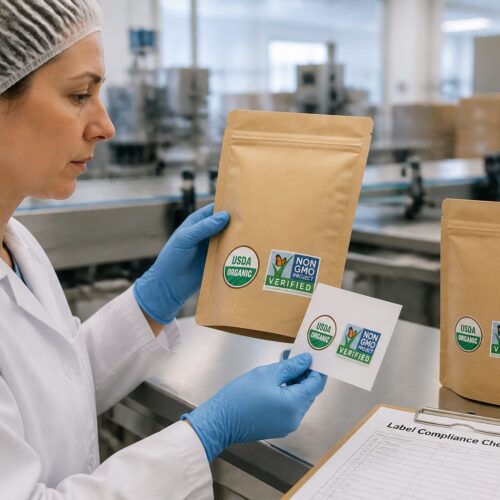
Country specific checks also include how origin interacts with claims like “organic,” “halal,” “CE,” or recycling marks, because packaging space gets crowded fast. When teams rearrange the back panel to fit new icons, origin is often the first thing that gets pushed into the margins.
For online sales, some platforms auto-populate origin fields from a catalog and then compare them to customer photos and reviews. If your physical packaging uses one phrasing and your listing uses another, you can get flagged even when the underlying origin is the same.
It helps to build a preflight checklist that includes destination, channel, and product category, because those three factors drive most origin label exceptions. If the checklist is part of your packaging release process, you catch issues before the first print run.
Finally, assume that enforcement intensity changes over time, because it does. A route that was quiet for months can suddenly become strict after a policy update or a high-profile enforcement action.
Handling multi component products without confusing buyers
Multi component products are where origin marking can turn into a word salad, and buyers hate that. If you sell a kit, a bundle, or a device with accessories, you need a clean strategy that stays truthful without becoming unreadable.
Start by deciding what level you are marking, because the kit can have one origin while parts inside have different origins. Many teams mark the outer package with the kit origin and then mark major components individually when they will be separated or serviced.
The moment you include a power adapter, cable, or consumable, you introduce a second set of origin questions. Customers may not care where a cable was made, but customs and some retailers might care if the accessory is sold separately or has its own SKU.
Service and spare parts are another reason to think ahead. If you expect to ship replacement components later, marking those components at the part level can save you from building a parallel labeling process for spares.
Try to avoid mixing multiple origin statements in the same visual area without hierarchy. If a buyer sees three countries next to each other, they may assume you do not know the origin or that you are trying to obscure it.
A practical approach is to use one primary statement for the main item and then a separate, clearly labeled section for component origins if needed. That way the main origin is easy to find, and the extra detail is available without overwhelming the label.
For kits, decide whether the kit is treated as a distinct product or just a packaging configuration. If your ERP treats the kit as a separate item number, make sure the origin field is defined at the kit level and not inherited accidentally from one component.
Be careful with “packed in” language, because it can be true but irrelevant to origin. Packing a kit in one country does not automatically make that country the origin, and the wording can confuse buyers if it sits next to the made in line.
When you have a main device and a manual or printed insert, remember that printed materials can have their own manufacturing origin too. You usually do not need to label the manual’s origin, but you do need to avoid accidentally placing “Printed in” statements where they look like the product origin.
Bundles sold online can create mismatches because the website may show a single origin for the bundle while the physical items have different marks. If you bundle items from different sources, align your product data so the customer is not surprised when they open the box.
Also consider how your packaging line handles substitutions, because accessory shortages can force last-minute swaps. If you swap a component from a different country, you may need to update the component origin callout or remove it to avoid a wrong claim.
For high mix operations, a controlled label template with variable fields can reduce errors, but only if the data feeding it is clean. If the data is messy, variable printing just scales the mess faster.
When in doubt, keep the buyer-facing statement simple and put the complexity in internal documentation. The goal is to be accurate without turning the package into a supply chain diagram.
- Define origin at item level and kit level
- Mark the outer package where buyers see it first
- Mark serviceable parts that ship separately
- Use one primary origin statement, then clarifiers
- Keep component origin claims out of marketing slogans
- Document the rule used for each origin decision
If you use clarifiers, make sure they are clearly subordinate to the main origin statement. A clarifier should never be bigger, bolder, or more prominent than the primary “Made in” line.
Finally, train customer support and sales teams on what the origin statement means for multi component products. If they improvise explanations to customers, you can end up with inconsistent claims that create reputational risk.
How to keep origin labels consistent across SKUs and revisions
Consistency is harder than it sounds, because packaging, product labels, and online listings often live in different systems. If you want fewer surprises, put origin text under the same change control as part numbers and regulatory marks.
Build a small set of approved origin statements and refuse one off variations, because synonyms create audit noise. “Made in Korea” and “Made in Republic of Korea” may both be true, but they can look like mismatches in retailer checks and internal inspections.
Tie each statement to an effective date and a manufacturing site or process definition, so you can prove why a label was correct at the time it shipped. This matters when you move assembly lines, qualify a new contract manufacturer, or change a key transformation step.
Finally, run label proofs through the same review path every time, even for small edits like moving the barcode. Origin marking errors often sneak in during layout changes, because someone reflows text and the country name drops off the artboard.
A practical way to enforce consistency is to maintain a master label spec that includes exact wording, capitalization, and punctuation. If you do not define whether you use a period, a comma, or a colon, you will get all three across different SKUs.
Make sure the origin statement is treated as a locked field in your artwork files. If designers can edit it like normal text, it will drift over time as templates get copied and modified.
Map the origin field across systems so the same value flows into packaging artwork, product labels, invoices, and online listings. If each system has its own origin entry, you are guaranteed to create mismatches as soon as a change happens.
When you release a new SKU, include origin verification as part of the launch checklist. New product introductions are when teams are moving fast, and origin is easy to miss if it is not a required sign-off item.
Supplier management is part of consistency, because contract manufacturers may use their own label templates unless you control them. Provide a controlled label file and require approval for any changes, including font substitutions and layout shifts.
Audits should include physical sampling, not just document checks. It is common for the approved artwork to be correct while the production floor uses an older file or a local print setting that changes size and placement.
Version control needs to cover both artwork and the underlying origin decision. If the origin rule changes, you should be able to trace which lots shipped under the old rule and which shipped under the new one.
Plan for transitions, because origin changes rarely happen at a clean cutover. If you have inventory of old packaging, decide whether you will scrap it, over-label it, or allow a controlled depletion with documented dates.
It also helps to standardize where origin appears in your label hierarchy, such as always near the model number or always near the barcode. When people know where to look, they spot mistakes faster during line checks.
Finally, assign a single owner for origin content, even if multiple teams contribute inputs. When ownership is unclear, changes get made by whoever is fastest, not whoever is accountable.
Conclusion
Clear origin marking is a practical skill that keeps freight moving and keeps buyers from second guessing what they purchased. When you treat country of origin label requirements for products as controlled data, your labels stop being a recurring fire drill.
Use a plain made in label when it fits, place it where people can find it fast, and print it in a size that survives real handling. If your product has complex sourcing, keep the main origin statement simple and support it with careful documentation and consistent import labeling.
If you want a simple takeaway, it is this: decide origin deliberately, then communicate it consistently everywhere the product appears. The companies that do this well are not doing anything fancy, they are just disciplined about small details.
When origin is correct and easy to read, customs questions become routine instead of disruptive. That frees your team to focus on scaling operations rather than fixing preventable labeling mistakes.