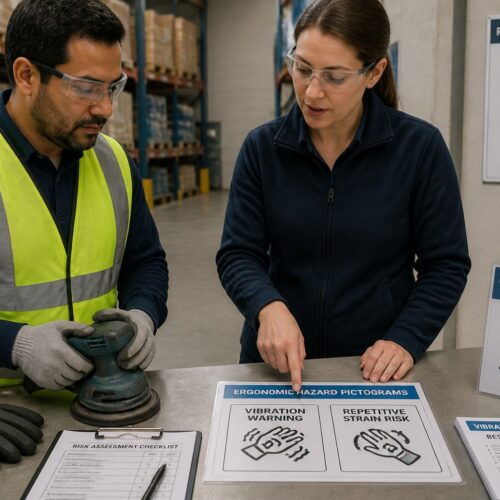


Walk through any multinational plant or warehouse and you will see the same problem in different languages. A forklift lane sign in Ohio looks nothing like the one in Monterrey, even though the hazard is identical.
That inconsistency is more than an aesthetic issue, it slows people down when they are tired, new, or under pressure. Pictogram standardization for global sites gives teams one visual language they can trust, even when they cannot read the local text.
I have seen sites spend months perfecting SOPs while the floor still has five versions of “eye protection required.” When symbols vary by vendor, country, or department, the sign stops being a safety control and becomes wall decoration.
This article lays out a practical rollout plan that respects real operations, tight shutdown windows, and the politics of local preference. The goal is signage harmonization that works in multilingual workplaces, backed by symbol governance that does not collapse after the first audit cycle.
The business case for standard symbols across locations
The cleanest argument for pictogram standardization for global sites is risk reduction, because confusion is a predictable failure mode. When a contractor rotates between sites and sees a different icon for the same rule, you train them to hesitate or ignore both.
In high tempo operations, hesitation is not neutral, it is a delay that turns into a shortcut. People will keep moving and rely on habit, which is exactly what you do not want when they are in a new building with unfamiliar traffic patterns.
There is also a cost argument that finance teams understand quickly. A shared library cuts design churn, reduces emergency print orders, and keeps you from paying three vendors to reinvent the same “flammable” sign.
Those savings show up in small line items that add up, like fewer rush shipments, fewer one off proofs, and less time from EHS managers doing layout work at night. You also reduce scrap because sites stop ordering signs that do not match the local mounting hardware or washdown requirements.
Quality and logistics teams gain consistency too, especially in shared spaces like docks, battery charging rooms, and pedestrian corridors. When a symbol set is stable, you can build it into standard work, audits, and even digital tools like WMS prompts and visitor check in screens.
Consistency matters when you run cross site labor sharing or seasonal staffing, because people transfer knowledge visually. If the same blue mandatory icon means the same thing in every facility, you reduce the time it takes for a borrowed team to operate safely.
Standard symbols help multilingual workplaces without forcing every message into six languages at 18 point font. You still use text where it matters, but the pictogram does the first pass so people orient themselves before they read.
This is especially useful in noisy areas where people cannot ask questions easily, like compressor rooms or packaging lines with hearing protection. A clear icon is a silent instruction that works even when the environment makes communication harder.
There is a brand and reputation angle too, even if you never call it that internally. Visitors notice when a facility looks controlled and coherent, and regulators notice when your signage does not look improvised.
Finally, a unified system makes investigations cleaner because you can separate “the sign was wrong” from “the sign was ignored.” If every site uses the same icon and layout rules, you can compare leading indicators across locations without arguing about signage definitions.
It also improves corrective actions because you can write a fix once and apply it everywhere. Instead of debating which template a site used, you can focus on placement, visibility, and whether the control actually changed behavior.
Even insurance and risk teams benefit because they can point to a defined standard and a governance process. That is a stronger story than “we told sites to use better signs,” especially when you are negotiating premiums or responding to a claim.
Inventory your current signs: what to document and photograph
Start with an inventory, because you cannot govern what you cannot see. Most companies underestimate the sprawl, including faded temporary placards, contractor made labels, and home printed warnings taped to cages.
The inventory is not busywork, it is how you find the hidden sign makers in the system. Every time you discover a different icon style, you also discover a process gap that allowed it to happen.
Document each sign with a photo, a location tag, and a reason it exists. If you can, capture a wide shot that shows context like sight lines, mounting height, and whether the sign competes with equipment labels or product marketing posters.
Take the photo from the angle a person actually approaches, not from two feet away with perfect lighting. A sign that looks fine up close can be invisible from a forklift seat or blocked by a pallet stack at normal operating levels.
Track the message type, such as prohibition, mandatory PPE, emergency equipment, traffic control, or informational wayfinding. This classification later drives which standards you lean on, and it keeps the library from turning into a random clip art folder.
Add a field for who “owns” the area, because signs often live in the cracks between departments. If facilities thinks operations owns it and operations thinks EHS owns it, the sign will never get replaced when it fades.
Record the languages used and whether the text is legally required in that jurisdiction. In multilingual workplaces, you will find that some sites rely on English by habit, while others have a patchwork of Spanish, Polish, Vietnamese, and pictograms that do not match.
Also note whether the message is understandable without the text, because that tells you how much the icon is doing. When the pictogram is ambiguous, people treat the sign as a reading task, which is slow and easy to skip.
Capture sign condition and credibility, because a cracked, sun bleached sign teaches people that rules are optional. Your inventory should flag which signs need immediate replacement for legibility, even before the full signage harmonization program is ready.
Condition includes more than fading, so look for peeling adhesive, warped plastic, graffiti, and bent frames. A sign that is physically damaged signals neglect, and that perception spreads to the rest of the safety system.
Document placement problems like signs mounted behind open doors, too high above eye level, or hidden by stored materials. These are easy fixes that often deliver more benefit than redesigning the icon itself.
Finally, capture duplicates and clusters, because too many signs in one spot is its own hazard. When you stack five warnings on a single post, you teach people to stop reading and keep walking.
Build a core library: approved pictograms, colors, and layouts
The core library is where pictogram standardization for global sites becomes real, because it turns preference into decisions. You should anchor the set to recognized standards like ISO 7010 for safety signs and ISO 3864 for color and design rules, then layer your company specific needs carefully.
Anchoring to standards reduces debate, because you can point to external logic instead of internal taste. It also makes it easier to explain the system to auditors, contractors, and new hires who have seen similar signs elsewhere.
Keep the library small enough that people can remember it, but complete enough that sites do not invent their own icons. When teams cannot find an approved symbol for “lithium battery fire blanket,” they will improvise, and symbol governance will fail on day one.
A useful approach is to start with the 30 to 50 symbols that appear everywhere, then add specialized ones through a controlled request process. That keeps the first release manageable while still giving sites a path to handle unique hazards.
Define what “approved” means in practical terms, including the exact artwork file, the allowed color variants, and the minimum clear space around the icon. If you only approve a concept and not a file, people will redraw it and slowly distort it.
Layouts matter as much as icons because they control scanning speed. When every sign uses the same grid and hierarchy, people learn where to look for the key instruction and where to find supporting text.
Decide early how you will handle bilingual or trilingual text blocks, because that is where many systems get messy. A consistent rule like “local language first, English second” prevents politics from becoming a design variable.
Include rules for arrows, distance markers, and directional variants so sites do not improvise their own. Wayfinding is often ignored in safety discussions, but it is critical during evacuations and medical response.
Material choices should be part of the library because durability is a safety feature. A perfect pictogram printed on the wrong substrate will fail in washdown areas, freezer rooms, or outdoor yards.
Make sure the library includes templates for common formats like door signs, floor decals, hanging signs, and equipment tags. If you only design wall placards, the floor will fill up with unofficial stickers and tape labels.
| Library element | Decision rule | Practical example |
|---|---|---|
| Pictogram source | Use ISO 7010 where available, request additions through governance | W001 general warning triangle for area hazards |
| Color coding | Match ISO 3864 safety colors and contrast requirements | Blue circle for mandatory PPE, red circle slash for prohibition |
| Layout grid | Standard margins, icon size, and text block placement | Icon left, short headline right, optional local language line below |
| Typography | One approved font family with minimum sizes by viewing distance | Sans serif font, 30 mm letter height for 10 m viewing |
| Material and finish | Specify indoor, outdoor, and washdown grades | UV resistant rigid PVC outdoors, laminated polyester in food areas |
Store the library in a place people already use, not in a hidden folder that requires special access. If the approved files are harder to find than Google Images, you will lose the battle.
Include naming conventions and file formats so vendors and internal teams do not create duplicates. A consistent ID like “ISO7010-M004_RespiratoryProtectionRequired” prevents five slightly different versions from floating around.
Test the symbols with real users before you freeze the first release, especially in multilingual workplaces. A quick shop floor review will reveal which icons people misinterpret and which ones need supporting text.
Finally, decide what you will not standardize globally, because not everything should be forced into one mold. Some process specific instructions belong in local work instructions, not on permanent signage that pretends to be universal.
Migration planning: replacing signs without disrupting operations
Migration is where good standards die if you treat replacement like a design project instead of an operations project. The easiest win is to replace the most safety critical and most confusing signs first, even if the full library is still expanding.
Think in terms of routes and touchpoints, not in terms of departments. If a person enters through security, walks to a locker room, then crosses a dock, those are the places where consistent symbols pay off immediately.
Build a site by site plan that matches shutdown calendars, peak seasons, and maintenance access. Warehouses often have narrow windows, so you may stage sign kits by zone and install them during planned aisle closures or off shift cleaning blocks.
Plan for the reality that some areas are never empty, like shipping lanes and break rooms. In those spaces, you may need quick swap mounting methods so installers can replace signs in minutes without setting up a long exclusion zone.
Use a two layer approach for changeover, with temporary overlays when you cannot remove old signs immediately. A simple approved sticker that converts an old nonstandard icon to the new one can buy you time without leaving mixed messages on the wall.
Overlays should be treated as controlled items, not as a free for all. If you allow anyone to print an overlay, you recreate the problem under a new name.
Do not forget digital surfaces like egress maps, screen based visitor orientations, and forklift mounted tablets that show traffic rules. If the pictograms on a kiosk disagree with the ones at the dock door, people assume the whole program is optional.
Include labels on equipment interfaces too, like lockout points, chemical cabinets, and first aid kits. When the physical environment and the training materials use different icons, people waste time reconciling them during an emergency.
Order and logistics matter more than most teams admit, so standardize SKUs and packaging for common sign types. When a site can reorder “mandatory hearing protection, 10×14, adhesive” in one click, signage harmonization becomes routine work instead of a special request.
Create a bill of materials per zone so installers are not making decisions on ladders. If the kit includes the right fasteners, cleaning wipes, and mounting instructions, the install quality stays high across shifts and regions.
Coordinate with 5S and visual management teams so you do not fight over wall space and color conventions. A safety sign system that clashes with production visuals will get ignored, even if it is technically correct.
Communicate the changeover schedule in advance so local teams do not feel surprised or overridden. A simple map that shows “this week: docks and battery charging” reduces friction and helps supervisors answer questions.
After installation, do a quick verification walk to catch the predictable errors like wrong arrow direction, wrong mounting height, or missing duplicates at both sides of a corridor. A 30 minute check prevents months of living with a small but meaningful mistake.
Inventory to gap analysis: deciding what changes and what stays
After the inventory, run a gap analysis that compares each sign to the core library and to local regulatory needs. This is where you decide whether a sign gets replaced, converted with an overlay, rewritten for clarity, or removed because it duplicates another control.
Make the gap analysis a working session with operations, not a spreadsheet exercise done in isolation. Operators will tell you which signs are ignored, which ones are trusted, and which ones are positioned where nobody can see them.
Be honest about signs that exist because someone once got burned in an incident review and added a warning to feel better. If the hazard is already controlled by guarding, interlocks, and training, the sign may still have value, but it should earn its wall space.
Some signs are really reminders for supervisors, not instructions for workers, and those should be handled differently. If a sign is trying to enforce a management process like “complete checklist daily,” it may belong on a board, not on a machine.
Create a priority score that mixes severity, frequency of exposure, and current confusion level. A mismatched emergency exit symbol is an urgent fix, while a slightly off brand recycling label can wait until the next print run.
Add a visibility factor to that score, because a critical sign hidden behind a rack is functionally the same as no sign at all. When you rank by both risk and visibility, you get a list that feels obvious to the people who work there.
Expect tension between global consistency and local reality, especially around traffic flow, PPE norms, and union posted notices. The best rollouts treat local teams as sources of constraints and context, not as obstacles to pictogram standardization for global sites.
Local reality also includes building age and layout, because a 1970s plant with narrow corridors will need different sign placement rules than a new distribution center. Standardization should control meaning and design, while allowing smart placement based on the environment.
Write down every exception and assign it an owner and an expiration date. If you allow one plant to keep a legacy icon for “confined space,” you need a reason, a review date, and a plan to retire it when training catches up.
Exceptions should be rare, but they should not be shameful, because sometimes regulations or customer requirements force them. The key is that exceptions are visible and managed, not hidden in a drawer until the next audit.
Use the gap analysis to remove clutter, not just to replace artwork. When you eliminate redundant signs and keep only the ones that add information, the remaining signs become more credible.
Close the loop by updating the library when you see repeated needs across sites. If three plants request the same new symbol, that is a signal that your initial set was incomplete, not that the sites are being difficult.
Training and onboarding: helping teams learn the new system
Training fails when it tries to teach every symbol like a flashcard set. People learn faster when you tie pictograms to the places they work, so train by walking routes like “from locker room to line” or “from security desk to dock.”
Route based training also reveals missing signs, because trainees will ask questions at the exact spots where decisions happen. Those questions are data, and they help you tune placement and wording before the system hardens.
Onboarding for multilingual workplaces should start with the highest consequence symbols, then expand to traffic and process icons. A short module that covers emergency, prohibition, and mandatory signs does more than a long slide deck that tries to cover every label in the building.
Keep the first module focused on recognition and action, not on standards trivia. People need to know what to do when they see the symbol, not which ISO number it came from.
Supervisors need a script for the first week after changeover, because that is when people notice and complain. Give them a one page guide that explains the new color rules, where to find the library, and how to request a new sign through symbol governance.
That script should include a simple explanation for why the change happened, because people accept change faster when it has a clear reason. If the message is “we are making the same sign mean the same thing everywhere,” most teams will support it.
Use real examples of near misses that came from misread signage, but keep the tone practical. Nobody wants a scare tactic video, they want to know what the new icon means when a pallet jack blocks the view.
Practice matters, so include quick exercises like matching symbols to locations or walking to the nearest emergency equipment using only pictograms. When people succeed in a low stakes drill, they trust the system more in real events.
Contractors and visitors deserve the same clarity, because they are often the least familiar with the site. A short orientation card with the core symbols can prevent misunderstandings without adding a long lecture at the gate.
Reinforce the system with micro reminders in the flow of work, like toolbox talks that cover one symbol per week. This keeps the learning lightweight and prevents the program from fading after launch month.
Make it easy for people to ask questions without feeling stupid, especially in multilingual workplaces where confidence varies. A simple poster that says “If you do not know a symbol, ask your supervisor” is sometimes the most effective training tool.
Finally, update training materials whenever the library changes, because drift between training and reality kills credibility. If the handbook shows an old icon, people will assume the whole standard is negotiable.
Governance: how you keep the system consistent over time
Symbol governance is the unglamorous part, and it is the part that decides whether signage harmonization lasts past the rollout. If anyone can download a random icon and print a sign, your standard will drift within weeks.
Governance is also about speed, because slow approvals create workarounds. If a site needs a sign for a new hazard and the process takes two months, they will print something unofficial and call it temporary forever.
Set up a small approval group with safety, operations, and facilities, and give them a simple intake form. The form should capture the hazard, the location type, any legal text requirements, and whether an ISO 7010 symbol already exists.
Keep the group small enough to move quickly, but broad enough that decisions stick. When operations is represented, sites are less likely to treat the standard as an EHS side project.
Define what counts as a new symbol versus a new application of an existing symbol. Many requests are really placement or wording questions, and you do not want to expand the library when a template would solve it.
Set rules for local printing, because some sites will always need to produce small batches quickly. If local printing is allowed, it should still use locked templates and approved materials so quality does not vary wildly.
Vendor management is part of governance, not procurement trivia. If one vendor uses slightly different reds and another stretches icons to fit, your “standard” will look inconsistent even when everyone tries to comply.
- Single source library with version control
- Approved vendors and print specifications
- Exception log with owners and review dates
- Quarterly site audits for sign compliance
- Change request workflow with response SLAs
- Retirement process for obsolete signs
Version control should be visible, so people can tell if they are using the current file. A simple version number on the template and a change log prevents quiet drift and makes audits less painful.
Retirement is just as important as creation, because old signs stick around for years. If you do not have a removal trigger, you will eventually have two standards on the wall and nobody will know which one to follow.
Give sites a clear escalation path for urgent needs, like a temporary sign for a new construction hazard. The escalation should still use controlled templates, but it should acknowledge that operations cannot wait for the next committee meeting.
Governance works best when it is boring and predictable. When people know exactly how to request, approve, print, and install, they stop improvising and start following the system.
Auditing and metrics: proving the program works
If you cannot measure it, the program becomes a branding exercise and people stop funding it. Build simple metrics that show whether pictogram standardization for global sites reduces confusion and improves compliance.
Measurement should be lightweight enough that sites do not game it or resent it. The goal is to spot drift early, not to create another scorecard that managers fear.
Start with leading indicators like percentage of signs that match the library, percentage with acceptable condition, and closure time for change requests. Pair those with a few outcome signals like audit findings tied to signage, near miss narratives that mention miscommunication, and time to orient visitors during safety briefings.
Include a metric for sign density in key zones, because clutter is measurable. If a corridor has 18 signs in 20 meters, the audit should flag it as a communication problem even if every sign is technically compliant.
Use photo audits because they are fast and they scale across regions. A reviewer can spot wrong colors, stretched icons, and missing headers in seconds, and you can keep the evidence for regulators and internal reviews.
Photo audits also help remote support teams, because they can coach sites without traveling. A shared album organized by zone and date becomes a simple history of improvement or drift.
Do not chase vanity metrics like “number of signs replaced” without context. A site that removes redundant signs and ends up with fewer, clearer messages often improves safety more than a site that adds new signs everywhere.
Look for behavioral signals, like fewer questions during visitor orientation or fewer wrong way travel events at intersections. When people stop asking “what does that mean,” you know the symbols are doing their job.
Share results back to sites in plain language and show a few before and after examples. When teams see that the same dock door looks identical in Germany and Texas, they start to trust the system and stop freelancing.
Use the metrics to guide support, not punishment, because most noncompliance is a resourcing issue. If a site has a high mismatch rate, the fix might be a sign kit and an install day, not another email about standards.
Finally, tie the program to broader management systems like internal audits, Gemba walks, and corrective action tracking. When signage checks are embedded into existing routines, the standard survives leadership changes and budget cycles.
Conclusion
Pictogram standardization for global sites works when you treat it like an operating system, not a poster campaign. You inventory what exists, build a disciplined library, migrate in phases, then train people in the places where the symbols matter.
The work is not glamorous, but it is measurable and it compounds over time. Once the library and governance are stable, every new site, expansion, and process change becomes easier to communicate.
Signage harmonization pays off fastest in multilingual workplaces, where clear icons reduce translation clutter and speed up decisions. Symbol governance keeps that payoff from evaporating the next time someone prints a quick sign to solve a local annoyance.
The best systems respect local constraints while protecting global meaning, so the same symbol always triggers the same action. That balance is what turns signage into a reliable control instead of a background texture.
If you want a practical north star, aim for a site where every safety sign looks like it came from the same hand and means the same thing everywhere. When that happens, the symbols stop competing for attention and start doing their job.