
Yard operations fall apart in small, annoying ways, a missed turn at the gate, a driver staging in the wrong lane, a trailer dropped one row off. Those mistakes look minor on paper, but they stack up fast when you have 40 trucks arriving inside a two hour window.
Wayfinding for yard and gate operations is the cheapest lever most sites ignore, then they spend real money on overtime and radio chatter to patch the same problems. If drivers cannot decode your yard in the first 60 seconds, you do not have a capacity problem, you have a communication problem.
Good signage is not decoration, it is a routing system that works in rain, glare, and night shift lighting. When gate signage and staging area signs are consistent, yard traffic flow stops depending on who happens to be working dispatch that day.
This article focuses on what drivers actually use, big lettering, predictable placement, and symbols that match what they see in front of them. The goal is simple, keep trucks moving without turning your yard into a maze of one off instructions.
Most yards already have some signs, but they are usually a mix of old vendor boards, hand painted plywood, and one-off notices taped to a window. That mix creates a situation where drivers have to guess which message is current and which one is just leftover noise.
The other issue is that yards change faster than signs do, so the physical layout drifts away from the written directions. When your layout and your messaging disagree, drivers will follow the pavement, not the policy.
Signage also becomes a culture problem when every exception is handled by radio instead of by a clear visual rule. The more you rely on exceptions, the more you train drivers to stop and ask, which is the opposite of flow.
Even experienced drivers struggle when they arrive at a new facility under time pressure and poor visibility. If your signs are designed for the best-case daytime visit, you are guaranteeing problems on the worst-case night run.
Common confusion points in yards and how signs fix them
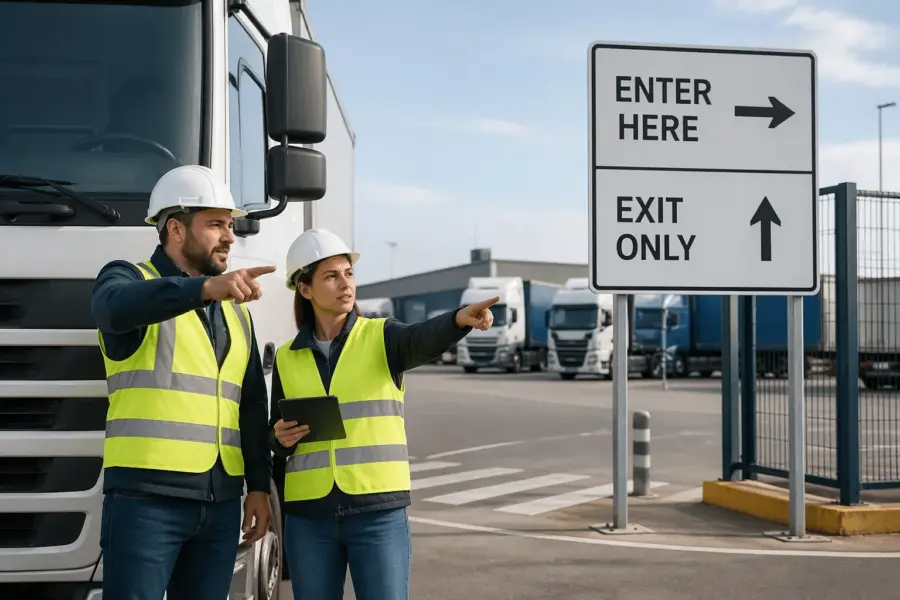
The first confusion point is the gate itself, especially when inbound, outbound, and visitor traffic share pavement. Clear gate signage that separates lanes early prevents last second merges that block the scale or the guard shack.
Drivers also get tripped up when the first sign they see is a list of rules instead of a direction. Put the movement instruction first, then the rules, because a stopped truck at the entrance becomes a line in under a minute.
Another common issue is when the gate has two similar looking kiosks and only one is active. A simple “Kiosk 1 Inbound” and “Kiosk 2 Outbound” label prevents drivers from backing up in the throat of the entrance.
The second problem is similar looking intersections, where every turn feels like the same wide radius corner next to the same chain link fence. A simple confirmation sign after each turn, like “You are on Route A to Dock 20-39,” cuts wrong way loops that burn 10 minutes per truck.
Those intersections get worse when the yard has multiple tenants or shared drive aisles. If your drivers cannot tell where your property ends and the neighbor begins, you will get accidental trespass and awkward three-point turns.
Drivers also get stuck when staging rules live only in a clipboard at the window. Staging area signs that call out “Empty staging,” “Loaded staging,” and “Live load check in” keep the yard traffic flow from turning into a guessing game.
Staging confusion often shows up as drivers parking along curbs or in fire lanes because they are afraid to commit to a lane. If you give them a clear staging entrance sign and a clear “Do not stage here” sign, the behavior changes quickly.
Another repeat offender is mixed equipment areas where chassis, reefers, and flatbeds share rows with no visual difference. If you label rows by function and post a big symbol at the row head, drivers stop dropping the wrong trailer where a yard goat cannot find it.
Equipment mix-ups also happen when empty return is not separated from drop-and-hook. A bold “Empty return only” marker at the row entry saves you from having to hunt for a loaded trailer parked behind empties.
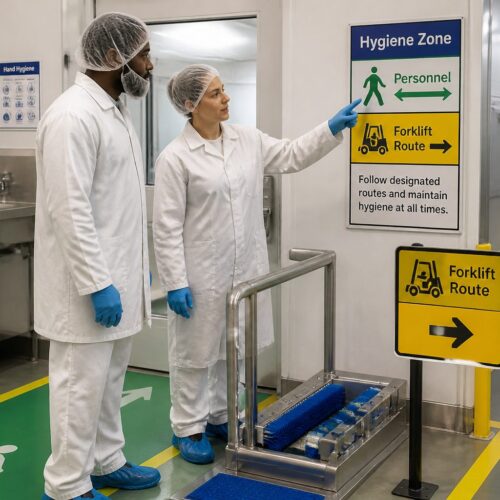
Pedestrian and forklift crossings are another confusion point because drivers do not expect foot traffic deep in a yard. A consistent crossing sign and a painted stop bar make it clear that the right of way changes in that zone.
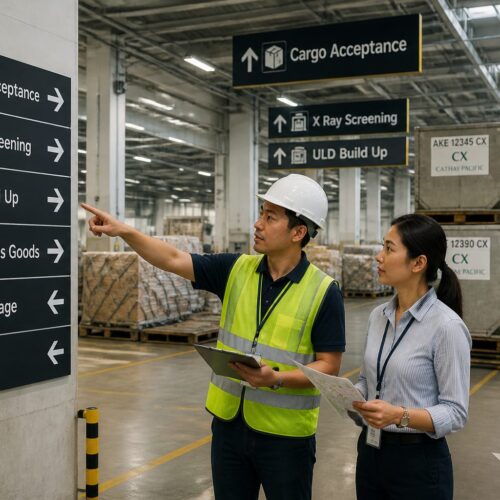
Some yards have multiple dock faces with similar numbering, like Dock 12 on shipping and Dock 12 on receiving. A sign that says “Shipping Docks 1-19” versus “Receiving Docks 1-19” prevents drivers from checking in at the wrong window and getting sent back around.
Finally, many yards rely on informal landmarks like “turn by the blue container,” which fails the moment somebody moves it. Signs fix that by making the yard readable even for a first time carrier at 3 a.m. in a snow squall.
When confusion points are removed, you also reduce the number of risky maneuvers like backing across active lanes. That is a safety win, but it is also a throughput win because every near miss triggers a slow down ripple behind it.
The best way to find confusion points is to listen to the exact phrases drivers use on the radio. If you hear “I think I missed it” or “I am by the trailers, where now,” that is a sign failure, not a driver failure.
Gate-to-dock route planning: the minimum info drivers need
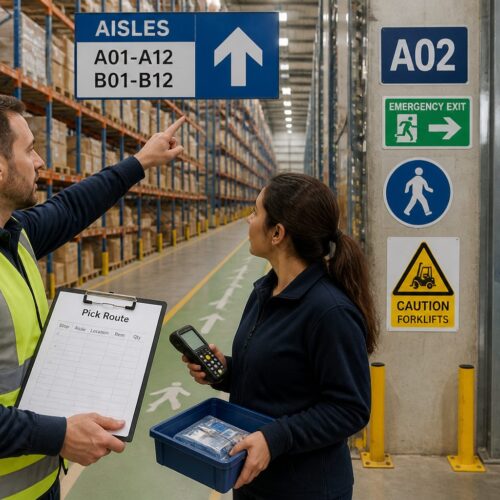
Drivers do not want a paragraph of instructions, they want a route they can confirm at every decision point. Wayfinding for yard and gate operations works best when you reduce the route to four things, where to enter, where to stage, which lane to follow, and where to stop.
Route planning should assume the driver is arriving with zero context and a clock running. If your directions require them to interpret a site map while creeping forward, you are designing for delay.
Start at the gate with one sign that answers “Inbound or outbound” and another that answers “Check in where.” If your check in happens at a kiosk, the sign should say “Kiosk check in” with an arrow, not a vague “Office.”
Make the first sign readable before the driver reaches the point of no return. If the driver has to stop at the entrance to read it, you just created a choke point that no amount of staffing will solve.
After check in, the next sign should confirm the route name or color and the first major destination, like “Route Blue to Docks 1-19.” If you cannot keep route names stable, use dock ranges and simple arrows, because drivers remember numbers better than internal nicknames.
That confirmation step matters because drivers are often juggling a door assignment, a reference number, and a time window. A quick “Yes, you are on the right path” sign reduces cognitive load and keeps speed steady.
At each major intersection, give one advance sign and one decision sign. The advance sign says what is coming, and the decision sign says what to do right now, which prevents abrupt lane changes.
When a route splits, avoid giving drivers two options that sound similar. “Docks 1-19 Left” and “Docks 20-39 Right” is clearer than “Shipping Left” and “Outbound Right” when both terms apply to the same driver.
Before the final approach, post a slow down and queue instruction that matches how your operation works, such as “Stop at line, wait for green light” or “Pull to call box.” When you leave that step to radio calls, you create uneven behavior and your yard traffic flow turns choppy.
Queue instructions should also include what not to do, like “Do not block cross lane” or “Keep intersection clear.” Drivers will comply when the rule is visible and specific, not when it is implied.
If your site uses appointment-based check-in, the route plan should still support late arrivals without drama. A simple “Late arrivals report to G-2” sign prevents a late driver from clogging the main kiosk while they argue about paperwork.
At the dock or drop spot, the stop point must be obvious from the cab, with a large bay number and a clear “Stop here” marker aligned with the trailer. If the driver has to get out to confirm the bay, the sign is too small or placed in the wrong spot.
Dock identification should be visible even when another trailer is already in the hole. If the number is only on the building wall, it disappears behind equipment and drivers start creeping along the face looking for clues.
When you use drop spots, label both the row and the individual spot, not just the row. A driver can hit the correct row and still be wrong by 200 feet, which is how you end up with “It is here somewhere” searches.
Exit routing matters too, because outbound traffic often intersects inbound staging. A clear “Exit to Gate” route keeps empty tractors from cutting through active dock approaches.
Finally, keep the route plan consistent with what your guard and dispatch actually say. If the sign says “Proceed to staging” but your team tells drivers to go straight to the dock, you just taught drivers that signs are optional.
Numbering and naming conventions for yard zones
Zone naming sounds boring, but it decides whether a dispatcher can give directions that survive a language barrier and a noisy cab. The best convention is short, consistent, and visible on signs, paint, and paperwork.
Consistency also helps when you have multiple shifts and multiple contractors working the same yard. If each group uses a different name for the same place, you will never get clean handoffs.
Avoid cute names that only your team understands, because carriers rotate drivers and they will not learn your inside jokes. Use a structure like Area letter plus row number plus spot number, then keep it the same for years.
Short formats matter because they fit on paperwork, on handheld screens, and on radio calls without getting mangled. If a location code is too long, people will shorten it in different ways and you lose control of the system.
Pick a pattern that scales as you grow, because yards rarely shrink. If you start with Row 1 through Row 9 and later add Row 10 through Row 25, make sure your signs and fonts still read clearly at distance.
Use leading zeros only if you commit to them everywhere, because “Row 03” and “Row 3” will be treated as different locations in some systems. It is better to keep it simple and avoid formatting that creates duplicates.
Separate functional zones from physical zones so drivers know what the area is for, not just where it is. A code like “Y-12E” is useful, but adding “Empty trailers” on the sign prevents misuse.
When you have special handling, like hazmat or high value loads, make the naming reflect the control point. A driver should not have to guess whether a “Secure” area is truly secure or just a nickname.
Make sure your naming convention works when spoken over the radio. Letters like B, D, E, and T can sound similar, so consider phonetic callouts in training even if the sign only shows the letter.
If you operate multiple yards or multiple buildings, avoid reusing the same codes in different places. Duplicate codes create the worst kind of error, the one that looks correct until the trailer is missing.
| Zone type | Recommended format | Example on sign and paperwork |
|---|---|---|
| Staging lanes | S + lane number | S-3 Inbound staging |
| Trailer rows | Y + row number + side | Y-12E Empty trailers |
| Special equipment | EQ + function code | EQ-RF Reefer plug in |
| Gate and scale points | G + point number | G-1 Guard check in |
| Dock groups | D + range | D20-39 Shipping docks |
Once you pick the convention, print it on the driver instruction sheet and on the check-in receipt. The more places the same code appears, the less room there is for interpretation.
Label the same code on the ground when possible, especially at row heads and staging lane starts. Paint wears, but it provides a second channel of confirmation when a sign is blocked by equipment.
Keep the naming tied to fixed features, not to temporary operations. If “Overflow” becomes a permanent area, give it a real code, because temporary names have a way of living forever.
When you renumber, do it as a project with a cutover date, not as a slow drift. Mixed numbering is the fastest way to create misdrops that are expensive to unwind.
Sign placement for large vehicles: height, angle, and distance
Most yard signs fail because they are placed like parking lot signs, low, close, and meant for cars. A driver in a sleeper cab needs to read the message while rolling, not after they are already committed to the turn.
Think in terms of sightlines from a high seat and a long hood, not from a person standing near the curb. If you cannot read the sign while approaching at a safe yard speed, the placement is wrong even if the sign looks fine up close.
Mount primary direction signs higher than typical pedestrian signage, so they clear parked trailers and stacks. If you mount everything at fence height, one dropped container can erase your wayfinding for yard and gate operations for an entire shift.
Height also helps when snow berms or pooled water force drivers to hug a different line than usual. A sign that stays visible above seasonal obstacles keeps your route stable when the pavement conditions change.
Angle matters because trucks approach wide and sit tall, so a sign that faces straight down a lane can glare out under yard lights. Rotate signs slightly toward the approach path, then check them from a cab height view, not from where a supervisor stands.
Glare is not just a night issue, it shows up in early morning sun and in wet conditions. A sign that is readable at noon can become a white mirror at 7 a.m. if it is aimed wrong.
Distance to decision points is where yards get sloppy, because they post the arrow at the corner instead of before it. Put an advance sign far enough back that a loaded tractor trailer can signal, slow, and still make the turn without blocking the lane behind it.
Advance distance should account for drivers who are unfamiliar with the yard and drive more cautiously. If your sign only works for the local regulars, it will fail for the carriers you need during peak season.
Do not hide critical signs behind open gates, parked hostlers, or stacks of pallets. If a sign is sometimes blocked, treat it as always blocked and move it.
Use repeated cues in long corridors, because drivers assume they missed something when they go too long without confirmation. A small “Route Blue continues” sign every few hundred feet can be more effective than one giant sign at the start.
Confirmation signs after the turn are just as important as advance signs, since drivers want proof they did not mess up. One well placed “Dock route continues” sign can remove half of the radio calls that start with “Am I in the right place.”
Place stop and yield signs where they are visible before the driver reaches the conflict point. If the driver sees the instruction too late, they will either roll it or brake hard, and both outcomes create risk.
At docks, place bay numbers where they are visible when a trailer is already backed in. Overhead numbers or numbers on columns often work better than numbers on the wall behind the dock plate.
Finally, check placement from both directions, because outbound routes often reuse the same lanes. A sign that reads well inbound can be useless outbound if it is single-sided or aimed the wrong way.
Using symbols to reduce radio calls and missed turns
Text heavy signs break down when a driver has limited English or when the cab is bouncing over potholes. Simple, standardized symbols give you a faster read and they support consistent gate signage across sites.
Symbols also help when drivers are scanning quickly while watching mirrors and trailer swing. A clear icon can be recognized in a fraction of the time it takes to read a sentence.
Use symbols for actions, stop, yield, scale, check in, and for destinations, docks, staging, empty return, reefer plug. When the same symbol appears on the check in ticket, the yard map, and the sign, drivers connect the dots without asking.
Keep the symbol set small so it stays learnable. If every special case gets its own icon, you end up with a confusing picture language that nobody trusts.
Color coding can work, but only if you control it like a system, not like a craft project. If blue means inbound staging on one sign and blue means outbound exit on another, you train drivers to ignore color completely.
If you do use colors, reserve them for routes and keep the background and text treatment consistent. Drivers should be able to say “Follow green” and see green repeated at every decision point without surprises.
Symbols also help with speed compliance in mixed traffic areas where forklifts and pedestrians cross. A large forklift crossing symbol placed before the crossing gets better driver behavior than a block of text that nobody reads.
For safety zones, pair the symbol with one short verb like “SLOW” or “STOP” to remove ambiguity. Drivers respond better to a clear action than to a warning that does not tell them what to do.
When you standardize symbols, you can shrink the words and still keep clarity, which helps at long viewing distances. That is how you improve yard traffic flow without cluttering every pole with a billboard sized paragraph.
Symbols are also useful for bilingual environments because they reduce the need for duplicated text blocks. If you must add a second language, the icon keeps the sign readable even when the text gets smaller.
Make sure the symbols match what drivers expect from road signage standards, because familiarity matters. When you invent a new icon for something common, you force drivers to learn under pressure.
Test symbols in the field by asking a few drivers what they think the sign means without coaching them. If you get three different answers, the icon is not doing its job.
Managing detours, closures, and peak-time overflow
Detours are where even good yards fall apart, because the normal signs point one way and a handwritten board points another. Plan for closures with a dedicated detour sign kit that uses the same arrows, colors, and symbols as your permanent wayfinding for yard and gate operations.
Detours also need a clear starting point, because drivers will not assume a detour applies to them unless it is obvious. Put the first detour notice before the driver commits to the normal route, not after they are already trapped in it.
When a lane is closed, mark the closure at the lane entry and again at the last safe turnaround. If you only mark it at the closure point, you force a driver into a risky backing move to escape.
Temporary signs should look temporary but still be professional and readable. A flimsy handwritten sign flapping in the wind is easy to ignore, especially at night.
Peak time overflow needs its own staging area signs, because drivers will create their own queue if you do not tell them where to go. I prefer an overflow plan that assigns a numbered lane and a clear release trigger, like “Wait for text, then proceed to Gate G-2.”
Overflow also needs a clear entry and exit so it does not interfere with normal circulation. If overflow vehicles have to cross the main route to rejoin, you just moved the bottleneck instead of removing it.
Use variable messaging panels for short-term changes like “Shipping closed, use Receiving” or “Scale out of service.” If you cannot do electronic boards, use standardized slip-in panels so the message format stays consistent.
During peak, drivers will look for any open pavement, including areas you need for emergency access. A few well-placed “No staging” signs with arrows to the correct overflow zone prevent that slow spread of bad parking.
Detours should include confirmation signs just like your normal routes. If you only post one detour arrow at the start, drivers will lose confidence and start calling after the second turn.
- Detour route boards with large arrows
- Magnetic or slip-in panels for temporary messages
- Closure covers sized for standard sign faces
- Overflow staging lane numbers posted at entry
- Portable stop signs for one-lane control
- Cones with reflective collars for night shifts
Store the detour kit in a known location and assign ownership for deploying it. A plan that depends on someone remembering where the cones are will fail the first time you need it.
After the event, remove detour signs immediately and verify the yard is back to normal. Nothing confuses drivers like a detour arrow that is still up two days after the closure ended.
Peak-time overflow is also a data signal that your appointment smoothing or check-in process needs attention. Signs can manage the symptom, but you should still track how often overflow is activated and why.
Keeping yard signs clean, reflective, and up to date
A dirty sign is a broken sign, and yards create grime faster than most teams admit. Diesel soot, dust, salt spray, and sun fade can make a good layout unreadable in one season.
Even when the text is still visible, grime reduces contrast and makes drivers slow down to confirm. That small hesitation multiplied by dozens of trucks becomes a measurable throughput hit.
Build sign cleaning into the same routine as sweeping and pothole checks, because it affects safety and throughput. If you already have a weekly yard walk, add a quick readability test from 100 feet and log failures like any other defect.
Cleaning should include trimming vegetation and removing stacked materials that block sightlines. A perfect sign does nothing when it is hidden behind a pallet pile that grew over time.
Reflectivity is where night operations either run smooth or turn chaotic, especially at gates with glare and mixed lighting. Use reflective sheeting rated for outdoor traffic control, then replace panels when they stop popping under headlights.
Do not assume a sign is reflective just because it looks bright under a flashlight. Test it with a vehicle at typical approach distance, because that is the real condition drivers experience.
Keep a single source of truth for names and numbers, and make every sign match it. When paperwork says “Y-12E” but the post says “Row 12 East,” drivers assume the whole system is unreliable and they start calling again.
That single source of truth should include a simple map with zone codes and a change log. When someone requests a new label, you want a controlled update, not a quick printout taped to a pole.
When you change a process, change the signs the same day, even if it means temporary panels for a week. Old instructions hanging around the gate are worse than no instructions, because they send confident drivers to the wrong place.
Audit your yard after any construction, restriping, or tenant change. Those projects often create new conflict points, and the old sign plan rarely matches the new pavement reality.
Keep spare panels for your most common messages, like staging, docks, exit, and check-in. When a sign is damaged by a trailer swing, you can restore the route quickly instead of improvising with paper.
Also pay attention to sign clutter, because too many signs in one place makes drivers ignore all of them. If a pole has five messages, you probably need to consolidate and prioritize the one action the driver must take.
Finally, verify that your sign maintenance matches your staffing reality. If nobody owns the system, it will decay slowly until the yard is back to relying on radio calls and tribal knowledge.
Conclusion
Wayfinding for yard and gate operations works when you treat signs like infrastructure, not like a last minute add on. Clear gate signage, consistent numbering, and readable staging area signs keep the yard traffic flow steady even when volume spikes.
The payoff is not just fewer wrong turns, it is fewer stop-and-start moments that create congestion and frustration. When drivers can self-navigate, your team can focus on exceptions instead of repeating directions all day.
If you want a practical starting point, walk the route from gate to dock like a first time driver and note every moment you would hesitate. Fix those hesitation points with fewer words, bigger numbers, and symbols that repeat across the whole yard.
Then keep the system alive with simple maintenance, consistent naming, and a detour plan that looks like it belongs. When the yard stays readable, your operation stays predictable, and predictable is what capacity really looks like.