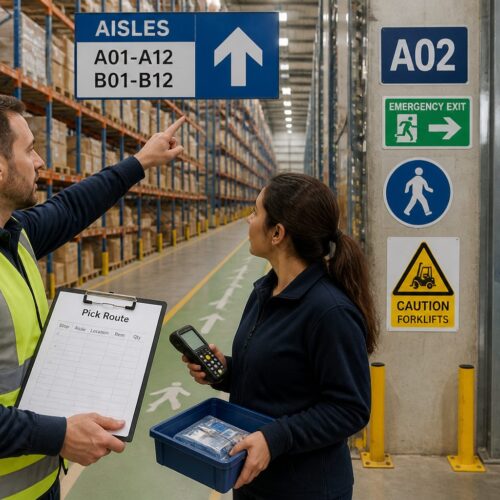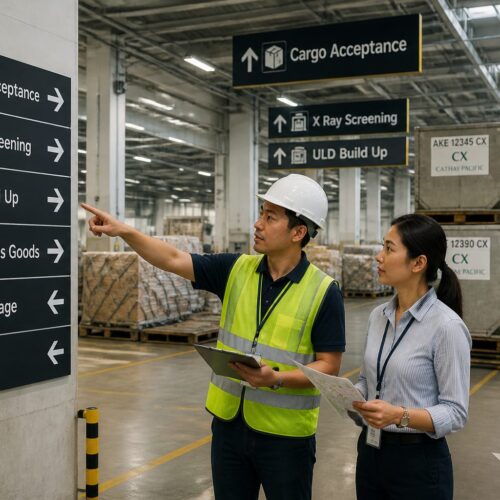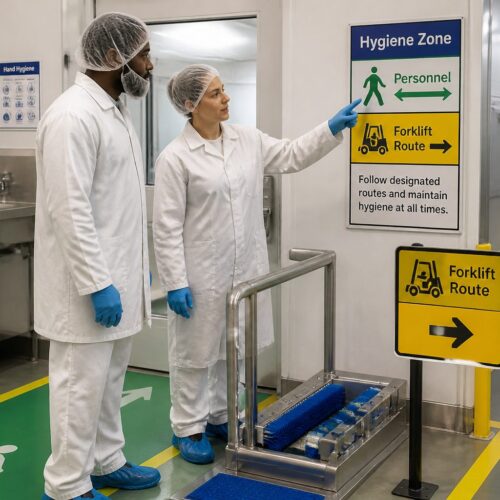

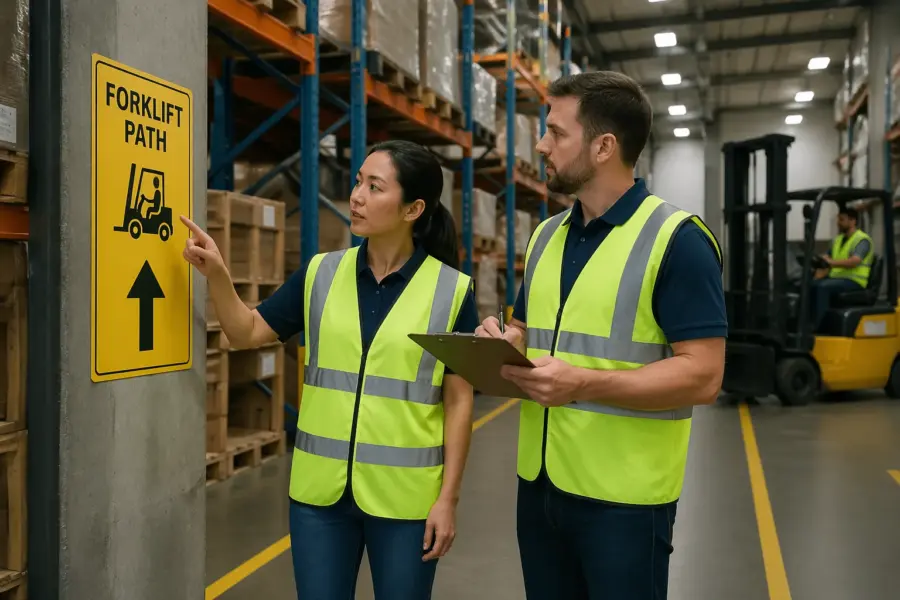
Forklifts move fast, turn wide, and do not stop like a person on foot expects them to. If your facility relies on hand signals and tribal knowledge, you are already gambling with near misses.
Wayfinding signs for forklift traffic routes turn that gamble into a system that new hires can follow on day one. When movement is predictable, operators pick better lines and pedestrians stop playing chicken at blind corners.
I have seen warehouses where the “route” was whatever path looked open around pallets and trash bins. Those sites usually have the same story, a close call at an intersection that finally forces a hard reset.
Good signage does not mean plastering every wall with warnings that everyone tunes out. It means choosing a simple route logic, marking it clearly, and enforcing it even when shipping volume spikes.
The goal is not to control every inch of concrete, but to remove the most common surprises. When operators can anticipate where people will be and pedestrians can predict where trucks will appear, the whole building calms down.
Most incidents start with small deviations that become normal, like cutting through a staging area to save ten seconds. Signs and markings give supervisors something objective to coach against instead of arguing about what someone “usually does.”
Mapping forklift routes around work zones and crossings
Start with a map that shows where forklifts actually drive, not where you wish they drove. Walk the building during receiving, replenishment, and shipping, then mark the real tracks around racks, dock doors, and pack lines.
Do the walk with the people who drive the routes, because they know where the pinch points and blind spots live. If you only map from an office, you will miss the turns that require a three point swing and the doors that stick in winter.
Separate travel lanes from work zones whenever you can, because staging creeps into aisles when nobody owns the boundary. If a picker has to step into a travel lane to reach product, treat that spot like a formal crossing and design it on purpose.
Work zones are not just pick faces, they include stretch wrap stations, battery changing areas, and scrap bins that attract foot traffic. If those zones sit on a main route, you should expect constant conflict unless you reroute or protect the area.
Crossings deserve the same attention you give to a roadway intersection because the conflict is the same, speed and limited sight distance. Put crossings where people already cross, then tighten the approach with floor cues that slow the forklift before the conflict point.
If you force pedestrians to take a long detour, they will eventually create their own shortcut through the forklift lane. A shorter, clearly marked crossing with a barrier funnel is usually safer than an unrealistic “no crossing” rule.
Do not design routes that force forklifts to back long distances, because backing creates a new set of blind spots. If turning radii or rack offsets force backing, change the route or adjust the storage layout instead of pretending a sign will fix it.
Backing also increases the temptation to cut corners and drift over lines, especially when an operator is trying to keep a load stable. A route that supports forward travel with predictable turns is easier to enforce and easier to train.
When you document the map, include the rules that make the map work, such as one way aisles, yield points, and no go zones near pedestrian break areas. That written rule set becomes the backbone for wayfinding signs for forklift traffic routes, because every sign should point back to a known rule.
Keep the map simple enough that a supervisor can explain it in five minutes, but detailed enough that a new operator can navigate without guessing. If a route requires exceptions like “unless the dock is busy,” you have not finished the design yet.
Update the map when operations change, because a new conveyor line or a moved pack station can break the original flow. If the map is outdated, the signs become background noise and the floor becomes a choose your own adventure again.
Route sign types: direction, priority, and restricted access
Direction signs answer one question, where does this lane go next. Use them to confirm turns at the end of aisles, to mark loop routes around production cells, and to keep visiting drivers from improvising.
They work best when they are placed before the decision point, not after it, because a forklift cannot pivot like a shopping cart. If the sign appears at the corner, the operator has already committed and will either swing wide or stop in traffic.
Priority signs answer the harder question, who goes first when paths meet. This is where intersection warning signs, stop signs, and yield signs matter, because a “polite” operator still cannot see through shrink wrap and uprights.
Priority also needs consistency, because mixed rules create hesitation and then sudden moves. If one intersection uses a stop sign and the next uses an informal courtesy yield, you will get different behaviors from different operators.
Restricted access signs keep forklifts out of places where the risk is high or the floor is not rated for load, such as mezzanines, maintenance bays, and narrow pick modules. If you rely on tape alone for these boundaries, expect them to be ignored once the tape peels and the first emergency rush hits.
Restricted access also applies to pedestrian only corridors and emergency egress paths that need to stay clear. When those areas are marked clearly, it is easier to correct a shortcut before it becomes a habit.
One way aisle signs are worth the wall space because they eliminate the most common surprise, a head on meeting in a tight aisle. If you choose one way flow, commit to it with repeated signs at every entry and with matching forklift route markings on the floor.
One way flow also simplifies right of way at intersections, because you can predict approach angles and reduce the number of conflict points. The fewer choices an operator has to make at speed, the more consistent the driving becomes.
Keep sign messages short and consistent across the site, because operators read at speed and under load. A mix of “Forklifts Only,” “Industrial Vehicles,” and “Powered Trucks” for the same rule makes people argue instead of comply.
Standardize colors and shapes so people can recognize meaning without reading every word. When the visual language is consistent, you do not need to over sign the building to get the point across.
Do not forget visitors, contractors, and office staff who step onto the floor occasionally and do not know your patterns. Clear restricted access and crossing signs protect the people who are least familiar with forklift behavior.
Using arrows, symbols, and floor markings together
Floor markings do the heavy lifting because they sit in the operator’s line of travel, while wall signs confirm the rule at decision points. The best setups use both, because paint gets scuffed and signs get blocked by stacked product.
Think of the floor as the route itself and the walls as the reminders that keep the route honest. When both agree, even a distracted operator gets pulled back into the correct lane.
Arrows are the workhorse symbol for wayfinding signs for forklift traffic routes, but they must match the lane logic exactly. If an arrow points left while the floor line implies straight, you will train people to ignore all of it.
Arrow size matters more than people think, because small arrows disappear under dust and tire marks. A larger arrow that is repeated at intervals gives the operator confidence that they are still on the intended path.
Use symbols to reduce reading time, especially at intersections where attention is split between steering and scanning. A clear pedestrian icon at a crossing does more than a paragraph of text that nobody reads at speed.
Color coding can help, but only if you keep it disciplined and teach what each color means. If every department paints their own favorite color, the floor becomes decoration instead of instruction.
Markings should also account for the reality of loads, because a tall pallet can block a wall sign that would otherwise be obvious. When the floor carries the core message, the operator still gets guidance even with limited forward visibility.
Place confirmation markings after turns, not just before them, because that is where people realize they made the wrong move. A quick confirmation arrow reduces the urge to stop and back up in the middle of traffic.
When you add new markings, remove or cover old ones instead of letting layers accumulate. Ghost lines and faded arrows create plausible excuses, and plausible excuses are the enemy of consistent compliance.
| Visual cue | Best placement | What it tells the operator |
|---|---|---|
| Directional floor arrows | Mid aisle and before turns | Confirm travel direction and upcoming turn |
| Solid lane lines | Along travel lanes and curves | Stay inside the route boundary |
| Dashed crossing lines | At pedestrian crossings | Expect foot traffic, reduce speed |
| Stop bar marking | Before intersections and doors | Stop at the bar, then proceed when clear |
| Wall mounted arrow sign | At aisle entry and end caps | Reinforce one way aisle signs and turns |
| Warning symbol sign | Blind corners and rack ends | Intersection warning signs, prepare to yield or stop |
Use the table as a starting point, then adjust spacing based on speed and congestion in each area. A main aisle that functions like a highway needs more advance cues than a slow pick module.
When in doubt, test the route with a loaded truck and a spotter watching from the side. If the spotter sees confusion at the same point twice, the signs and markings are not doing their job yet.
Intersection design: stop points, mirrors, and sightline aids
Intersections are where good routes fail, because the route logic meets human impatience. Treat every crossing of two forklift paths, or forklifts and pedestrians, as a designed feature with clear priority.
Do not assume that horns will solve the problem, because horns become background noise in a loud building. The intersection should still work when someone forgets to honk or when hearing protection dulls the sound.
Paint a stop bar far enough back that the operator can see around the rack end without the forks already in the intersection. If you put the stop point at the corner, the operator has to creep forward anyway, and the stop sign becomes theater.
Make the stop bar wide and obvious, because a thin line disappears under rubber marks and grime. If you want a real stop, you need a real visual cue that looks different from every other line on the floor.
Convex mirrors help, but only when you mount them where the line of sight is real and the mirror stays clean. I prefer mirrors as a backup, because glare, dust, and vibration can turn them into a false sense of security.
Mirrors also need maintenance ownership, because a mirror that is aimed wrong is worse than no mirror at all. If nobody is assigned to check them, they drift and become wall art.
Use intersection warning signs before the conflict point, not at it, so operators have time to slow down. If you have a high speed main aisle, add advance warning on both approaches and repeat it at eye level.
Advance warnings can be paired with floor messages like “SLOW” or rumble style markings that signal a change in risk. The point is to get speed down before the operator is busy scanning both directions.
Fix sightlines with layout changes when you can, because no sign compensates for a pallet stack at the corner. A simple rule like “no storage within 10 feet of intersections” only works if supervisors enforce it every shift.
Use physical controls to protect sight triangles, such as corner guards, painted no store boxes, or short rails that prevent staging creep. If the corner stays open, the intersection becomes predictable instead of a constant surprise.
Consider lighting at intersections, because shadows can hide a moving truck until it is too close. A brighter corner with clear contrast makes it easier to detect motion even when loads block part of the view.
If pedestrians cross at intersections, give them a defined waiting spot that is outside the forklift sweep. People hesitate when they do not know where to stand, and hesitation is when they step into the wrong place.
Keeping routes clear during staging and peak volume
Peak volume reveals whether your routes are real or just paint on concrete. When the docks get slammed, pallets creep into travel lanes and forklift route markings disappear under product.
Congestion also changes behavior, because operators start taking shortcuts to avoid waiting. If the official route adds time during a surge, people will route around it unless you make the official route the easiest path.
Designate staging rectangles that are clearly outside the travel lane, then label them by function such as “Outbound staging” or “Quality hold.” If you do not give people a legal place to put overflow, they will create an illegal place in the aisle.
Make staging limits visible from a distance, because a small box is easy to ignore when a driver is focused on clearing a trailer. A large, well marked zone with a label reduces the excuse that someone “did not realize” they were blocking the lane.
Use physical cues where it matters, like low profile bollards or rack end guards that prevent pallets from being set into the lane. Paint alone is easy to violate when someone is rushing to clear a trailer.
Physical cues also protect the markings themselves, because repeated pallet drops chew up paint and tape. If you protect the boundary, you extend the life of the route and reduce maintenance churn.
One way aisle signs reduce congestion during surges because they eliminate the negotiation that happens when two trucks meet. If you keep two way aisles, widen the pinch points or you will see horn battles and risky backing.
During peak, the worst delays often happen at the same choke points, like dock door approaches and end cap turns. Those are the areas where extra signs, extra floor cues, or a temporary traffic control plan can pay off quickly.
Build a simple escalation rule for blocked routes, such as “stop and call a lead” instead of “squeeze through.” That rule sounds strict, but it prevents the slow slide where every operator decides their own acceptable clearance.
Escalation also gives leadership a chance to fix the root cause, like insufficient staging space or poor trailer scheduling. If operators always self solve by squeezing through, management never sees the real cost of congestion.
Plan for exceptions like floor cleaning, maintenance work, and inventory counts that temporarily change traffic patterns. If you do not plan them, people will invent detours that cut through pedestrian areas and create new conflicts.
Temporary signs can help during special events, but they should match the same visual language as permanent signs. If temporary controls look homemade, they will be treated as optional.
Training operators to follow visual cues consistently
Training fails when it treats signs as decoration instead of rules with consequences. If you want wayfinding signs for forklift traffic routes to work, you have to teach operators that the markings are the route, even when the route is inconvenient.
Consistency is the real target, because a safe route used half the time is still a chaotic environment. Operators should know that the expectation does not change based on who is watching or how busy the shift feels.
Do route training in the building, not in a classroom slideshow, because operators need to see the actual corners and choke points. Walk the main loop, call out one way aisle signs, and make each trainee stop at every stop bar until it becomes muscle memory.
Use real examples during the walk, like a door that swings out or a rack end that hides cross traffic. When trainees connect the sign to the specific hazard, they stop treating it like a generic rule.
Train pedestrians too, because routes only work when both sides play the same game. A pedestrian who steps outside the crossing because it is “faster” can undo all the structure you built for the operators.
Coaching should be immediate and specific, like pointing to the stop bar and explaining what the operator missed. Vague reminders like “be careful” do not change behavior, but clear feedback tied to a marking does.
Supervisors need the same training, because they are the ones who decide whether the system is enforced during chaos. If a lead waves a truck through a restricted area once, the sign loses authority for everyone.
Refresh training after layout changes, because people keep driving the old route out of habit. The first week after a re-slot or expansion is when wrong way travel spikes.
- Walk the full travel loop with a lead operator
- Identify every pedestrian crossing and stop bar
- Call out all one way aisle signs at entry points
- Practice yielding at marked priority intersections
- Review horn use at blind corners and doors
- Verify load height does not block sightlines at intersections
- Confirm parking areas and no go zones near exits
After the walk, test understanding with a short route run where the trainee narrates what they see and why they are stopping or yielding. If they cannot explain the cue, they will not follow it under pressure.
Make route compliance part of normal performance conversations, not just a safety week topic. When the route is treated like a production standard, it stops being optional.
Routine inspections for faded markings and missing signs
Markings fail slowly, then all at once, when a new operator follows a half visible arrow into the wrong aisle. Treat forklift route markings like safety equipment, because worn paint is the same as a missing guard.
People adapt to fading cues without realizing it, and then they teach the next person the adapted behavior. The longer you wait, the more the unofficial route replaces the official one.
Set an inspection cadence that matches traffic, because a high throughput dock lane can chew through paint in months. Use a simple checklist that covers arrows, stop bars, crossing lines, and the presence of intersection warning signs at every blind corner.
Do not limit inspections to the floor, because wall signs get bent, blocked, or removed during repairs and never put back. A missing sign at one entry point can create wrong way travel even if the rest of the aisle is marked correctly.
Check sign height and visibility while standing on a forklift, since a sign that looks obvious on foot can be hidden by a mast or a tall load. If your facility changes slotting often, expect signs to get blocked by new rack banners, new cages, or seasonal overflow.
Also check visibility at the speed people actually drive, because a sign that is readable at a standstill may be useless in motion. If operators cannot process it quickly, you need a simpler message or better placement.
Track damage causes, not just replacements, because repeated hits tell you the route design is wrong. If a corner sign gets clipped every week, widen the turn, move the sign, or switch to a protected post instead of buying the same sign again.
Damage patterns can also reveal training gaps, like operators cutting a corner because the route line is too close to the rack. When you see the same scrape marks, treat them as data, not bad luck.
Document repairs with dates and photos, then tie them to your training refresh so people see that the rules stay current. When workers watch management repaint a stop bar and replace a bent sign, compliance goes up because the system looks real.
Keep a small stock of common signs and marking materials so fixes do not wait for a long purchasing cycle. If a missing sign stays missing for weeks, people learn that the system is not maintained.
When you repaint, consider upgrading materials in high wear areas, because cheap paint in a high traffic lane is a false economy. A more durable marking reduces downtime and keeps the route legible through the busiest seasons.
Conclusion
Predictable forklift movement is not a slogan, it is a design choice you reinforce every day. The combination of wayfinding signs for forklift traffic routes, clear forklift route markings, and consistent one way aisle signs removes the guesswork that causes close calls.
Focus your effort where conflict happens, especially crossings and blind intersections, and use intersection warning signs before operators commit to the turn. When the routes stay clear during staging and the markings stay fresh, the whole building moves with less drama and fewer surprises.
If you want a quick reality check, watch a shift change or a rush period and see whether people still follow the intended flow. A system that only works when the floor is quiet is not a system yet.
When routes are mapped, signed, trained, and maintained as a single package, you stop relying on luck and start relying on design. That is how you turn forklift traffic from a constant risk into a controlled process.