

“Fragile” is the most common word on shipping labels, and it is also one of the least reliable. I have watched boxes stamped FRAGILE get tossed onto a conveyor like gym bags.
If you ship glassware, lab samples, electronics, or artwork, you need clearer instructions than a single vague warning. Fragile Label Alternatives give handlers specific, testable directions that match how damage happens in transit.
This matters even more in international moves where English is not the first language on the dock. The best handling labels work fast, read fast, and back up what your packaging already does.
The limitations of the “Fragile” label
“Fragile” is a catchall, so it rarely tells a worker what to do differently. A handler cannot infer whether the risk is shock, vibration, compression, puncture, or temperature just from that word.
It also gets ignored because it is overused on shipments that are not truly delicate shipping. When every other carton screams FRAGILE, the label stops carrying any urgency.
Another issue is that “fragile alternatives” often matter more than the warning itself because carriers train around measurable actions. “Do not stack” or “keep upright” can be audited, while “fragile” is a mood.
Damage claims show the gap between intent and reality, since a label cannot overcome weak packaging or sloppy palletizing. If the box caves under top load, the word FRAGILE does not change physics.
Internationally, the word can also create translation problems and inconsistent interpretations. Some teams treat it as “handle with care,” others treat it as “this will break anyway, move it quickly.”

Even when a handler wants to be careful, “fragile” does not tell them what careful looks like in that moment. A worker deciding between sliding a carton across a belt or lifting it needs a clearer rule than a warning label.
The label also fails to communicate priority, because not all fragile items are equally sensitive. A framed print might survive a short bump but fail from bending, while a precision sensor can fail from a single sharp impact.
In many networks, cartons are handled by multiple people and machines, so the instruction has to survive handoffs. A vague label loses meaning as soon as the box is tossed into a gaylord, a rolling cage, or a mixed pallet.
There is also a psychological effect where “fragile” becomes a liability tag instead of a handling instruction. Some handlers read it as “this shipper will complain,” not as “this carton needs a different process.”
On automated sortation, the label is almost irrelevant because the system treats cartons by size and barcode, not by emotion. That is why fragile alternatives that influence packaging design and orientation matter more than a single word.
Another limitation is that “fragile” does not help the last person in the chain, the consignee, who might cut into the box or drag it across a floor. Labels like “Do not use knives” and “Team lift” can prevent damage at delivery and unboxing too.
Finally, the label can create a false sense of security for shippers, as if printing it completes the job. The reality is that carriers assume your packaging is engineered for the network, and they treat labels as hints, not guarantees.
Alternative labels for specific handling needs
Start by naming the handling action you want, not the consequence you fear. “Handle with care” is still broad, but it signals behavior more clearly than “fragile” on its own.
For orientation-sensitive goods like compressors, monitors, and some medical devices, “This side up” and “Keep upright” are better Fragile Label Alternatives than a generic warning. Pair them with arrows on at least two adjacent sides so the instruction survives rotation.
For crush risk, use “Do not stack” or “Top load only” when you can justify it, because warehouses stack by default. If you need a strict limit, add “Stacking limit: 1” or a maximum weight in pounds and kilograms.
For shock-sensitive shipments like optics, servers, and calibrated instruments, “Shock sensitive” communicates the real failure mode. It also sets you up to use impact indicators or data loggers that match the label.
For puncture risk, especially with soft cases, bagged parts, or thin corrugated, “Do not use knives” prevents the classic box-cutter slice. I have seen more returns from unboxing damage than from long-haul vibration, and that label stops a lot of it.
If the item is heavy enough to create handling risk, “Team lift” or “Use mechanical assistance” can be more protective than any fragile warning. Drops often happen because a single person tries to muscle a box that should have been lifted by two people or with a cart.
For long and awkward cartons, “Do not clamp” and “Do not forklift here” can prevent the kind of damage that looks mysterious on arrival. If a fork tine hits a product cavity, the carton may look fine while the contents are ruined.
For sensitive finishes, “Do not rub” or “Do not scuff” is surprisingly useful when cartons are packed in tight cages. Painted parts, coated lenses, and polished metal can be damaged by abrasion even when nothing cracks.
For items that must stay clean, a simple “Keep sealed” or “Do not open” label can prevent well-meaning inspections from turning into contamination. This is especially relevant for sterile packs and dust-sensitive components.
For time-sensitive shipments, “Deliver by” and “Perishable” can align the dock behavior with the service you paid for. Time labels are not magic, but they do reduce the chance your box sits in a corner over a weekend.
If the shipment includes batteries, magnets, or regulated materials, the correct compliance marks are also handling instructions in disguise. A proper lithium battery mark can change routing, storage conditions, and even what aircraft the package can fly on.
When you use action labels, keep the wording consistent so the instruction becomes familiar. A warehouse that sees the same “Keep upright” panel on every one of your cartons will start to treat your freight as a known pattern.
Also consider adding a brief qualifier when it prevents confusion, like “Keep upright at all times” or “Do not stack pallets.” Small clarifications reduce the loopholes that appear when a shipment is repacked or cross-docked.
Using pictograms to communicate handling instructions
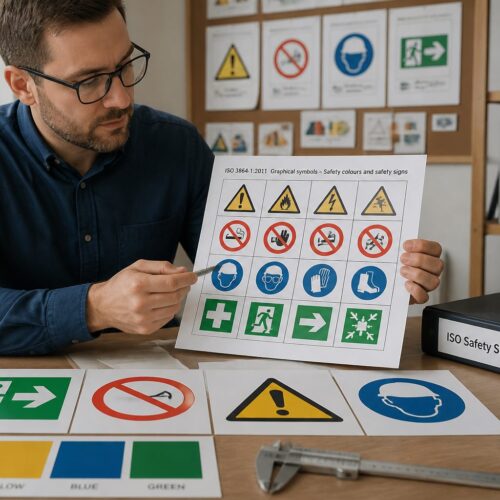
Pictograms cut through language barriers and reduce the time a handler spends reading text. They also stay consistent across regions when they follow common logistics symbology conventions.
Use pictograms for the instructions that truly change handling behavior, then keep the rest of your label set minimal. Too many icons on one carton looks like noise, and noise gets ignored.
A good pictogram works at a glance from a few feet away, even when the carton is moving. If your icon requires someone to stop and interpret it, it will lose to the pace of the dock.
Consistency matters more than creativity, so avoid custom icons that only your company understands. Standard symbols reduce debates at transfer points where nobody has time to ask what you meant.
Pairing a pictogram with a short text line is often the best compromise for mixed-language environments. The icon catches attention and the text removes ambiguity, especially for stacking limits and temperature ranges.
Size and placement matter with pictograms, because small symbols disappear under tape seams and corner crush. If you want the icon to influence behavior, print it large enough to survive scuffs and still be readable.
Color can help, but it should not be the only signal because labels get dirty and lighting varies. A black icon on a white field is boring, but it is usually the most reliable in real warehouses.
Be careful with icons that look similar, like umbrella versus hands, because quick scanning can cause mistakes. When in doubt, simplify the label set so each pictogram has a distinct silhouette.
Pictograms also help your own team pack consistently, since they act like a checklist on the carton. When the packer sees the arrows and the stack limit, they are reminded to build the internal packing to match.
If you ship internationally, pictograms can reduce the need for multi-language text panels that clutter the box. A cluttered carton makes it harder to find the one instruction that actually matters.
Finally, pictograms can support training because they are easy to photograph and include in SOPs. A one-page guide with the icons you use and what they mean can prevent a lot of label drift over time.
| Pictogram | Meaning | Best use cases |
|---|---|---|
| Wine glass | Fragile, handle carefully | Ceramics, glass components, finished consumer goods |
| Two upward arrows | This side up, keep upright | Liquids, compressors, certain instruments and displays |
| Umbrella | Keep dry | Paper goods, electronics, powders, moisture-sensitive packaging |
| Stack limit symbol | Limit stacking or do not stack | Light corrugated cartons, delicate assemblies, retail-ready packs |
| Thermometer | Temperature limits apply | Pharma, biologics, adhesives, batteries, specialty chemicals |
| Hands holding a box | Handle with care | Mixed shipments where a single risk mode is not dominant |
Combining labels for comprehensive protection
One label rarely covers the full risk profile of delicate shipping, especially for high-value items. The trick is to combine two or three instructions that do not contradict each other.
A good combo for consumer electronics is “This side up” plus “Do not stack” plus a small “Shock sensitive” mark near the main label panel. That set tells a warehouse exactly how to stage the carton and how to treat it during handoffs.
For liquids, “Keep upright” and “Keep from freezing” often matter more than “fragile alternatives” like “handle with care.” If a liquid freezes and expands, you can lose the shipment even if the carton never takes a drop.
For artwork or framed prints, combine “Do not bend” with “Do not stack” and a clear orientation arrow. Carriers love to slide flat packs under heavier freight, so you need to block that behavior directly.
Place your primary handling labels on the same face as the shipping label, because that is the face most workers look at. Repeat the single most important instruction on two other sides so it stays visible after pallet wrap.
Think in terms of failure modes and pick labels that map to each one without overlap. If the real risk is compression, adding three different “handle carefully” messages will not do as much as one clear stacking limit.
Do not combine instructions that fight each other, like “Do not stack” next to “Top load only” unless you define what top load means for that carton. Conflicting labels train people to ignore all of them.
When you need multiple instructions, prioritize them visually so the top rule is obvious. A large “Keep upright” panel with smaller secondary notes works better than three equal-sized stickers competing for attention.
For mixed-case pallets, consider a pallet-level label that states the overall rules, like “Do not double stack pallet” or “Keep dry.” Pallet rules are often more actionable than carton rules once the load is wrapped.
Combining labels also means combining expectations, so make sure your packaging can survive when the rules are only partially followed. A carton labeled “Do not stack” should still tolerate some incidental top load, because reality is messy.
If you use indicators like tip-n-tell or impact sensors, treat them as part of the label system, not a separate gimmick. The indicator should sit near the instruction it supports, and the instruction should explain what the indicator implies.
It also helps to keep a standard label recipe by product family so your warehouse is not making decisions on the fly. When the same SKU always ships with the same two or three labels, your process becomes repeatable.
Finally, remember that labels are for humans, while barcodes are for machines, and both need space. A clean label panel with a few strong instructions usually beats a collage of stickers that nobody can parse.
Reinforcing labels with packaging materials
Handling labels are promises, and packaging materials are how you keep them. If the carton fails the first compression event, the best Fragile Label Alternatives will not save the contents.
Match the packaging to the damage mechanism, because bubble wrap is not a universal fix. Foam-in-place, molded pulp, and engineered end caps all behave differently under shock and vibration.
For shock, focus on cushion thickness and the drop height you expect in the carrier network. Small parcel systems can generate repeated drops, while LTL freight tends to cause fewer drops but higher compression and fork impacts.
For crush, upgrade corrugated grade, add corner posts, or ship in a double-wall carton with proper void fill. If you label “Do not stack” but use flimsy board, you are asking a warehouse to do you a favor.
For moisture, use poly bag liners, desiccant, or a sealed overpack, then back it up with “Keep dry” handling labels. Rain on a dock or condensation in a container happens all the time, and paper-based cartons soak it up fast.
Void fill is not just about stopping movement, it is about controlling where energy goes during an impact. If the product can shift and hit a corner, the carton will telegraph that shock straight into the most fragile point.
Double boxing is still one of the simplest upgrades when you are shipping something with an unpredictable carrier path. The outer box takes abuse and the inner box stays aligned with your cushioning system.
For vibration, pay attention to how the product is supported over long durations, not just how it survives a single drop. Some foams soften under heat and time, which can turn a tight pack into a loose one halfway through transit.
Edge protection is underrated because corners are where cartons fail first. Corner posts, honeycomb rails, and rigid end caps can make your “Do not stack” label less of a plea and more of a backup plan.
Sealing method matters too, because a carton that pops open becomes a damage magnet. If your box can burst at the seam, reinforce it with proper tape width, pattern, and adhesion for the temperatures you ship through.
If you ship items with sharp internal edges, add internal guards so the product does not cut its way out during vibration. A carton that looks punctured from the inside will not be saved by any external label.
For temperature-sensitive goods, insulation and refrigerants have to be sized to the lane and dwell time, not just the distance. A “Temperature limits apply” label is only credible when the packout is designed for worst-case delays.
Palletizing is part of packaging, so build stable pallets with aligned corners and minimal overhang. Overhang invites impacts and crush, and it makes your labels harder to see because the wrap gets messy.
When you upgrade packaging, update the labels to match the new reality, because instructions should reflect the engineered intent. A carton that is now stackable with corner posts might not need the same “Do not stack” message you used before.
Label placement and print quality that handlers can actually see
Placement is the quiet reason many handling labels fail. If the label sits on a seam, under stretch wrap, or on the bottom panel, the instruction never reaches the person lifting the carton.
Use large, high-contrast printing and avoid tiny icons that blur at a glance. Thermal labels can fade with heat, so consider durable stock or overlamination for long international legs.
Keep the message short and consistent across shipments, because workers learn patterns. When you swap between five versions of “fragile alternatives” that mean the same thing, you retrain the dock every week.
Do not bury handling instructions inside a crowded shipping label panel. Give them their own space, and keep barcodes clear so scanners do not force handlers to rotate the box repeatedly.
If you ship on pallets, label the outside of the stretch wrap too, since many loads never get unwrapped until delivery. A simple “Do not stack” placard on two sides of the pallet often works better than eight small carton stickers hidden inside wrap layers.
Aim for eye-level placement where a person naturally looks when approaching a carton on a shelf or conveyor. Labels placed too low get blocked by pallet deck boards and labels placed too high get hidden by wrap folds.
Put orientation arrows near corners on multiple faces so at least one set stays visible after the carton gets scuffed. If arrows only exist on the top, they disappear the moment another carton is placed above it.
Surface prep matters, because dusty cartons and cold rooms can cause labels to peel. A peeling label communicates that nobody cares, which is the opposite of what you want for delicate shipping.
Use adhesives that match your environment, especially if you ship in refrigeration or humid climates. A label that slides off in condensation is worse than no label because it leaves sticky debris that attracts dirt.
Print quality is not just about ink density, it is about legibility after abrasion. If your cartons rub in a cage, thin lines and light gray text will vanish before the shipment reaches the hub.
Keep handling labels away from edges that are likely to crush, because that is where information gets destroyed first. A label placed one inch inboard can survive impacts that would obliterate a corner sticker.
Also avoid placing instructions where they will be covered by carrier labels at pickup. If the driver slaps a routing label over your arrows, your careful system becomes invisible in one second.
When you have to choose between more labels and better labels, choose better labels. One large, readable instruction on the right face beats four small stickers scattered around the box.
Communicating handling instructions to carriers
Labels help, but carrier paperwork and system notes decide how freight gets routed and staged. Put the same instructions in your bill of lading notes, your booking, and any delivery appointment comments.
If you need special handling, call it out before pickup and confirm the service level that matches it. I have seen “do not stack” ignored simply because the shipment moved as standard LTL with no accessorials or special instructions in the carrier system.
Carriers also respond better when the instruction is tied to a service they recognize, like “protect from freezing” with a temperature-controlled option. If you ask for special outcomes without buying the right service, your label becomes wishful thinking.
For high-value shipments, ask how the carrier handles exceptions like reweighs, inspections, and relabeling at terminals. Those touchpoints are where cartons get opened, rotated, and stacked in ways you did not plan for.
It helps to share a simple packing photo and a note that says what “good” looks like, especially for pallets. A dispatcher or terminal manager can forward that to the dock in a way your carton sticker cannot.
If you ship regularly, build a relationship with a local terminal contact who can answer what actually happens to your freight. The best fragile alternatives are the ones that match the carrier’s real process, not the one you imagine.
Also be specific about appointment windows and delivery constraints when they affect handling, like “no curbside drop” for sensitive equipment. A rushed curbside delivery is where cartons get tipped, dragged, and left in weather.
When damage happens, use the incident to refine your instructions instead of just filing a claim. A claim might recover money, but a better label-and-packout system prevents the next loss.
- Add handling notes to the bill of lading
- Repeat instructions in booking and pickup requests
- Confirm pallet orientation and stack limits at tender
- Request temperature control when required
- Use accessorials for inside delivery or liftgate needs
- Share photos of proper packing with carrier contacts
Training your own team to use labels consistently
Many shipping errors start before the carton ever leaves your building. If your team applies handling labels randomly, carriers learn to ignore them because they do not correlate with real risk.
Create a simple decision rule for Fragile Label Alternatives, such as “use shock-sensitive for calibrated devices” or “use keep upright for any liquid over 1 liter.” That kind of rule beats relying on whoever packed the box that day.
Keep a label kit at each pack station so people do not improvise with markers or leftover stickers. Improvised notes can help in a pinch, but they look unofficial and they smear under tape.
Run quick spot checks and tie them to damage feedback, because that is where habits change. When a team sees that a missing “do not bend” label caused a return, they stop treating handling labels like decoration.
Standardize the label location on the carton, then document it with a one-page photo guide. Consistency helps carriers too, since they learn where to look on your shipments.
Training should include the why, not just the what, because people follow rules better when they understand the failure mode. If packers know that a certain device fails calibration from vibration, they will take “Shock sensitive” more seriously.
Build label selection into your packing checklist so it is not an afterthought at the end. If the last step is always rushed, the last step will always be wrong.
Use a small approved library of labels and retire the rest, because variety creates confusion. If three different “This side up” designs are floating around, you will eventually see all three on the same pallet.
Make it easy to do the right thing by pre-kitting labels with the right cartons or SKUs. When the correct labels are in the bin with the correct packing materials, compliance becomes automatic.
Track damages by SKU and by packer shift when possible, because patterns show up quickly. The goal is not to blame people, but to find where the process is unclear or the materials are inconsistent.
Refresh training when you change carriers or lanes, because the handling environment changes with it. A packout that works for parcel may fail for freight, and your label set should evolve accordingly.
Finally, empower the team to flag shipments that need an exception, like a damaged carton or missing foam. A packer who can stop the line for a minute prevents a customer-facing failure later.
Common delicate shipment scenarios and the labels that work
For wine and spirits, leakage and orientation cause more losses than shattered glass. Use “Keep upright,” “Do not stack,” and “Keep from freezing” when the route crosses cold regions.
For laptops and servers, shock and corner drops are the usual killers. “Shock sensitive” plus orientation arrows and a clear “Do not stack” instruction beats a lonely fragile label every time.
For ceramics and stoneware, the packaging fit matters as much as the label, since rattling breaks edges. Pair “Handle with care” with a visible “Do not drop” pictogram if your carrier network supports it and your packaging can justify the request.
For lab reagents or diagnostics, temperature and time matter, so handling labels must match the service you paid for. “Refrigerate on arrival” is useless if the shipment moves ground without cold chain support.
For flat printed materials, bending is the silent damage that customers notice first. Use “Do not bend” on the mailer and again on the outer carton if you consolidate multiple packs.
For framed mirrors, the glass is only part of the risk, because corner impacts can also crack the frame and loosen mounts. “This side up” plus “Do not stack” plus “Handle with care” is a practical set when you cannot control the carrier’s stacking behavior.
For musical instruments, humidity and puncture are common problems because cases get scraped and stored in damp areas. “Keep dry” and “Do not use knives” can prevent damage that a generic fragile label would never address.
For cameras and lenses, micro-impacts and vibration can knock alignment even when nothing looks broken. “Shock sensitive” is the right headline, but it should be paired with packaging that keeps the item suspended and centered.
For industrial parts with machined surfaces, abrasion is the enemy, not breakage. “Keep sealed” and “Keep dry” help, but the real win is preventing internal movement so parts do not rub through protective wraps.
For cosmetics in glass bottles, heat can cause leaks and label failure even when the bottle survives. “Keep from heat” or a temperature limit label can reduce the chance of a sticky, unsellable arrival.
For adhesives, resins, and certain chemicals, temperature and orientation can both matter because separation and curing can happen in transit. “Keep upright” plus a temperature range label is more honest than calling it fragile.
For medical devices, the biggest issue is often not visible damage but performance drift after rough handling. “Shock sensitive” and “Do not stack” are useful, but only if you also control internal bracing and immobilization.
For subscription boxes with mixed items, the risk is that one heavy product becomes the wrecking ball for everything else. A “Do not drop” or “Handle with care” label can help, but the packout needs dividers and top-fill so weight stays low and centered.
Conclusion
“Fragile” is easy to print, but it rarely changes how a shipment gets handled. Fragile Label Alternatives work because they tell people exactly what to do, and they match how damage happens in real carrier networks.
Pick handling labels that describe actions, back them up with pictograms, and keep the set small enough that workers notice it. Then reinforce the message with packaging materials, consistent placement, and clear instructions in carrier paperwork.
If you treat delicate shipping like a system instead of a sticker, your damage rate usually drops fast. The best label strategy is the one your team can repeat on every shipment without improvising.
When you review your damage data, look for the specific ways products fail and update your labels to match those patterns. Over time, your label set becomes a practical language that reflects how your shipments actually move.
Most importantly, remember that labels are a communication tool, not a shield. When the instruction, the packaging, and the carrier service all point in the same direction, you get fewer surprises at delivery.