

Emergency Exit Wayfinding is one of those building details people ignore until the worst day happens. When smoke is thick, alarms are screaming, and power is shaky, clear wayfinding is what keeps a crowd moving instead of freezing.
I have walked plenty of sites where the exit sign looks fine in daylight, but disappears the moment you step behind a column or a door swings open. A safe building needs more than a glowing word over a door, it needs a system that guides people from wherever they start.
Good Emergency Exit Wayfinding also has to work for visitors who do not know the building, people who do not read English well, and anyone who panics under stress. That is why international standards lean hard on consistent symbols, predictable placement, and redundancy.
Logistics sites, warehouses, hospitals, schools, and high rise offices all share the same problem, people must find a safe path fast. The smart approach is to treat wayfinding like a safety device that you design, test, and maintain.
When you look at real incidents, the story is often the same, people head toward what feels familiar and then get stuck. Wayfinding is what interrupts that instinct and replaces it with a clear, repeatable route to safety.
Even a calm evacuation drill exposes weak spots because people move differently when they are distracted or carrying bags. If your system only works when everyone is paying attention, it will not work when it matters.
Understanding emergency exit requirements
Emergency exit rules start with life safety codes, but the practical goal is simple, occupants must reach an exit without getting trapped or misdirected. Emergency Exit Wayfinding should match the building’s egress plan, not the marketing floor plan taped to a wall.
Most jurisdictions require exits to be continuously available, clearly identified, and reachable by a compliant path of travel. If a door is locked, blocked, or disguised, the best sign in the world cannot fix that.

Internationally, ISO 7010 safety signs and ISO 16069 for safety way guidance systems shape how symbols, arrows, and route information look and behave. Many regions also reference NFPA 101 and the International Building Code, so facilities often need to satisfy both local law and global consistency.
Emergency Sign Placement is usually tied to sight lines, mounting height, and the need to mark changes in direction. A hallway that turns twice needs way guidance at each decision point, because people do not guess well when they are stressed.
Evacuation Route Marking also has to account for accessibility requirements, including routes that people using wheelchairs can follow. If the accessible route differs from the general route, you must label that difference clearly so nobody ends up at stairs they cannot use.
One requirement that gets overlooked is continuity, meaning the guidance should not stop halfway to the exit. If the last sign is three doors before the stair, people will still hesitate at the exact moment you need them to commit.
Another common requirement is that exit access doors cannot be confusingly similar to exit doors. If you have identical doors in a corridor, the wayfinding has to do extra work to make the correct one obvious.
Many codes also care about what happens after the door, because discharge needs to lead to a safe location. If people exit into a fenced yard with no gate signage, you have not actually finished the job.
Stairwell rules are often stricter because stairs are the primary egress route in multi story buildings. That is why you see requirements for stair identification, floor numbering, and sometimes reentry information posted inside the stair.
If your building has areas of refuge or evacuation elevators, the requirements become more specific and less forgiving. The wayfinding must clearly differentiate between a standard exit route and a protected waiting area so people do not mix them up.
It also helps to remember that enforcement is not always consistent, but emergencies are. Designing to the minimum wording of a local rule can still leave you with a system that fails under smoke, crowding, or low visibility.
Key elements of effective emergency exit wayfinding
An effective system uses a few consistent sign types, exit identifiers, directional arrows, reassurance markers, and final exit confirmation at the discharge. If you mix styles, colors, and arrow logic, people slow down and start second guessing.
Fire Safety Wayfinding works best when it repeats information in more than one place. A ceiling mounted sign can be blocked by smoke, so low level route markers and door hardware markings add a second layer.
Arrows deserve extra attention because they cause real world mistakes. Use a single arrow standard across the site, and verify that an up arrow means straight ahead for your chosen standard, because different systems treat that differently.
Pictograms beat text when you have mixed languages and visitors, but text still matters for clarity in some settings. A warehouse with contractors from multiple companies often benefits from ISO symbols plus short, plain English labels like “Exit stairs” or “Exit corridor.”
Wayfinding also includes the physical route, not only the signs. If you send people through a door that looks like a staff only access point, they hesitate, so use consistent door appearance, panic hardware where required, and clear markings on the door leaf.
Reassurance markers are the quiet workhorses of the system because they reduce doubt. After someone commits to a corridor, a simple confirmation sign tells them they are still on the right path.
Consistency is not only about graphics, it is also about message hierarchy. If every sign tries to say everything, people stop reading and start scanning for the one cue that feels familiar.
Good systems also handle vertical movement cleanly, with clear cues for stairs, ramps, and level changes. If you label a stair as an exit route, the sign should also indicate whether it leads down to discharge or up to another level.
Door labeling matters more than most people think because doors are the moment of decision. A small “Not an exit” label on a tempting door can prevent a crowd from piling into a storage room.
Maps can help, but they are not a substitute for route guidance. In an emergency, people do not want to interpret a diagram, they want to follow a simple chain of cues.
Audible and visual systems should not fight each other. If a voice alarm tells people to use Stair A, the signage needs to make Stair A easy to identify without searching.
Color and contrast are part of the element set even when codes do not spell them out in detail. A sign that technically meets size rules can still disappear if the background is the same tone as the wall.
Finally, effective wayfinding anticipates human behavior, including herding and hesitation. If you know crowds will drift toward the main entrance, your system should intercept that drift early and redirect it clearly.
Choosing the right sign materials and illumination
Materials and lighting decide whether Emergency Exit Wayfinding survives heat, impact, cleaning chemicals, and time. Cheap printed vinyl can curl and fade, and a faded arrow is worse than none because it gives false confidence.
Illumination choices depend on the risk profile, normal lighting conditions, and backup power strategy. Photoluminescent signs can work well in stairwells and corridors, but only if the area has enough ambient light to charge the material and the surfaces stay clean.
In industrial settings, you also have to think about abrasion and frequent washdowns. A sign that looks perfect on day one can become unreadable after repeated cleaning cycles if the ink and substrate are not matched to the environment.
Temperature swings matter in loading docks and unconditioned spaces. Adhesives can fail in cold weather and plastics can warp near heat sources, so the material choice has to match the actual conditions, not the office spec.
Glare is another quiet failure mode, especially with glossy faces and strong overhead lighting. If a sign reflects a bright fixture, the message can vanish at the exact angle people approach from.
Illuminated signs are only as good as the power behind them. If your emergency power system is undersized or poorly maintained, you end up with dark signs and a false sense of readiness.
Photoluminescent products need a realistic charging plan, not just a note in a spec sheet. If a corridor is normally dim, the glow time and brightness may not meet expectations when the lights go out.
In some buildings, a hybrid approach works best, with illuminated exit identifiers and photoluminescent low level markers. That combination gives you redundancy without relying on a single failure point.
Hardware and fasteners are part of the material decision too. A rugged sign face does not help if the mounting method fails when vibration, impact, or repeated door slams take their toll.
Cleaning protocols should be discussed early because they can destroy the wrong materials. If housekeeping uses harsh disinfectants, you need faces and inks that can handle them without hazing or peeling.
Even the best material needs legible typography and symbol sizing. A durable sign that is too small or too busy is still a failure in practice.
| Option | Best use case | Watch-outs |
|---|---|---|
| Internally illuminated LED exit signs | High occupancy areas, long corridors, retail floors | Needs reliable emergency power and periodic battery tests |
| Edge-lit acrylic signs | Modern interiors where ceiling clutter is a concern | Can glare at angles and may wash out in bright daylight |
| Photoluminescent route markers | Stairwells, low-level Evacuation Route Marking, smoke-prone routes | Requires charging light and clean surfaces to stay effective |
| Rigid aluminum or stainless sign panels | Industrial sites, washdown areas, loading docks | Needs high-contrast graphics and may need separate lighting |
| High-durability polycarbonate signs | Schools, gyms, areas with impact risk | Scratches over time and can haze with harsh cleaners |
When you compare options, think about failure modes instead of just aesthetics. Ask what happens if the power fails, if smoke drops visibility, or if the sign takes a hit from equipment.
It is also smart to standardize on a small set of materials across the site. Too many different sign types make maintenance harder and increase the chance that replacements do not match.
In areas with high ceilings, illumination and viewing distance become more critical. A sign that is readable at ten feet may be useless at fifty feet, especially when people are moving quickly.
Do not forget about emergency lighting levels along the route itself. Wayfinding is stronger when the path, the door hardware, and the floor surface are all visible enough to move without tripping.
Optimizing sign placement for maximum visibility
Emergency Sign Placement starts with one idea, people follow what they can see from where they stand. If a person exits a conference room into a corridor, they should immediately see a directional cue without walking forward to hunt for it.
Mounting height matters, but so does the clutter around the sign. A perfect sign placed above a vending machine bank, a banner, or a TV wall still gets lost in the noise.
Decision points are where you earn your keep, intersections, elevator lobbies, corridor turns, and stair doors. Put a sign before the decision point so people can adjust early, then put a reassurance marker after the turn so they know they picked right.
Do not assume the shortest route is the best route for wayfinding. A slightly longer path with clean sight lines and fewer turns often moves people faster than a tight route with blind corners and confusing door sets.
Low level Fire Safety Wayfinding is worth the effort in many buildings, especially hotels, hospitals, and older high rises. Smoke stratifies, and ceiling signs can vanish first, so a combination of door frame markings, baseboard strips, and stair identification helps keep movement steady.
Start placement planning by walking the building at normal speed and then at a faster pace, because people do not stroll during an evacuation. You will notice quickly where your eyes naturally look and where signs fall outside that scan pattern.
Look for visual traps like mirrored walls, glass partitions, and long rows of identical doors. In those areas, you often need stronger contrast or additional directional cues to prevent wrong turns.
Door swings can block signs, especially when doors are held open during normal operations. If a door can hide a sign, treat that as a placement failure and redesign the location.
Elevator lobbies deserve special attention because people instinctively go to elevators. Clear “Exit stairs” direction at the lobby edge helps redirect that instinct without requiring people to stop and think.
In large rooms like cafeterias or production floors, you need direction from multiple angles. A single sign over one door may not be visible from the far side of the space, especially when equipment or crowds block sight lines.
Think about the approach angle, not just the spot on the wall. A sign that is readable straight on can be unreadable when approached from the side, so placement should follow the actual travel path.
Stair doors should be marked clearly on the approach and at the door itself. People often hesitate at stair doors because they look like service entries, so the labeling has to remove doubt.
Exterior discharge points should also be marked so people know they are truly out. If the exit dumps into a covered loading area, a final confirmation sign helps prevent people from reentering the building by mistake.
If you use floor lines or wall stripes as part of Evacuation Route Marking, keep them continuous and unbroken at intersections. A broken line at a junction is where people stop, and stopping is what creates crowd pressure.
Finally, coordinate sign placement with security devices like card readers and turnstiles. If normal circulation uses controlled access, the emergency path must still read as obvious and available when systems switch to fail safe.
Conducting regular inspections and maintenance
Emergency Exit Wayfinding fails quietly, a lamp burns out, a battery ages, or a sign gets removed during a renovation and never comes back. You need a schedule that treats wayfinding like fire extinguishers and alarm devices, with dates, checklists, and accountability.
Start with a walking inspection that follows each egress route from real starting points, break rooms, restrooms, conference rooms, and production floors. If you only test from the main lobby, you miss the places where people actually get confused.
Battery backup testing is where many sites cut corners, then regret it later. A monthly quick check and an annual full duration test catch problems early, and they also force you to confirm that illumination levels stay readable when normal power is gone.
Maintenance also includes keeping the route clear and the visuals consistent. If a storage rack creeps into the corridor and blocks a sign, fix the rack location, do not just move the sign to a worse spot.
Renovations and tenant changes are a common source of broken Evacuation Route Marking. Every time a wall moves, a door changes swing, or a room changes use, someone should revalidate the egress plan and update signage before the space reopens.
Inspections should include a simple visibility test, can you read the sign at a normal approach distance without stopping. If the answer is no, treat it as a corrective action, not a note for later.
Check for missing arrows and mismatched messages, because partial replacement is a common problem. One new sign with a different arrow style can create a contradiction that only shows up when someone follows it.
Look for dirt, paint overspray, and stickers that reduce contrast. A sign can be technically present and still functionally invisible if the face is coated with grime or covered by a notice.
Confirm that emergency lighting still supports the wayfinding plan. If a lighting retrofit changed fixture locations, you may have created dark pockets that make signs hard to see.
Include doors and hardware in the checklist because they are part of the guidance system. A door that sticks, a closer that slams, or panic hardware that is loose will slow movement and create bottlenecks.
Documenting problems is only useful if you close the loop. Track issues to completion and verify the fix in the field, because paperwork does not guide anyone to an exit.
Training maintenance and cleaning staff helps more than people expect. When staff understand that a missing sign is a life safety issue, they are more likely to report it immediately instead of working around it.
Drills are also a form of inspection because they reveal real behavior. If people consistently hesitate at the same junction, that is a wayfinding defect even if every sign meets a spec.
After any incident, even a minor one, do a quick post event walk. Small failures like a blocked corridor or a confusing door are easier to fix when the memory is fresh.
Adapting wayfinding to different building layouts
A warehouse has long sight lines and tall racks, while a hospital has short corridors, smoke doors, and a lot of people who cannot self evacuate. Emergency Exit Wayfinding has to match those realities, not a one size template.
In open plan offices, the problem is furniture churn and visual clutter. Emergency Sign Placement should anticipate that teams will add phone booths, whiteboards, and partitions, so mount key signs where they will stay visible after the next reconfiguration.
In high rise towers, stair identification and floor level information matter because occupants may enter a stair and travel many floors. Mark the stair designation, reentry floors if applicable, and the direction to discharge so people do not bail out into a locked door or a dead end.
In schools and campuses, you often need a blend of adult and child readable cues. Use clear pictograms, keep arrows obvious, and avoid placing essential signs behind open classroom doors, because that happens constantly during the day.
Industrial plants add noise, PPE, and unusual hazards, so Fire Safety Wayfinding must stay readable through face shields and dust. I prefer high contrast graphics, simple arrow logic, and rugged materials that can take washdown and abrasion.
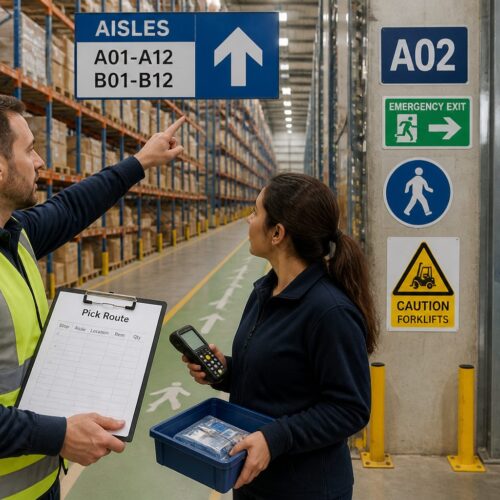
Warehouses also change constantly as inventory and racking layouts evolve. If aisles move, you may need overhead aisle markers and repeated exit direction cues so people do not rely on yesterday’s memory.
In hospitals, the egress strategy may include defend in place concepts and staged relocation. That means wayfinding must support staff led movement without sending visitors into restricted smoke compartments.
Hotels have a unique challenge because occupants wake up disoriented and may be barefoot in low light. Low level Evacuation Route Marking and clear stair door identification reduce the time spent searching in corridors.
Retail environments are visually loud by design, with signs, promotions, and displays competing for attention. Emergency exit cues need enough contrast and consistent placement so they do not disappear into the branding.
In theaters and assembly spaces, crowd flow is the main risk because everyone moves at once. You want multiple visible exit cues from seating areas so people distribute naturally instead of funneling to one familiar door.
In mixed use buildings, you often have different tenant standards under one roof. A base building wayfinding standard keeps the experience consistent so occupants do not have to relearn arrows when they cross a lease line.
Older buildings add quirks like split levels, narrow stairs, and legacy corridors that were never meant for modern occupancy. In those spaces, extra reassurance markers and clearer door labeling can compensate for geometry you cannot easily change.
Large campuses need a plan for exterior movement after discharge. If the safe assembly area is not obvious, people cluster near doors and block others from exiting.
Data centers and secure facilities add access control complications. The wayfinding has to respect security boundaries while still guaranteeing that doors release and routes remain intuitive during an emergency.
Whatever the layout, the best approach is to prototype and walk it like a first time visitor. If you cannot find the exit without thinking, a stressed occupant will not either.
Conclusion
Emergency Exit Wayfinding works when it is designed as a system, installed with discipline, and maintained like any other life safety feature. If you do the work upfront, people move with confidence during drills and they move even faster when the situation is real.
Focus on consistent symbols, smart Emergency Sign Placement, durable materials, and clear Evacuation Route Marking that still reads under stress. When those pieces line up, Fire Safety Wayfinding stops being decoration and starts doing its job.
The goal is not to impress an auditor with a binder, it is to guide a person who is scared and in a hurry. If you design for that person, you end up with a building that is calmer, safer, and easier to manage.
Wayfinding is also one of the few safety upgrades that improves daily operations, because it reduces confusion for visitors and contractors. When people can orient themselves quickly, staff spend less time giving directions and more time doing their work.
If you are unsure where to start, walk the routes, note every hesitation point, and fix those first. Small improvements at the right junctions often deliver more safety value than a big sign package installed without a plan.