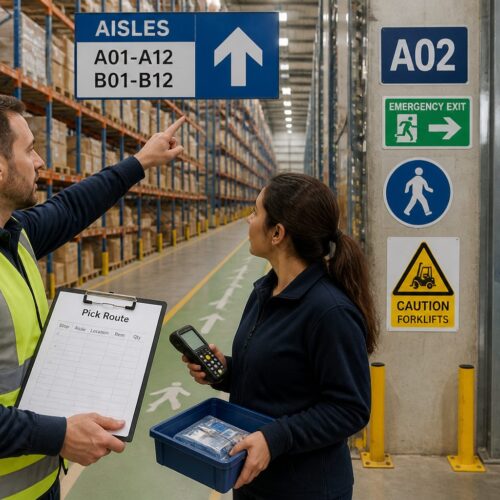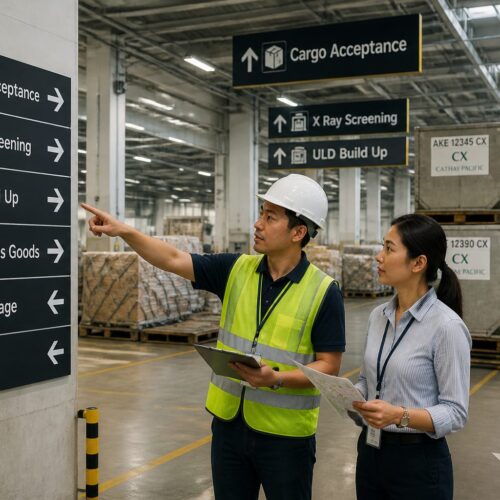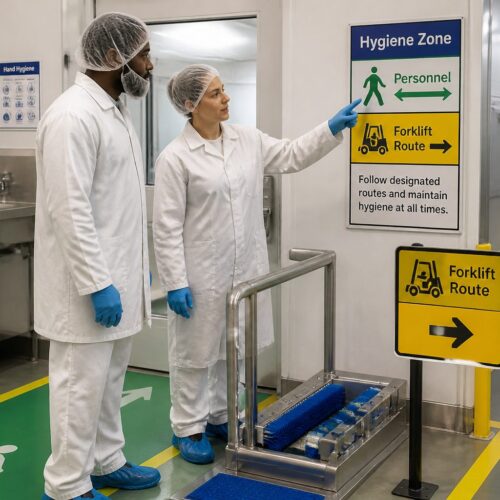


Loading docks are where warehouse plans meet the real world, and the real world includes tired drivers, tight schedules, and forklifts that do not stop on a dime. Wayfinding for Loading Docks turns that chaos into a system people can follow without arguing over radios.
I have seen docks with great racking and modern doors still lose hours because nobody can tell a driver where to go. When directions live in someone’s head, you get missed appointments, blocked fire lanes, and near misses that never make the incident log.
Good wayfinding is practical, not fancy, and it starts outside the fence where trucks first queue. It carries through to the exact bay, the right paperwork window, and the correct exit route so traffic keeps moving.
International safety and logistics symbology gives you a common language, which matters when your carriers rotate weekly and your yard team changes by shift. Clear Dock Identification Systems, consistent Truck Route Signage, and simple Loading Bay Navigation keep people from improvising in places where improvisation gets expensive.
Optimizing traffic flow in loading dock areas
Traffic flow at a dock is a design problem, not a personality problem, so stop relying on your best yard jockey to keep the peace. Map the paths for tractors, straight trucks, forklifts, and pedestrians, then remove every point where two groups need to negotiate for space.
Start with a simple rule, one direction beats two direction almost every time in a tight yard. A one way loop with wide turns reduces backing, reduces horn use, and lowers the odds that a driver will cut across a forklift lane to “save a minute.”
Build your Wayfinding for Loading Docks around real constraints like trailer swing, dock door spacing, and where drivers actually stop to check paperwork. If you place a stop sign where nobody can see it until they are already committed, you trained them to ignore signs.
Queue space is part of flow, so mark it like it matters. Painted stall numbers, posted dwell time expectations, and a clear pre check area keep arrivals from stacking across the entrance and blocking outbound moves.

Use physical separators where the risk is high, because paint alone does not stop a tired person. Bollards, curbs, and guardrails around pedestrian doors and charging stations keep a small routing mistake from turning into a major incident.
Finally, test your routes with the biggest equipment you expect, including lowboys, day cabs with 53 foot trailers, and any carriers running liftgates. If the route only works for a short box truck, your Truck Route Signage will be ignored by the drivers who need it most.
Look at where trucks naturally slow down, because those are your control points for signage and pavement markings. A gentle slowdown before the dock face is safer than a surprise stop at the last second.
Keep intersections boring, because complicated intersections create creative driving. If you cannot eliminate a crossing, make the priority obvious with stop bars, yield triangles, and a clear sight triangle that stays clear of stored pallets and parked trailers.
Forklift routes deserve the same attention as truck routes, especially where lift traffic crosses the yard. A marked forklift lane with a protected crossing reduces the “I thought you saw me” moments that happen in noisy environments.
Pedestrian movement should be planned, not tolerated, because people will always take the shortest path. If the shortest path crosses a truck lane, build a safer shortcut with barriers and a marked crossing so the safe choice is also the easy choice.
Speed control works better when it feels natural rather than punitive. Narrowing a lane with striping, adding a chicane where appropriate, or using a raised crossing can slow traffic without turning the yard into a stop and go obstacle course.
Think about what happens when one door goes down or a trailer is stuck at the dock longer than planned. A good flow plan includes a bypass route so one problem does not paralyze the entire dock line.
Give drivers a place to correct a mistake without forcing a risky three point turn in front of the doors. A marked turnaround pad or a designated re route loop keeps wrong turns from becoming near misses.
When you change the yard layout, treat it like a controlled rollout instead of a surprise. Temporary signs, cones, and a short adjustment period reduce the confusion that spikes incidents right after a re stripe.
Implementing clear signage for truck drivers
Drivers make decisions fast, often in bad weather, so your signs need plain language and big characters. A sign that requires a second read is a sign that causes a sudden stop, and sudden stops are how bumpers meet forklifts.
Place the first decision sign before the decision point, not at it. If the split between receiving and shipping is 200 feet ahead, post it 400 feet ahead so a driver can change lanes without cutting anyone off.
Use consistent terms across the property, because “Inbound,” “Receiving,” and “Unload” are not the same to every carrier. Pick one naming scheme, match it to your paperwork and appointment emails, and keep it stable so regular drivers build muscle memory.
Dock Identification Systems work best when the driver can confirm the bay from the cab without guessing at tiny stencils. Large bay numbers, reflective materials, and a repeated identifier on the dock door and the dock post prevent the classic mistake of backing into the wrong slot.
Symbols help when language fails, but only if you use symbols people recognize. Stick to standardized safety and logistics pictograms for hazards, PPE, and restricted access, then pair them with short text so new drivers do not misread your intent.
Maintenance matters more than design, because faded signs train people to ignore the whole system. Put sign inspection on a schedule, replace anything sun bleached or hit by a mirror, and keep vegetation from turning your Truck Route Signage into a guessing game.
Use a clear hierarchy so drivers know what to look for first, like route direction, then zone, then door number. When every sign tries to be the most important sign, drivers stop trusting all of them.
Keep sign placement consistent, such as always on the right side of travel and at a predictable height. Consistency reduces scanning time, which is important when a driver is also watching for pedestrians and trailer tails.
Do not overload a single panel with rules, because a driver cannot read a paragraph while rolling. Put the critical instruction on the primary sign and move detailed policies to the check in area where the truck is stopped.
Reflectivity is not optional if you run early mornings or nights. Retroreflective sheeting on route signs and bay markers keeps your system usable when headlights are the main light source.
Make sure your signs are readable from the angles drivers actually approach, not just from a perfect straight on view. A sign that is technically visible but angled away becomes invisible when a trailer is blocking half the line of sight.
Use confirmation signs after turns so drivers know they did the right thing. That small reassurance reduces the mid lane hesitation that causes backups and last second lane changes.
Include a simple “Wrong Way” or “No Truck” message where mistakes are common, because prevention beats recovery. The best time to stop a wrong turn is before the driver commits to a narrow lane with no escape.
Coordinate with security and gate staff so they repeat the same terms the signs use. If the guard says “Go to receiving” but the signs say “Inbound,” you just created a translation problem at the worst moment.
Using color-coding to differentiate loading zones
Color coding is the fastest way to communicate zone meaning at a glance, especially in busy yards where drivers see a wall of doors. The trick is to limit the palette and assign colors to functions that stay consistent across shifts and seasons.
Use color as a layer on top of Dock Identification Systems, not a replacement for numbers and letters. A driver should be able to say “Blue zone, door B12” and have that mean the same thing to security, shipping, and the yard hostler.
Apply the color in more than one place so it survives real conditions like snow banks, stacked trailers, and open doors. When the door header, the lane stripe, and the sign panel all match, the zone stays readable even when one cue is blocked.
Keep the meaning of each color tied to a process, not a temporary project. If orange means special handling this month and overflow parking next month, you train drivers to ignore the colors and ask anyway.
Think about color visibility in different lighting, because a color that looks obvious at noon can disappear under sodium lights at 3 a.m. Test your palette at night and in rain so the system works when conditions are worst.
Account for color vision deficiencies by pairing color with shape, text, or pattern. A striped band, a letter prefix, or a simple icon next to the color cue keeps the message accessible to everyone.
Use the same color scheme on paperwork, appointment confirmations, and driver instructions so the yard feels consistent. When the email says “Green zone,” the driver should see green on the first approach sign and know they are in the right place.
Train your own team to speak in the same color language, because internal inconsistency breaks external confidence. If shipping calls it “the north doors” while signs call it “Green,” drivers will keep getting mixed instructions.
Maintain the paint like it is part of your safety system, because worn stripes look like optional suggestions. A simple re stripe schedule prevents the slow drift where zones become vague and arguments start again.
| Zone color | Assigned dock function | Recommended visual cues |
|---|---|---|
| Blue | Inbound receiving | Blue door header band, blue ground stripe, “INBOUND” sign panel |
| Green | Outbound shipping | Green bay number plate, green lane arrows, “OUTBOUND” sign panel |
| Yellow | Staging and marshaling | Yellow boxed parking stalls, dwell time sign, cone storage area |
| Red | Restricted and emergency access | Red curb paint, “KEEP CLEAR” marking, fire lane symbol |
| Orange | Oversize or special handling | Orange placard mount, clearance height sign, escort required symbol |
Providing directional information for incoming and outgoing shipments
Inbound and outbound traffic should not compete for the same choke points if you can avoid it. Separate gates, separate lanes, or at least separate time windows reduce conflicts and make Loading Bay Navigation simpler for everyone.
Directional information needs repetition, because drivers miss signs when they are checking mirrors or watching pedestrians. Use a sequence, gate sign, lane sign, yard arrow, and final bay confirmation so one missed cue does not break the route.
Give inbound drivers a clear “check in” target that is visible from the approach road. If they cannot find the window, they will stop wherever they can, and that random stop becomes an obstacle that forces risky passes.
For outbound, mark a clean exit path that avoids backing across active lanes. A dedicated outbound lane with clear arrows and “TRUCK EXIT” signs keeps finished loads from mixing with arrivals that still need instructions.
If your site uses a yard management system, tie the physical wayfinding to the digital message. When a driver gets a text that says “Proceed to Green, G7,” the yard should show green zone markers and an obvious G7 plate from 100 feet away.
Do not forget internal drivers, because your own hostlers and switchers set the tone. When they follow the posted Truck Route Signage and respect one way lanes, outside carriers copy the behavior without being told.
Make the first 30 seconds after the gate as simple as possible, because that is where drivers are most overloaded. If they have to decide between three lanes, a scale, a guard shack, and a stop line all at once, they will pick the wrong thing and stop in the wrong place.
Use pavement arrows that match the signs, because drivers trust the ground when they are unsure. A big arrow and a short word like “INBOUND” can do more than a small sign hidden behind a parked trailer.
Provide a clear exception route for late arrivals, rejected loads, or drivers sent back to staging. Without an exception path, every unusual event turns into a radio conversation in the middle of traffic.
When you have multiple buildings or dock faces, name them in a way that cannot be confused over a scratchy phone call. Letters and colors beat similar sounding names, and they reduce the chance that a driver heads to the wrong side of the property.
At the dock face, add a final confirmation marker that is visible while the driver is lining up. That last cue, like a large door number and zone color band, prevents the slow realization that they are backing toward the wrong bay.
Give drivers a safe place to wait if they arrive early, and make that instruction part of the inbound route. Early arrivals are not the problem, but early arrivals parked in travel lanes are.
Make sure your outbound route does not force trucks past pedestrian break areas or employee parking exits. If people and trucks must cross, mark the crossing like a real intersection with stop control and clear sight lines.
Update route information when construction or seasonal changes affect the yard, because drivers will follow old habits if the signs are unclear. Temporary detour signs should look official enough that drivers trust them instead of guessing.
Creating designated parking areas for trucks
Unplanned parking is where a yard loses control, because every parked trailer becomes a blind corner. Designated parking gives you predictable sight lines and keeps fire lanes, dock approaches, and pedestrian doors clear.
Build separate areas for bobtails, live loads waiting for a door, and drop trailers, because each group behaves differently. Clear stall markings and posted rules reduce the back and forth calls that waste time and irritate drivers.
Number the stalls and treat them like addresses within your Dock Identification Systems. When dispatch or security can say “Park in P14,” you stop the habit of drivers choosing the closest empty space to the docks.
Include basic amenities where you can, like a restroom access point and a trash station, because drivers will walk somewhere anyway. If you ignore that reality, they will cross active lanes at the worst possible spot to find what they need.
Use signs that set expectations on idle time, engine off policies, and where to stage paperwork. Drivers accept rules faster when the rules are posted clearly and enforced consistently across carriers.
If space is tight, use timed staging and appointment windows to keep the lot from turning into overflow storage. That operational discipline pairs well with Wayfinding for Loading Docks because the route stays open and the signs stay true.
Design parking with turning radii in mind, because a stall that looks fine on paper can be impossible to enter without blocking the lane. Angle parking or pull through stalls can reduce backing and speed up staging when you have the space.
Separate parked trailers from active travel lanes with curbs, posts, or a buffer stripe so mistakes do not become collisions. A small buffer also gives drivers room to open doors and do inspections without stepping into traffic.
Provide a clearly marked late night or overflow area so drivers are not improvising when staffing is minimal. If the only instruction is “find a spot,” the yard will look different every morning and your flow plan will collapse.
Make the parking rules visible at the entrance to the lot, not just at the guard shack. Drivers should know whether they are allowed to drop, whether they must stay with the unit, and how they will be called when a door opens.
Use simple call up methods that match your operation, like a posted phone number, a QR code, or a yard channel, but keep it consistent. When the method changes by shift, drivers will pick the wrong one and wait longer than necessary.
Consider where reefer units will park, because noise and exhaust become a people problem fast. A designated reefer row with clear rules keeps complaints down and prevents drivers from parking reefers next to pedestrian doors.
Plan for trailer inspections and securement checks so they happen in a safe area, not in the travel lane. A marked inspection bay with lighting and a buffer zone reduces the temptation to do a quick check in a dangerous spot.
If you tow or boot unauthorized parking, post that policy clearly so enforcement does not look arbitrary. Predictable enforcement supports the wayfinding system because drivers believe the posted rules matter.
Ensuring adequate lighting for safe operations
Lighting is a wayfinding tool, because people follow what they can see and avoid what looks uncertain. A well lit approach lane and dock face reduces backing errors and makes bay numbers readable at night.
Focus on vertical illumination at the dock doors, not just bright pavement. Drivers need to see door numbers, color bands, and hand signals, and yard staff need to see trailer edges and gaps around dock levelers.
Match lighting levels to the task, because backing to a door needs more clarity than a low traffic perimeter road. If everything is dim, drivers will creep and hesitate, and that hesitation stacks up into delays.
Control glare, because glare hides pedestrians and makes reflective signs bloom into unreadable blobs. Proper fixture aiming and shielding keeps the light on the work area instead of in the driver’s eyes.
Plan for shadows created by parked trailers, canopies, and building offsets. If a door number disappears in a shadow pocket, your Dock Identification Systems just lost half their value at night.
Use lighting to emphasize the route, like brighter illumination at turns, crossings, and decision points. People naturally steer toward the better lit path, which supports Truck Route Signage without adding extra panels.
Emergency lighting and backup power are part of safe operations, not a luxury. A power outage should not turn the yard into a blacked out maze with trucks still moving.
Keep fixtures protected from impacts, because loading dock areas are hard on equipment. A broken light over a dock door can stay broken for weeks if it is difficult to access or constantly gets hit.
Weather matters, because rain and fog change how light behaves. A lighting plan that works in clear air can create reflections and hot spots on wet pavement that hide lane lines.
- Light dock numbers and zone color bands directly
- Eliminate dark corners at pedestrian doors and stairs
- Add glare shields where drivers face fixtures on approach
- Use consistent pole spacing along truck routes
- Inspect and relamp on a fixed schedule, not after complaints
- Mark emergency egress paths with dedicated fixtures
Conclusion
Wayfinding for Loading Docks works when it matches how people move, where they hesitate, and what they can read from a cab at a crawl. If your system depends on a perfect driver on a perfect day, it will fail on Monday morning in the rain.
Combine Dock Identification Systems, Truck Route Signage, and Loading Bay Navigation into one consistent language, then maintain it like any other piece of safety equipment. When the yard is predictable, operations speed up and the close calls drop, which is the kind of improvement everyone notices.
The goal is not to add more signs, but to remove the need for constant questions and corrections. When drivers can self navigate, your team spends less time directing traffic and more time moving freight.
Start with the highest friction points, like the gate approach, the first split, and the dock face, because that is where confusion costs the most. Small upgrades in those areas often produce bigger gains than a full yard repaint done without a plan.
Wayfinding also supports accountability, because clear routes make it obvious when someone is in the wrong place. That clarity makes coaching easier and enforcement fairer, which improves compliance over time.
Keep measuring what changes after improvements, like turn times, missed doors, and yard congestion at peak hours. If you can see the data move, you can justify maintaining the system instead of letting it fade back into tribal knowledge.