
Ensuring workplace safety requires clear and unambiguous communication, especially when it comes to potential hazards. Safety signs and labels are fundamental tools in this effort, guiding personnel and visitors to understand risks and necessary precautions. However, navigating the world of safety symbology can become complex, particularly when comparing different international standards.
Two prominent systems often come into discussion: ANSI Z535 and ISO 7010. These standards dictate how safety information should be presented, but they approach the task with distinct philosophies and visual conventions. Understanding the differences between ANSI Z535 and ISO 7010 is essential for any organization operating domestically or internationally.
This article will explore the core tenets of both standards, examine their unique characteristics, and discuss their implications for safety labeling across various industries and logistics operations. We will help clarify the nuances of each system, providing a clearer picture of their application in real-world safety scenarios.
The Foundation of Safety: What is ANSI Z535?
The ANSI Z535 series of standards originates from the United States and provides comprehensive guidelines for safety signs and tags. This collection of standards ensures consistency in safety communication across American industries. It covers everything from the design of safety colors to the specific layout of warning labels.
Developed by the American National Standards Institute, ANSI Z535 aims to prevent accidents and injuries by effectively communicating hazards. The standards are widely adopted in manufacturing, construction, and various other sectors within the U.S. They represent a well-established framework for visual safety communication.
One defining characteristic of ANSI Z535 is its reliance on a combination of symbols, signal words, and text messages. This multi-modal approach ensures that safety information is understood by a broad audience, even if they have varying literacy levels or language proficiencies. The signal words, like DANGER, WARNING, and CAUTION, immediately convey the severity of a hazard.
The ANSI Z535 series is actually composed of several individual standards, each addressing a specific aspect of safety sign design. For instance, ANSI Z535.1 deals with safety colors, while Z535.2 focuses on environmental and facility safety signs. This modular structure allows for detailed guidance on different types of safety communication.
These standards also specify the format for product safety labels, which are crucial for equipment and machinery. Proper labeling under ANSI Z535 ensures that users are informed about potential risks associated with product operation. This attention to detail helps mitigate liability and promotes safer product use.
Adherence to ANSI Z535 is often mandated by regulatory bodies like OSHA for workplaces in the United States. Compliance is not just a recommendation; it is a legal requirement in many contexts. Businesses must understand and implement these safety standards to avoid penalties and, more importantly, to protect their employees.
The clear, text-heavy approach of ANSI Z535 contrasts with purely symbolic international systems, which can sometimes lead to confusion in global operations. However, for domestic use, its structured methodology provides a robust system for safety communication. It remains the benchmark for safety labeling within the United States.
Global Harmony: What is ISO 7010?
ISO 7010 is an international standard that prescribes graphical symbols for safety signs, aiming for universal recognition across different countries and languages. This standard emphasizes pictograms, reducing reliance on text to convey critical safety messages. It promotes a common visual language for safety around the globe.
The International Organization for Standardization (ISO) developed ISO 7010 to overcome language barriers and foster immediate understanding of safety information. Its primary goal is to minimize accidents by ensuring that safety symbols are intuitively understood by anyone, anywhere. This makes it particularly valuable for international logistics and diverse workforces.
| Category | Shape | Color | Purpose |
|---|---|---|---|
| Prohibition | Circle with diagonal line | Red border, black pictogram on white background | Indicates actions that are forbidden |
| Warning | Triangle | Yellow background, black border, black pictogram | Alerts to a specific hazard or danger |
| Mandatory Action | Circle | Blue background, white pictogram | Specifies an action that must be carried out |
| Emergency Exit/First Aid | Square or Rectangle | Green background, white pictogram | Indicates safe conditions or escape routes |
| Fire Equipment | Square or Rectangle | Red background, white pictogram | Marks the location of fire-fighting equipment |
Core Differences in Design Philosophy
The fundamental distinction between ANSI Z535 and ISO 7010 lies in their approach to conveying information. ANSI Z535 primarily uses a combination of signal words, symbols, and supplementary text, offering a comprehensive textual explanation. ISO 7010, conversely, prioritizes universally understood graphic symbols, minimizing or eliminating text. This difference profoundly impacts how safety messages are received.
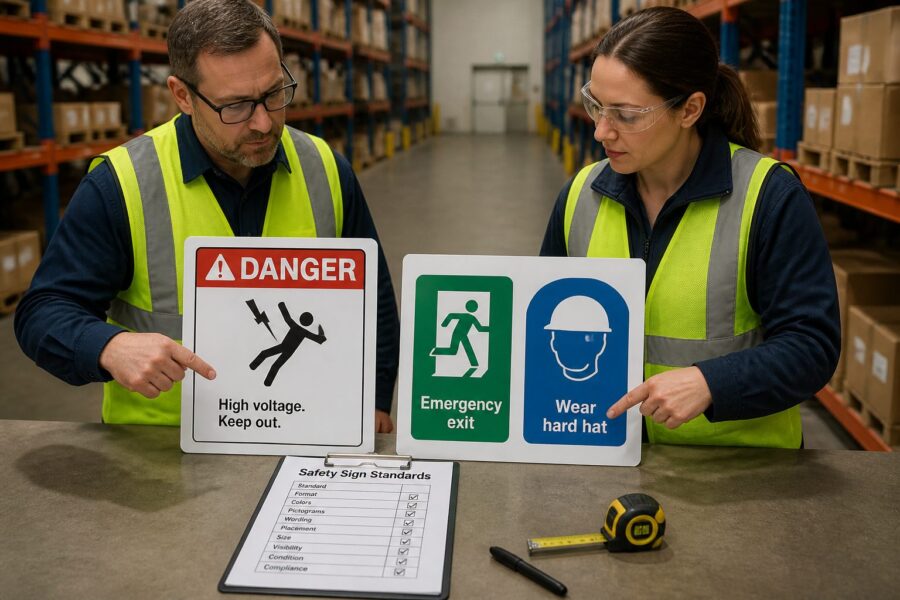
ANSI Z535 signs often feature a “header” or “signal word” panel at the top, such as “DANGER,” “WARNING,” or “CAUTION,” which immediately communicates the hazard’s severity. Below this, a pictogram may appear, followed by a detailed text message explaining the hazard, consequences, and avoidance instructions. This structured format ensures a thorough understanding of the safety message.
ISO 7010 signs, on the other hand, are almost entirely pictorial, relying on standardized shapes and colors to categorize the type of safety message. A prohibition sign, for example, will always be a red circle with a diagonal line over a black pictogram, universally understood as “do not.” This visual shorthand is designed for rapid comprehension across linguistic boundaries.
The color schemes also differ significantly between the two standards, although some overlap exists. ANSI Z535 uses specific colors for signal words (e.g., red for DANGER, orange for WARNING), which are then paired with a specific hazard level. ISO 7010 assigns colors to the *type* of safety action or condition, like red for prohibition and blue for mandatory actions.
Another key difference is the role of text. ANSI Z535 considers text an integral and often primary component of the safety message, providing explicit instructions and consequences. ISO 7010 views text as supplementary, to be used only when a symbol alone cannot convey the necessary information clearly, often in a secondary panel. This distinction is crucial for international logistics where diverse languages are common.
The shapes used for different categories of signs also vary. While both standards use triangles for warnings, the specific colors and internal pictograms differ. ISO 7010 uses a red circle with a diagonal line for prohibition, whereas ANSI Z535 might use a “DO NOT” header with a red background. These subtle yet significant variations demand careful attention when selecting safety labeling.
Ultimately, the choice between using ANSI Z535 vs ISO 7010 depends heavily on the target audience and regulatory environment. ANSI Z535 offers detailed, explicit instructions, while ISO 7010 provides quick, universal recognition. Each has its strengths in specific contexts for effective safety communication.
Understanding Symbol Conventions
Both ANSI Z535 and ISO 7010 employ specific symbol conventions to categorize and convey safety messages, but their visual language often diverges. A clear understanding of these conventions is paramount for correct interpretation and application of safety signs. Misinterpreting a symbol can lead to dangerous situations.
For warning signs, ANSI Z535 typically uses an equilateral triangle with a yellow background and a black border, containing a black symbol. ISO 7010 also uses an equilateral triangle with a yellow background and a black border, but the specific pictograms inside, though similar, can have subtle differences. Both aim to alert individuals to potential hazards.
Prohibition signs are a prime example of divergence in symbols. ISO 7010 uses a red circle with a diagonal line across a black pictogram on a white background, universally signifying “do not.” ANSI Z535, while it can incorporate prohibition pictograms, often relies more on the “DANGER” or “WARNING” signal word panel combined with explicit text to convey forbidden actions. This difference highlights the visual versus textual emphasis.
Mandatory action signs also show distinct conventions. ISO 7010 uses a blue circle with a white pictogram to indicate actions that must be performed, such as “wear eye protection.” ANSI Z535 includes mandatory action symbols, but they are frequently accompanied by a “CAUTION” or “NOTICE” panel and explanatory text. The blue circle is a strong visual cue for mandatory actions in the ISO system.
Emergency information signs, like those for first aid or emergency exits, typically use a green square or rectangle with a white pictogram in both standards. This is one area where the visual conventions show greater alignment, facilitating quicker recognition in critical situations. The green color consistently indicates safety or safe conditions.
Fire equipment signs also share a similar approach, using a red square or rectangle with a white pictogram to indicate the location of fire extinguishers or alarms. This commonality helps ensure that fire safety information is readily identifiable regardless of the specific standard. Such consistency is beneficial for broad safety awareness.
Understanding these specific symbol conventions is crucial when implementing safety labeling in a warehouse or any facility. Choosing the appropriate standard for your audience ensures that vital safety messages are conveyed effectively, preventing confusion and enhancing overall safety. The choice between ANSI Z535 vs ISO 7010 impacts how these symbols are perceived.
Text Panels and Supplemental Information
The role of text panels and supplemental information fundamentally distinguishes the ANSI Z535 and ISO 7010 approaches to safety communication. ANSI Z535 integrates text as a primary component, providing detailed instructions and clarifying potential hazards. This reliance on written language offers comprehensive guidance to the reader.
ISO 7010, conversely, minimizes text, preferring universally understood pictograms, but it does allow for supplemental text panels when necessary. These panels are typically placed below or adjacent to the primary symbol and are intended to provide additional context or specific instructions that the pictogram alone cannot convey. They serve as an augmentation, not a replacement, for the symbol.
- Clarifying ambiguous symbols
- Providing specific hazard details
- Listing precise safety instructions
- Detailing consequences of non-compliance
- Offering multilingual explanations
Application Across Industries: Where Each Standard Dominates
The adoption of ANSI Z535 vs ISO 7010 often depends on the geographical location and the specific industry. Each standard has carved out its niche, driven by regulatory requirements, historical precedent, and operational needs. Understanding these dominances helps in selecting the correct safety labeling for any given environment.
ANSI Z535 standards are the undisputed benchmark for safety signage and labeling within the United States. Industries such as manufacturing, construction, and chemical processing in the U.S. rigorously adhere to ANSI Z535. This ensures a consistent safety language across American workplaces and products. OSHA regulations frequently reference ANSI Z535 for compliance.
Conversely, ISO 7010 holds sway in most European countries and many other nations worldwide, particularly those involved in international trade and global logistics. Companies operating across borders find ISO 7010 beneficial for its universal recognition, reducing the need for multiple language translations on every sign. This global approach simplifies safety communication for diverse workforces and public spaces.
In the realm of product safety labels, American-made machinery and consumer goods destined for the U.S. market will almost certainly feature ANSI Z535 compliant labeling. These labels combine symbols with clear text warnings, ensuring that users understand risks specific to the product. This explicit guidance is a hallmark of the ANSI system.
For international supply chains and warehouses that handle goods from various countries, the presence of both standards can be a reality. A warehouse receiving equipment from Europe might encounter ISO 7010 symbols, while its internal safety protocols follow ANSI Z535. Managing this duality requires careful consideration and often a hybrid approach to safety signage.
Public spaces, like airports, train stations, and public buildings, especially those with international visitors, often lean towards ISO 7010 symbols. The goal here is immediate, intuitive understanding by people from diverse linguistic backgrounds. A universally recognized “no smoking” symbol prevents confusion that text-based signs might cause.
Ultimately, the choice of standard is not merely preferential; it is often dictated by legal and operational necessity. Facilities primarily serving a domestic U.S. audience will prioritize ANSI Z535, while those with an international scope or located outside the U.S. will gravitate towards ISO 7010 for their safety labeling. This distinction is critical for effective safety management.
Challenges of Compliance and Implementation
Implementing and maintaining compliance with safety signage standards, whether ANSI Z535 or ISO 7010, presents several challenges for organizations. The initial investment in new signs and labels can be substantial, especially for large facilities or those needing to update outdated systems. This financial consideration often influences the pace of adoption.
Training personnel to understand the specific conventions of each standard is another significant hurdle. Employees accustomed to one system might misinterpret signs from another, potentially leading to safety incidents. Effective training programs are crucial to bridge any knowledge gaps regarding different safety symbols and their meanings.
Existing infrastructure can also pose a challenge. Many older facilities might have a mix of signs from various eras or standards, creating visual clutter and confusion. Replacing all signs simultaneously can be disruptive, requiring careful planning and execution to minimize operational impact. This transition needs to be managed strategically.
For companies with global operations, the challenge is compounded by the need to comply with multiple national and international standards. A product manufactured in a country following ISO 7010 might need ANSI Z535 labeling when exported to the U.S., necessitating dual labeling or market-specific production. This complexity adds layers to product development and distribution.
Ensuring consistency across all safety communication points, from facility signs to machine labels, requires diligent oversight. A patchwork of different standards can undermine the entire safety program. Regular audits and updates are essential to maintain a cohesive and effective safety signage system.
The dynamic nature of standards themselves also presents a challenge, as both ANSI Z535 and ISO 7010 undergo periodic revisions and updates. Organizations must stay informed about these changes and adapt their signage accordingly. Falling behind on updates can lead to non-compliance and outdated safety information.
Finally, the sheer volume of safety information required in complex environments, such as a large warehouse or a manufacturing plant, demands a systematic approach to labeling. Overloading areas with too many signs can lead to “sign blindness,” where important warnings are overlooked. Strategic placement and clear design are vital for effective safety communication.
Navigating Dual Standards: Best Practices for International Operations
Companies operating across international borders often face the complex task of navigating both ANSI Z535 and ISO 7010 standards. This situation demands a strategic approach to safety labeling to ensure compliance and effective communication in diverse environments. A clear policy on safety symbology becomes indispensable for global organizations.
One best practice involves conducting a thorough risk assessment to determine the most appropriate signage for each specific location and audience. This assessment should consider local regulations, the linguistic diversity of the workforce, and the potential for international visitors. Tailoring the approach ensures optimal safety communication.
Harmonization is a key strategy for managing dual standards. Where possible, organizations can opt for signs that are compliant with both ANSI Z535 and ISO 7010, leveraging common elements like symbol shapes or colors. Some manufacturers offer “hybrid” signs designed to meet the requirements of both systems, simplifying procurement and implementation.
For product labeling, it is often necessary to create region-specific labels. Products destined for the U.S. market will require ANSI Z535 compliant labels, while those for Europe or other ISO-adopting regions will need ISO 7010 labels. This means maintaining different labeling templates and processes in production. Careful management of these variations is critical for market access.
Providing supplementary information in multiple languages, even when using ISO 7010 symbols, can significantly enhance clarity. While ISO symbols aim for universality, adding text in local languages or common languages like English can reduce ambiguity for complex warnings. This approach ensures that all workers fully grasp the safety message.
Employee training programs should explicitly address the differences between ANSI Z535 and ISO 7010, particularly for personnel who work in or visit international facilities. Educating staff on both sets of safety symbols and their interpretations helps prevent miscommunication and promotes a culture of safety awareness. This proactive education is vital.
Finally, establishing clear internal guidelines for safety signage and labeling procurement and placement is essential. A centralized system for managing safety standards helps ensure consistency across all global sites. This structured approach minimizes confusion and strengthens overall safety protocols for international logistics and operations.
The Future of Safety Symbology
The landscape of safety symbology is continuously evolving, driven by technological advancements, global interconnectedness, and a deeper understanding of human factors. As industries become more complex and workforces more diverse, the need for effective and universally understood safety communication grows. The dynamic interplay between ANSI Z535 and ISO 7010 will continue to shape this future.
One emerging trend is the increased integration of digital signage into safety protocols. Digital displays offer flexibility, allowing for dynamic updates to safety messages, multi-language support, and even animation to draw attention. This technology can bridge the gap between static signs and real-time hazard information, enhancing responsiveness in safety management.
There is also a growing push towards greater harmonization between national and international standards. While a complete merger of ANSI Z535 and ISO 7010 might be unlikely due to their distinct philosophies, efforts to align specific symbols and conventions are ongoing. Such alignment would simplify compliance for global companies and reduce confusion. This convergence benefits all stakeholders.
The development of new symbols to address emerging hazards, such as those related to advanced robotics, artificial intelligence, or novel chemical compounds, is another critical aspect of the future. Standards bodies must continually adapt to new risks, creating clear and intuitive symbols that communicate these dangers effectively. This proactive approach ensures safety keeps pace with innovation.
User experience and cognitive psychology are increasingly influencing safety sign design. Research into how people perceive and process visual information helps create more effective symbols that are instantly understood, regardless of cultural background. This scientific approach ensures that safety messages truly resonate with the intended audience.
The role of augmented reality (AR) and virtual reality (VR) in safety training and hazard identification is also gaining traction. These immersive technologies can simulate dangerous scenarios, allowing workers to learn and react to safety symbols in a controlled environment. This enhances understanding and retention of safety information, making it more impactful than traditional methods.
Ultimately, the future of safety symbology aims for ubiquitous, unambiguous, and adaptive communication that transcends linguistic and cultural barriers. Whether through refined existing standards or innovative technologies, the goal remains the same: to prevent harm and protect lives through clear visual messages. Both ANSI Z535 and ISO 7010 contribute significantly to this ongoing mission.