
Overhead signs are particularly effective in large, open warehouse spaces where they can be seen from a distance and above obstructions like shelving or machinery. These signs often point to major sections, such as “Shipping,” “Receiving,” or “Main Office,” using large text and directional arrows. They serve as beacons in expansive areas.
Within office corridors, wall-mounted signs at eye level are appropriate for directing people to specific rooms or departments. These signs should be consistently placed at decision points, such as intersections or before a series of doors. They provide detailed, localized navigation.
Adequate lighting is also non-negotiable for sign visibility, especially in areas with varying light conditions. Backlit signs or those made with reflective materials ensure readability in both bright and dim environments. This attention to detail guarantees that wayfinding signage for office areas inside warehouses remains effective 24/7.
Regularly auditing sign placement helps identify any new obstructions or changes in layout that might compromise visibility. A sign might be perfectly placed one day, but a new stack of pallets could render it invisible the next. Proactive checks maintain the integrity of the entire wayfinding system.
The Power of Symbology and Consistent Labeling
Effective wayfinding signage for office areas inside warehouses heavily relies on a consistent system of `symbols` and `labeling`. Pictograms transcend language barriers, offering instant recognition and understanding, which is crucial in fast-paced or multi-lingual environments. A well-chosen symbol communicates a message far more quickly than text alone.
Adopting `ISO` `standards` for `safety` `symbols` ensures that common messages, such as emergency exits or mandatory protective equipment, are universally interpreted. Consistency in the style, color, and size of these `symbols` across the entire facility reinforces their meaning. This systematic approach reduces cognitive load and improves response times.
- Utilize ISO 7010 compliant safety pictograms
- Maintain consistent font styles and sizes for text
- Standardize color-coding for different zones (e.g., green for safety, red for danger)
- Apply uniform `labeling` conventions for departments and rooms
- Ensure all directional arrows point clearly and unambiguously
- Use high-contrast colors for maximum readability
Material Choices and Durability for Industrial Settings
The harsh conditions typical of a `warehouse` environment demand that wayfinding signage for office areas inside warehouses be constructed from robust and durable materials. Unlike standard office signage, these signs must withstand dust, temperature fluctuations, potential impacts, and industrial cleaning agents. Choosing the right materials ensures longevity and continued effectiveness.
Metals like aluminum or stainless steel are excellent choices for main directional signs due to their strength and resistance to corrosion. These materials can be powder-coated for added protection and to match specific branding or `safety` color schemes. They stand up well to incidental bumps and scrapes.
High-grade plastics, such as PVC or acrylic, offer good durability for indoor office `labeling` and can be easily cleaned. For floor `labeling` or areas prone to heavy traffic, specialized industrial-grade vinyl or epoxy coatings are necessary. These materials resist abrasion from foot traffic and machinery.
Reflective materials are vital for signs in areas with low light or where vehicle headlights might be the primary illumination source. These materials enhance visibility and contribute to overall `safety` during off-hours or in dimly lit sections of the `warehouse`. They ensure signs are seen when they are needed most.
Consider also the mounting hardware for signs; it must be secure enough to prevent accidental dislodgement, which could become a `safety` hazard. Industrial-grade fasteners and robust mounting systems are crucial for maintaining the integrity of your `wayfinding signage for office areas inside warehouses`. This attention to detail extends the lifespan of your investment.
Integrating Digital Solutions with Physical Signage
While physical signs form the backbone of `wayfinding signage for office areas inside warehouses`, integrating digital solutions can significantly enhance their effectiveness and adaptability. Digital displays offer dynamic capabilities that static signs simply cannot match, providing real-time information and flexibility. This blend creates a more responsive navigation system.
Digital screens at key entry points or reception areas can display dynamic maps, current `logistics` updates, or even emergency alerts. These screens can be updated instantly, allowing for rapid communication of changes in `warehouse` layout or operational status. They are particularly useful for guiding visitors to temporary meeting rooms or events.
QR codes placed on physical signs can link users to mobile-friendly maps, detailed directions, or specific `ISO` `standards` documentation. This allows individuals to access more granular information on their personal devices, complementing the general guidance provided by static signage. It offers a deeper level of engagement and information access.
Interactive kiosks can provide personalized directions, helping visitors navigate complex routes to specific office departments or `warehouse` sections. These kiosks can also offer information in multiple languages, further enhancing accessibility and user experience. They empower users to find their own way efficiently.
The integration of digital and physical `wayfinding signage for office areas inside warehouses` creates a layered system that caters to different preferences and situations. Physical signs provide constant, reliable information, while digital elements add flexibility and depth. This combination ensures comprehensive and future-proof navigation.
Regular Audits and Adaptability for Evolving Spaces
A `warehouse` is rarely a static environment; layouts change, departments move, and `logistics` processes evolve, directly impacting the effectiveness of `wayfinding signage for office areas inside warehouses`. Regular audits and a commitment to adaptability are essential to keep your signage system current and accurate. Outdated signs are more than just confusing; they can be a `safety` hazard.
Schedule periodic reviews of all `wayfinding signage` to ensure it still reflects the current layout and operational requirements of both the `warehouse` and office areas. This includes checking for physical damage, fading, or signs that have become obscured by new equipment or inventory. A thorough audit identifies discrepancies before they cause problems.
Establish a clear process for updating `labeling` and directional signs whenever there are changes to office locations, department names, or `warehouse` zones. This proactive approach prevents confusion and maintains the integrity of your navigation system. Quick updates are crucial for maintaining efficiency.
Training staff on the importance of reporting damaged or incorrect `wayfinding signage` empowers everyone to contribute to maintaining a safe and efficient environment. Foster a culture where employees feel responsible for the accuracy of their surroundings. This collective effort ensures continuous improvement.
Maintaining compliance with `ISO` `standards` and local `safety` regulations also requires ongoing vigilance. As `standards` are updated or new regulations are introduced, your `wayfinding signage` system must adapt accordingly. Staying current with these guidelines is a non-negotiable aspect of responsible facility management.
The Business Case for Superior Wayfinding
Investing in superior `wayfinding signage for office areas inside warehouses` offers tangible business benefits that extend far beyond mere convenience. This strategic investment directly contributes to operational efficiency, enhanced `safety`, and a more professional image. The return on investment becomes clear through various improvements.
Firstly, clear `labeling` and directional `symbols` reduce wasted time for both employees and visitors searching for specific locations. This efficiency translates into increased productivity, as staff can focus on their core tasks rather than navigating confusing corridors. Time saved is money earned in a busy `logistics` operation.
Secondly, robust `safety` `standards` embedded in your `wayfinding signage` significantly reduce the risk of accidents and injuries. Preventing even a single incident can save substantial costs associated with medical expenses, lost work time, and potential legal fees. A safe environment is a cost-effective environment.
Thirdly, a well-organized and easy-to-navigate facility leaves a positive impression on clients, suppliers, and prospective employees. It demonstrates professionalism, attention to detail, and a commitment to operational excellence. This positive perception can strengthen business relationships and attract top talent.
Compliance with international `standards` and local regulations regarding `safety` and `logistics` `symbology` also protects your business from fines and legal penalties. Proactive adherence to these guidelines is a smart business practice that avoids costly repercussions. It shows a commitment to responsible operations.
Ultimately, the overall improvement in workflow, `safety`, and reputation makes the case for prioritizing `wayfinding signage for office areas inside warehouses` undeniably strong. It is an investment that pays dividends in multiple areas of your business. This comprehensive approach supports long-term success and sustainability.
Navigating the complex environment of a modern warehouse can be a challenge, even for experienced personnel. When you add dedicated office areas within these bustling industrial spaces, the need for clear and effective wayfinding signage for office areas inside warehouses becomes absolutely critical. This unique hybrid environment demands a thoughtful approach to guide both internal staff and external visitors safely and efficiently.
Traditional office wayfinding principles often fall short in a setting dominated by heavy machinery, high shelving, and constant movement. Integrating office zones into a warehouse requires a specialized system that bridges two very different operational philosophies. Our focus today is on how to implement superior wayfinding signage for office areas inside warehouses, ensuring seamless transitions and enhanced safety for everyone.
Proper signage isn’t just about convenience; it’s a fundamental component of operational efficiency and a robust safety program. We will explore the international standards, practical design considerations, and strategic implementation necessary to achieve this crucial balance. Understanding these elements helps create a functional and secure environment where warehouse operations and office functions coexist harmoniously.
The Blended Environment: Why Wayfinding Matters Here
Warehouses are inherently dynamic spaces, characterized by constant movement of goods, vehicles, and personnel. Introducing administrative offices or client reception areas into this setting creates a distinct challenge for intuitive navigation. Effective wayfinding signage for office areas inside warehouses must clearly delineate these different zones.
Visitors unaccustomed to industrial environments can easily become disoriented, potentially straying into hazardous operational areas. Clear and consistent labeling prevents confusion, guiding individuals directly to their intended destination without unnecessary detours. This careful planning avoids disruptions to core logistics activities.
Office staff also benefit from well-designed signage, especially when their roles require movement between the office and the warehouse floor. They need quick visual cues to identify safe pathways, emergency exits, and specific departmental locations. Such systems support efficient internal movement, saving time and reducing frustration.
The contrast between a quiet office corridor and a noisy loading dock can be stark, requiring signage that adapts to both visual contexts. Signs must be equally effective whether viewed from a pedestrian’s perspective or from a vehicle operator’s cab. This adaptability ensures universal understanding across diverse user groups within the warehouse environment.
Ultimately, superior wayfinding signage for office areas inside warehouses enhances overall site accessibility and operational fluidity. It transforms a potentially confusing layout into an easily navigable space, reflecting positively on the organization’s commitment to order and safety. This strategic investment benefits everyone who steps foot into the facility.
Safety First: Navigating Warehouse Hazards and Office Zones
Safety remains the paramount concern in any warehouse operation, and wayfinding signage plays a critical role in mitigating risks. Clearly marked pathways and restricted area indicators are essential for preventing accidents and ensuring personnel safety. This applies equally to both the warehouse floor and adjacent office spaces.
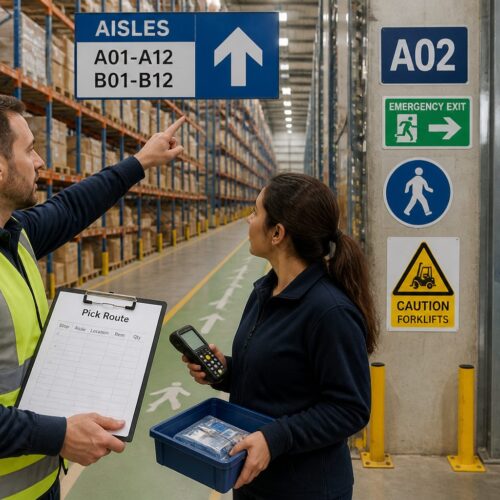
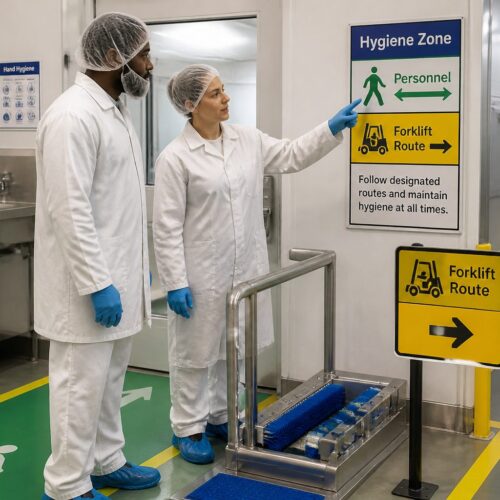
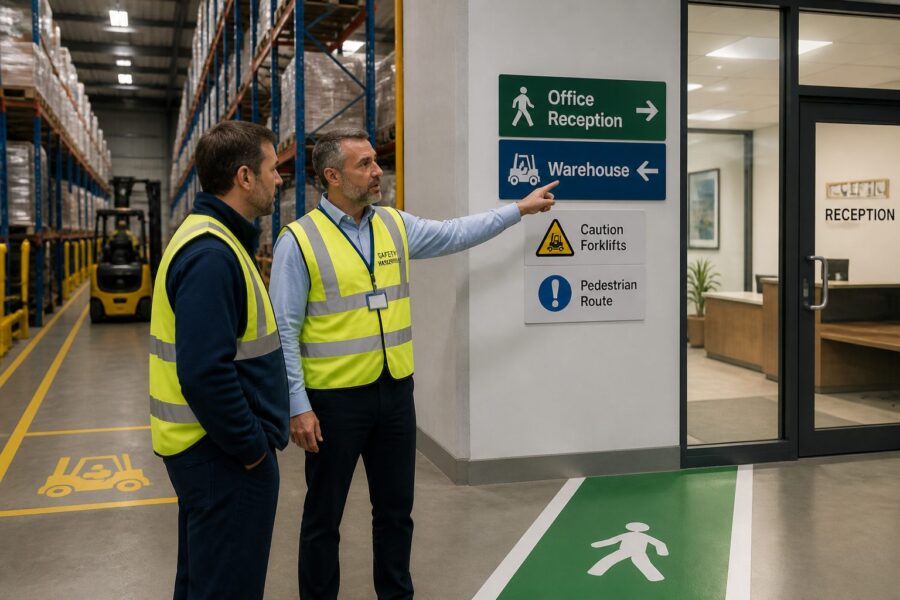
Wayfinding signage for office areas inside warehouses must effectively separate pedestrian traffic from vehicle routes, especially where these paths converge or cross. Distinct visual cues, such as floor markings and overhead signs, guide individuals along safe corridors. This clear separation minimizes the risk of collisions with forklifts or other heavy equipment.
Emergency egress routes and assembly points require highly visible and unambiguous symbols, complying with international safety standards. These signs must be easily understood by everyone, including visitors who may be unfamiliar with the facility layout. Consistent labeling of emergency exits saves precious time during critical incidents.
Furthermore, signs indicating specific hazards, like “Eye Wash Station” or “First Aid,” must be strategically placed and universally recognizable. Integrating these safety messages into the overall wayfinding system reinforces a culture of awareness. This proactive approach helps prevent injuries and ensures rapid response when incidents occur.
The transition points between the high-activity warehouse floor and the more controlled office environment are particularly important for safety signage. Clear warnings about changes in floor surface, noise levels, or required personal protective equipment (PPE) prepare individuals for the altered conditions. Proper wayfinding signage for office areas inside warehouses ensures a smooth and safe transition for all.
Leveraging International Standards for Clarity
Adhering to international standards ensures that wayfinding signage for office areas inside warehouses is universally understood, regardless of language or cultural background. Organizations like the International Organization for Standardization (ISO) provide crucial guidelines for safety symbols, colors, and design principles. These standards promote consistency and reduce ambiguity in critical messaging.
For example, ISO 7010 specifies graphical symbols for safety signs, covering everything from emergency exits to mandatory PPE. Implementing these standardized symbols in your warehouse office areas means that visitors and staff instantly recognize warnings and instructions. This global recognition is invaluable in diverse workforces and for international visitors.
| Standard Body | Relevant Standard | Key Application for Wayfinding |
|---|---|---|
| ISO (International Organization for Standardization) | ISO 7010: Graphical symbols — Safety colours and safety signs | Standardized safety symbols for emergency exits, fire safety, mandatory actions, warnings. Critical for universal understanding in warehouse and office zones. |
| ANSI (American National Standards Institute) | ANSI Z535 Series: Safety Signs and Tags | Guidelines for the design, application, and use of safety signs, including signal words (DANGER, WARNING, CAUTION). Important for U.S. compliance and consistent safety labeling. |
| OSHA (Occupational Safety and Health Administration) | 29 CFR 1910.145: Specifications for Accident Prevention Signs and Tags | U.S. regulatory requirements for specific sign types, colors, and layouts to communicate hazards and instructions. Essential for domestic legal compliance in `warehouse` facilities. |
| EU Directives (e.g., Council Directive 92/58/EEC) | Minimum requirements for the provision of safety and/or health signs at work | Harmonized European standards for safety signs, often aligning with ISO 7010. Important for facilities operating within the European Union, ensuring consistent `safety` `symbols`. |
Designing for Diverse Users: From Forklift Operators to Clients
Effective wayfinding signage for office areas inside warehouses must cater to a broad spectrum of users, each with unique needs and perspectives. A forklift operator navigating a busy aisle requires different visual cues than a client visiting a sales office for the first time. Designing for this diversity ensures clarity for everyone.
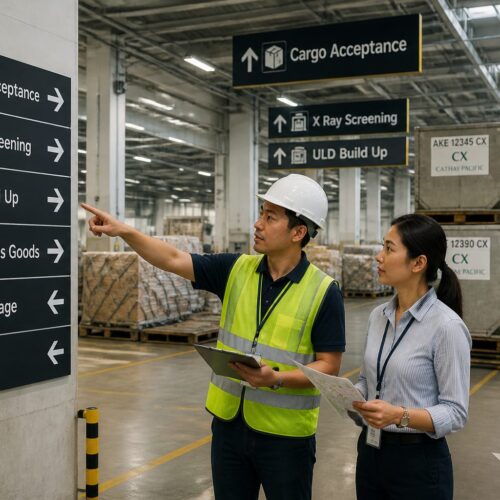
Consider the varying heights at which signs are viewed; a pedestrian sees signs at eye level, while a forklift driver might need overhead signage. Signage in the main warehouse area should be large, bold, and positioned to be seen from a distance, often with minimal text and prominent symbols. This ensures quick comprehension in a dynamic environment.
Conversely, signs within the office areas can be more detailed, offering specific room numbers, departmental names, and perhaps even directory maps. These signs should maintain a professional aesthetic while still aligning with the overall facility’s branding and safety guidelines. The visual language needs to adapt to the context.
Accessibility is another crucial design consideration, especially for visitors with disabilities. Incorporating tactile signs, braille, and high-contrast color schemes ensures that information is available to all users. This commitment to inclusivity reflects modern `standards` for public and commercial spaces.
Finally, language diversity within your workforce or client base might necessitate multi-language signage or universally recognized pictograms. Relying heavily on `ISO` standardized `symbols` can bridge language barriers, making wayfinding intuitive for a global audience. Thoughtful design anticipates these varied requirements.
Strategic Placement: Maximizing Visibility and Impact
The most well-designed wayfinding signage for office areas inside warehouses is useless if it cannot be seen or is placed incorrectly. Strategic placement is paramount to ensuring maximum visibility and impact, guiding individuals effectively through the facility. Every sign’s location should be carefully considered based on traffic flow and sightlines.
Entry points to the facility and transitions between distinct zones (e.g., warehouse to office) are prime locations for clear directional signage. These critical junctures provide initial orientation and reinforce the separation of different functional areas. Visitors need immediate guidance upon arrival.
Overhead signs are particularly effective in large, open warehouse spaces where they can be seen from a distance and above obstructions like shelving or machinery. These signs often point to major sections, such as “Shipping,” “Receiving,” or “Main Office,” using large text and directional arrows. They serve as beacons in expansive areas.
Within office corridors, wall-mounted signs at eye level are appropriate for directing people to specific rooms or departments. These signs should be consistently placed at decision points, such as intersections or before a series of doors. They provide detailed, localized navigation.
Adequate lighting is also non-negotiable for sign visibility, especially in areas with varying light conditions. Backlit signs or those made with reflective materials ensure readability in both bright and dim environments. This attention to detail guarantees that wayfinding signage for office areas inside warehouses remains effective 24/7.
Regularly auditing sign placement helps identify any new obstructions or changes in layout that might compromise visibility. A sign might be perfectly placed one day, but a new stack of pallets could render it invisible the next. Proactive checks maintain the integrity of the entire wayfinding system.
The Power of Symbology and Consistent Labeling
Effective wayfinding signage for office areas inside warehouses heavily relies on a consistent system of `symbols` and `labeling`. Pictograms transcend language barriers, offering instant recognition and understanding, which is crucial in fast-paced or multi-lingual environments. A well-chosen symbol communicates a message far more quickly than text alone.
Adopting `ISO` `standards` for `safety` `symbols` ensures that common messages, such as emergency exits or mandatory protective equipment, are universally interpreted. Consistency in the style, color, and size of these `symbols` across the entire facility reinforces their meaning. This systematic approach reduces cognitive load and improves response times.
- Utilize ISO 7010 compliant safety pictograms
- Maintain consistent font styles and sizes for text
- Standardize color-coding for different zones (e.g., green for safety, red for danger)
- Apply uniform `labeling` conventions for departments and rooms
- Ensure all directional arrows point clearly and unambiguously
- Use high-contrast colors for maximum readability
Material Choices and Durability for Industrial Settings
The harsh conditions typical of a `warehouse` environment demand that wayfinding signage for office areas inside warehouses be constructed from robust and durable materials. Unlike standard office signage, these signs must withstand dust, temperature fluctuations, potential impacts, and industrial cleaning agents. Choosing the right materials ensures longevity and continued effectiveness.
Metals like aluminum or stainless steel are excellent choices for main directional signs due to their strength and resistance to corrosion. These materials can be powder-coated for added protection and to match specific branding or `safety` color schemes. They stand up well to incidental bumps and scrapes.
High-grade plastics, such as PVC or acrylic, offer good durability for indoor office `labeling` and can be easily cleaned. For floor `labeling` or areas prone to heavy traffic, specialized industrial-grade vinyl or epoxy coatings are necessary. These materials resist abrasion from foot traffic and machinery.
Reflective materials are vital for signs in areas with low light or where vehicle headlights might be the primary illumination source. These materials enhance visibility and contribute to overall `safety` during off-hours or in dimly lit sections of the `warehouse`. They ensure signs are seen when they are needed most.
Consider also the mounting hardware for signs; it must be secure enough to prevent accidental dislodgement, which could become a `safety` hazard. Industrial-grade fasteners and robust mounting systems are crucial for maintaining the integrity of your `wayfinding signage for office areas inside warehouses`. This attention to detail extends the lifespan of your investment.
Integrating Digital Solutions with Physical Signage
While physical signs form the backbone of `wayfinding signage for office areas inside warehouses`, integrating digital solutions can significantly enhance their effectiveness and adaptability. Digital displays offer dynamic capabilities that static signs simply cannot match, providing real-time information and flexibility. This blend creates a more responsive navigation system.
Digital screens at key entry points or reception areas can display dynamic maps, current `logistics` updates, or even emergency alerts. These screens can be updated instantly, allowing for rapid communication of changes in `warehouse` layout or operational status. They are particularly useful for guiding visitors to temporary meeting rooms or events.
QR codes placed on physical signs can link users to mobile-friendly maps, detailed directions, or specific `ISO` `standards` documentation. This allows individuals to access more granular information on their personal devices, complementing the general guidance provided by static signage. It offers a deeper level of engagement and information access.
Interactive kiosks can provide personalized directions, helping visitors navigate complex routes to specific office departments or `warehouse` sections. These kiosks can also offer information in multiple languages, further enhancing accessibility and user experience. They empower users to find their own way efficiently.
The integration of digital and physical `wayfinding signage for office areas inside warehouses` creates a layered system that caters to different preferences and situations. Physical signs provide constant, reliable information, while digital elements add flexibility and depth. This combination ensures comprehensive and future-proof navigation.
Regular Audits and Adaptability for Evolving Spaces
A `warehouse` is rarely a static environment; layouts change, departments move, and `logistics` processes evolve, directly impacting the effectiveness of `wayfinding signage for office areas inside warehouses`. Regular audits and a commitment to adaptability are essential to keep your signage system current and accurate. Outdated signs are more than just confusing; they can be a `safety` hazard.
Schedule periodic reviews of all `wayfinding signage` to ensure it still reflects the current layout and operational requirements of both the `warehouse` and office areas. This includes checking for physical damage, fading, or signs that have become obscured by new equipment or inventory. A thorough audit identifies discrepancies before they cause problems.
Establish a clear process for updating `labeling` and directional signs whenever there are changes to office locations, department names, or `warehouse` zones. This proactive approach prevents confusion and maintains the integrity of your navigation system. Quick updates are crucial for maintaining efficiency.
Training staff on the importance of reporting damaged or incorrect `wayfinding signage` empowers everyone to contribute to maintaining a safe and efficient environment. Foster a culture where employees feel responsible for the accuracy of their surroundings. This collective effort ensures continuous improvement.
Maintaining compliance with `ISO` `standards` and local `safety` regulations also requires ongoing vigilance. As `standards` are updated or new regulations are introduced, your `wayfinding signage` system must adapt accordingly. Staying current with these guidelines is a non-negotiable aspect of responsible facility management.
The Business Case for Superior Wayfinding
Investing in superior `wayfinding signage for office areas inside warehouses` offers tangible business benefits that extend far beyond mere convenience. This strategic investment directly contributes to operational efficiency, enhanced `safety`, and a more professional image. The return on investment becomes clear through various improvements.
Firstly, clear `labeling` and directional `symbols` reduce wasted time for both employees and visitors searching for specific locations. This efficiency translates into increased productivity, as staff can focus on their core tasks rather than navigating confusing corridors. Time saved is money earned in a busy `logistics` operation.
Secondly, robust `safety` `standards` embedded in your `wayfinding signage` significantly reduce the risk of accidents and injuries. Preventing even a single incident can save substantial costs associated with medical expenses, lost work time, and potential legal fees. A safe environment is a cost-effective environment.
Thirdly, a well-organized and easy-to-navigate facility leaves a positive impression on clients, suppliers, and prospective employees. It demonstrates professionalism, attention to detail, and a commitment to operational excellence. This positive perception can strengthen business relationships and attract top talent.
Compliance with international `standards` and local regulations regarding `safety` and `logistics` `symbology` also protects your business from fines and legal penalties. Proactive adherence to these guidelines is a smart business practice that avoids costly repercussions. It shows a commitment to responsible operations.
Ultimately, the overall improvement in workflow, `safety`, and reputation makes the case for prioritizing `wayfinding signage for office areas inside warehouses` undeniably strong. It is an investment that pays dividends in multiple areas of your business. This comprehensive approach supports long-term success and sustainability.