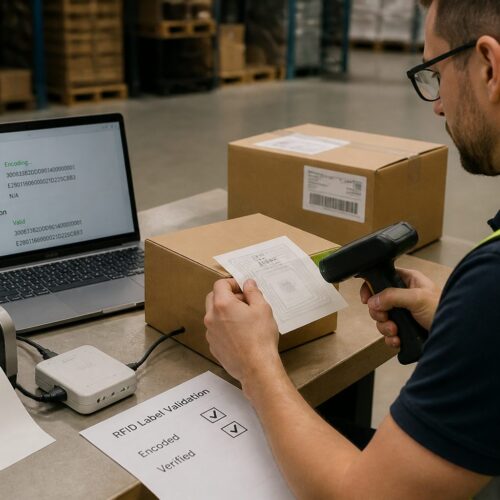


Warehouses run on labels, and the fastest way to break a smooth operation is to ship product with identifiers that nobody else can read. A GS1 logistics label gives trading partners a shared language for what is inside a case or on a pallet.
When people ask for a GS1 logistics label explained, they usually want two things, how to encode the right data and how to print it so scanners do not choke. The details matter because small formatting mistakes can turn into chargebacks, quarantine holds, and rework.
The good news is that GS1 rules are strict in a way that helps you, because the same structure works across retail, grocery, healthcare, and industrial supply. Once you understand how the GS1-128 barcode and application identifiers fit together, label building turns into a repeatable template job.
What a GS1 logistics label is used for
A GS1 logistics label is used to identify a logistics unit while it moves through receiving, putaway, picking, staging, and shipping. The label ties the physical unit to electronic messages like an ASN so teams can verify what arrived without opening shrink wrap.
In practice, the label is the handshake between your WMS and someone else’s WMS. If your partner can scan the SSCC label and match it to the ASN, they can receive faster and argue less about shortages.
The same label supports internal control, because you can track a pallet through cross dock lanes, freezer zones, or a QA hold location. If you ever ran a recall, you know why that matters, because fast isolation depends on clean identifiers.
It also reduces manual keying, which is where most shipping errors start. A clerk typing a 20 digit serial number at 5 p.m. on Friday is a predictable failure point, so scanning wins every time.
It helps carriers and 3PLs too, because a consistent label makes it easier to sort freight and confirm handoffs. Even if the carrier does not parse all fields, a stable SSCC barcode gives them a reference that stays with the load.
For high volume operations, the label is what enables touchless flows like scan-and-go receiving and automated putaway suggestions. When the identifier is trustworthy, the system can make decisions without waiting for someone to inspect the product.
It also supports better cycle counting because logistics units can be counted as units of handling instead of loose inventory. If your WMS supports license plates, the SSCC is often the external version of that same concept.
Another use is dispute resolution, because the SSCC gives both sides a specific unit to talk about instead of a vague pallet description. When a receiver claims damage or shortage, you can trace the exact handling unit through your shipping records.
GS1 logistics labels are also common in returns and reverse logistics, especially when product must be quarantined and evaluated. A scanned identifier lets you connect the returned unit to the original shipment and the associated lot history.
In regulated environments, the label can be part of compliance evidence because it shows the traceability fields that were shipped. Auditors like systems where the physical label and the digital record agree without manual interpretation.
Key parts of the label: human-readable and barcode data
A standard logistics label has two audiences, people and scanners, and you have to satisfy both. Human readable text helps a receiver confirm what they scanned, especially when a label is wrinkled or a forklift tine scraped the edge.
The machine side is the GS1-128 barcode, which is a Code 128 symbol carrying GS1 application identifiers and data. Many teams say EAN-128 out of habit, but the operational goal is the same, a barcode that encodes structured fields in a predictable order.
The most common backbone field is the SSCC, which uniquely identifies one logistics unit, usually a pallet but sometimes a roll cage or tote. If you are doing a GS1 logistics label explained training, start with SSCC discipline because everything else builds on it.
Beyond the barcode, layout rules matter more than people expect, because scanners have limits on quiet zones, bar height, and print contrast. A label that looks fine to a person can fail at the dock door when the scan angle is bad and the lighting is harsh.
Human readable text should mirror the encoded values, not a reformatted version that looks nicer on paper. If you add hyphens, spaces, or internal part numbers, make sure it is clear what is the GS1 value and what is internal decoration.
The barcode data string is not just numbers, it is numbers with meaning because the application identifiers tell the parser what to do. That is why a GS1-128 barcode can carry multiple fields without needing separate symbols for each field.
Most labels also include basic shipment context like ship-from, ship-to, or purchase order in human readable form, even if it is not encoded. That extra context helps when a pallet is separated from its paperwork or staged in the wrong lane.
Receivers often rely on the human readable SSCC when a scan fails, so make it large enough to read from a reasonable distance. If the SSCC is tiny, the fallback becomes reprinting, and reprinting is where duplicate identifiers sneak in.
Good labels also consider where the label will live, such as on corrugate, shrink wrap, or a reusable plastic tote. The same barcode can behave very differently depending on surface texture, glare, and how the label edges lift over time.
If you use multiple barcodes on one label, the visual hierarchy matters so the operator knows which one to scan. A common pattern is one primary GS1-128 barcode and then optional secondary symbols only when a customer explicitly requires them.
Finally, remember that scanners do not read intent, they read contrast and geometry. You can meet every data rule and still fail operationally if the print is too light, the bars are compressed, or the quiet zone is violated by a border line.
Application identifiers you’ll use most often
Application identifiers are the two to four digit prefixes that tell a scanner what each data element means, such as SSCC, GTIN, lot, or expiration date. They let you combine multiple fields in one GS1-128 barcode without guessing where one value ends and the next begins.
Most warehouse labels use a small set of application identifiers over and over, and you should standardize on them instead of improvising by customer. When teams mix formats, they usually end up printing multiple barcodes per label, which wastes space and causes mis-scans.
The SSCC AI (00) is the one that drives logistics workflows because it is meant to be unique per handling unit. If you treat SSCC like a reusable pallet ID, you will break the promise that the number maps to one specific unit at one point in time.
The GTIN AI (01) is the product identity, and it is most useful when the handling unit is a case or an inner pack. On pallets, GTIN becomes optional and sometimes confusing if the pallet is mixed or if the receiver expects contents only from the ASN.
Lot AI (10) is variable length, which is why it trips people up when concatenated with other fields. The lot value is also where companies sneak in internal codes, so you need discipline to keep it stable and traceable across systems.
Expiration AI (17) is fixed length and uses YYMMDD, which makes it easy for systems to parse and validate. The operational impact is big because it drives FEFO picking, quarantine logic, and customer compliance checks.
Best before AI (15) looks similar to expiration, but it is not the same promise about product safety or usability. If you are in food or consumer goods, align with your QA team so the right date is printed and the right date is encoded.
Count AI (37) is helpful when the logistics unit contains a known number of trade items and you want the receiver to confirm quantity quickly. It is not a replacement for the ASN, but it can reduce receiving time on simple, homogeneous loads.
| AI | Meaning | Typical use on logistics labels |
|---|---|---|
| (00) | SSCC | Pallet or logistics unit identifier for receiving and tracking |
| (01) | GTIN | Trade item identifier for the product, often used on cases |
| (10) | Batch or lot | Traceability for food, pharma, and regulated goods |
| (17) | Expiration date (YYMMDD) | Shelf life control, FEFO picking, compliance checks |
| (15) | Best before date (YYMMDD) | Quality date used in grocery and consumer goods |
| (37) | Count of trade items | Number of units inside a logistic unit, often cases per pallet |
There are many other AIs, but the ones above cover most day to day warehouse shipping. If you add more, do it for a real business reason, not because you saw it on someone else’s label.
One practical rule is to keep the barcode payload as short as possible while still meeting partner requirements. Longer strings can still scan, but they are less forgiving when print quality drops or when the scanner is older.
Another practical rule is to confirm which fields your partner actually captures into their system. Some receivers scan only SSCC and ignore everything else, so extra AIs become noise unless they are part of an agreed workflow.
If you are encoding both fixed and variable length AIs, make sure your software handles separators correctly. This is one of those details that nobody notices until a customer says their WMS is importing garbage data.
Also decide whether you will encode leading zeros exactly as specified, because some fields require them and some systems strip them. Consistency matters because the same value may be used later for traceability searches and chargeback disputes.
Building a label for cases vs pallets
Cases and pallets look similar on paper, but the identifier strategy is different because the unit of handling is different. A case label often focuses on the GTIN and production data, while a pallet label leads with the SSCC.
For cases, many shippers encode (01) GTIN plus (10) lot and (17) expiration in a GS1-128 barcode, especially for healthcare and food. That combination lets a receiver scan one symbol and capture the item and traceability fields in one pass.
For pallets, the SSCC label is the anchor because it identifies the logistics unit rather than the product itself. Your ASN then carries the relationship between the SSCC and the contents, which can be mixed SKU or single SKU depending on how you build pallets.
If you ship a homogeneous pallet, you can still include product AIs like (01) and (37), but be careful about what your customer expects. Some receivers want only (00) on the pallet label and they rely on the ASN for everything else, so align on one rule set per customer group.
Case labels tend to be handled more, because they get picked, scanned, and sometimes relabeled during repack. That is why case label durability and placement are just as important as the data you encode.
Pallet labels are more exposed to stretch wrap, condensation, and abrasion from other pallets. A pallet label that survives the trip but fails to scan at receiving is still a failure, because the receiver will stop the line to fix it.
If you build pallets from pre-labeled cases, you still need a pallet identifier that is unique to that pallet. The SSCC is not a summary of the case labels, it is a separate license plate for the handling unit.
Mixed pallets increase the importance of the ASN because the pallet label alone cannot describe every SKU without becoming unreadable. In those scenarios, keep the pallet label simple and let the electronic data carry the detail.
Some operations also use internal pallet IDs or pick labels, but you should avoid printing them in a way that competes with GS1 barcodes. If an operator scans the wrong symbol, you will see inventory moves that make no sense.
If you ship to multiple channels, you may need both a retail-friendly case label and a distribution-friendly pallet label. The key is to keep the GS1 logic consistent so you do not end up maintaining two incompatible data models.
When you are unsure, map the physical flow and decide where scanning actually happens. The right label is the one that supports the scan points that matter, not the one that looks the most complete on a spec sheet.
How to choose the right data set for your trading partner
Customers often publish a routing guide or label spec that tells you exactly which application identifiers to use and where to place them. Treat that document like a contract, because their receiving system may reject a shipment that does not match the expected AI set.
When the spec is vague, push for clarity by asking what their scanners and WMS map from the GS1-128 barcode. If they only map SSCC today, you can still print lot and dates in human readable text, but do not assume their software will capture it.
I prefer a conservative approach for new partners, start with (00) SSCC on pallets and a clean case label with (01) plus the traceability fields that apply. You can always add fields later, but removing fields after someone builds a mapping table is painful.
Be consistent about date AIs, because (15) best before and (17) expiration mean different things operationally. If you swap them, a receiver can quarantine good product or ship expired product, and both outcomes cost real money.
Start the conversation by asking how they receive, because some sites receive by pallet and some receive by case. A partner that breaks pallets immediately may care more about case-level GTIN and lot than a partner that stores full pallets.
Ask whether they require a specific label format like a GS1 Logistic Label layout or a retailer-specific template. Even when the barcode data is correct, a partner may enforce placement rules for automated scan tunnels and conveyor systems.
Confirm whether they want one GS1-128 barcode with multiple AIs or separate barcodes for each field. Many modern systems prefer one barcode, but some legacy systems are hardwired to scan a single AI per symbol.
Also confirm whether they want the SSCC to be the only pallet identifier on the label. If they require their own pallet ID or routing code, keep it clearly separated so it does not get confused with GS1 data.
If you ship internationally, pay attention to regional practices and language expectations in the human readable area. The barcode is universal, but the supporting text can still cause confusion if it uses unfamiliar abbreviations.
When you have multiple ship-from locations, validate that each site uses the same AI set and the same business rules. Trading partners rarely care which plant shipped it, but they care a lot when labels vary by origin.
It helps to do a small pilot shipment and ask the receiving team for feedback on scan rate and data capture. A ten minute call with the dock supervisor can save weeks of back-and-forth with EDI and compliance teams.
Finally, document the agreed data set in your own internal shipping playbook. If the knowledge stays only in email threads, the next system upgrade will quietly undo it.
Label layout templates that work on the dock
A workable template puts the main barcode where a forklift driver can present it to a fixed scanner without twisting the load. If you bury the GS1-128 barcode at the bottom edge, stretch wrap and pallet boards will ruin your scan rates.
Most operations do best with a 4×6 inch label for cases and a 4×6 or 6×4 for pallets, depending on the amount of text required. Bigger is not always better, because oversized labels wrinkle and peel on cold or damp packaging.
Use clear field labels in the human readable area, like SSCC, GTIN, LOT, and EXP, and keep the values aligned. People read columns faster than they read scattered text blocks, especially when they are standing in a trailer with a handheld scanner.
Do not cram multiple barcodes close together unless you have a real need, because scanners can pick the wrong one. If you must print more than one symbol, separate them with white space and label each one in plain text right above it.
Think about orientation, because many dock doors have scanners mounted at a consistent height and angle. A rotated barcode can still scan, but it often requires extra wrist movement that slows down high volume receiving.
Keep the barcode away from heavy borders and decorative boxes, because those lines can invade quiet zones when printers drift. If you want visual structure, use light spacing and alignment instead of thick frames.
Put the SSCC in both barcode and large text, because people will reference it when they call about a problem. If the SSCC is easy to read, your customer service team can resolve issues without asking for photos.
For pallet labels, many shippers apply two identical labels on adjacent sides to improve scan access. That small extra cost often pays for itself by reducing rescans and manual receiving exceptions.
For cases, place the label on the longest flat side and avoid seams, hand holes, or closures. If the label bridges a box flap, it will wrinkle and the barcode will distort.
Do not forget about the real packaging artwork and any existing labels already on the carton. A perfect template can still fail if it competes with a carrier label, a hazmat label, or a marketing sticker placed in the same area.
Finally, test your template with the worst cases, like low contrast brown corrugate, cold shrink wrap, and scuffed totes. If it scans in those conditions, it will usually scan everywhere else.
Printing and scanning considerations in warehouses
Warehouse printing is rough on labels, so choose materials that match the environment, such as freezer grade adhesive for cold chain or synthetic stock for wet areas. Paper labels can work, but only if you control moisture, abrasion, and handling.
Thermal transfer printing with a resin or wax resin ribbon usually produces the most durable GS1-128 barcode, especially when cases slide on conveyors. Direct thermal is fine for short life labels, but heat and friction can fade the bars before the shipment arrives.
Print darkness and speed settings matter, because a barcode that is too dark can bleed and a barcode that is too light can wash out. The right settings are usually a compromise between crisp edges and durable contrast.
Printer maintenance is not glamorous, but dirty printheads and worn rollers are common causes of scan failures. If you see streaks or missing bars, treat it as a maintenance ticket, not an operator mistake.
Scanner performance depends on distance, angle, and symbol size, so design for the way your docks actually work. A barcode meant for close-range handheld scanning may fail when a fixed scanner reads it from a few feet away.
Cold chain adds extra risk because condensation can soften adhesives and cause labels to slide or curl. If you ship from a freezer to an ambient dock, test labels through that temperature transition.
Stretch wrap can create glare and distortion, especially with glossy labels or glossy wrap. If you must label under wrap, choose materials and print settings that keep contrast high and reflections low.
Conveyors and sorters can scuff labels, so the barcode should not be placed where it rubs the belt edge or guide rails. A label that is perfect at pack-out can be unreadable after ten minutes of mechanical handling.
Verification is different from scanning, because a verifier measures quality metrics while a scanner just tries to decode. If you are onboarding a new customer with strict compliance, a verifier report can save you from expensive surprises.
- Print at 203 or 300 dpi based on symbol size and scanner distance
- Keep quiet zones clear of text, lines, and box borders
- Avoid glossy overlaminates that create glare under dock lighting
- Verify bar height meets your customer’s minimum scan spec
- Place labels on flat surfaces, not across seams or corner radiuses
- Run a barcode verifier on each new template and printer setup
Also standardize your label stock and ribbon combinations, because mixing supplies can change print density and edge sharpness. If one shift uses a different ribbon, you can end up with inconsistent scan rates and no obvious root cause.
Train operators to spot early warning signs like smudging, banding, and peeling corners. A two minute pause to fix a printer is cheaper than a truckload of noncompliant labels.
If you print in multiple facilities, align on printer models and settings where possible. The same template can behave differently on different hardware, so consistency reduces troubleshooting.
Finally, keep a few sample labels from each production day for quick investigation when a customer complains. Physical samples help you determine whether the issue was data, print quality, placement, or damage in transit.
Governance: keeping number ranges and templates controlled
Label quality falls apart when everyone can generate an SSCC from a spreadsheet and print it from a desktop printer. You need a controlled SSCC label process so serial ranges do not collide across plants, shifts, or contract packers.
Start by assigning ownership for the GS1 Company Prefix and for the serial reference allocation rules. If you run multiple ERPs or multiple WMS instances, centralize SSCC generation in one service or one master system, then distribute the numbers.
Template governance matters too, because a small font change or a moved barcode can break a trading partner’s scan tunnel. Lock templates in version control, document the change reason, and require a test print and scan before release.
Audit your data mappings at least quarterly, especially if you onboard new customers or change packaging. When a partner says “your barcode scans but the data is wrong,” the root cause is usually an AI formatted wrong or a field length that got truncated.
Governance also includes who can request a new label format and how that request gets approved. If sales can promise a custom label overnight, operations will end up supporting dozens of one-off templates.
Define a single source of truth for product master data like GTIN, lot rules, and date rules. If the label pulls from a different database than the ASN, you will eventually ship a mismatch and spend days reconciling it.
Number range control should include what happens during downtime, because people will invent workarounds under pressure. If the SSCC service is unavailable, have a documented fallback that still prevents duplicates.
Contract manufacturers and co-packers need special attention because they may ship under your prefix but operate their own systems. Give them clear rules, provide approved templates, and require periodic compliance checks.
It also helps to maintain a label specification sheet internally that lists each field, its source system, and its validation rule. When something breaks, that document turns troubleshooting into a checklist instead of a guessing game.
Governance should include security, because identifiers can be abused if anyone can print them. If you treat label printing like a controlled process, you reduce the risk of counterfeit labels and inventory manipulation.
Finally, keep governance practical, because overly rigid processes encourage shadow IT. The goal is to make the right way the easy way, with tools that generate correct SSCCs and correct barcodes by default.
Common mistakes when a GS1 logistics label goes live
The most common failure is mixing up human readable text with what is actually encoded in the GS1-128 barcode. A receiver scans the barcode, sees a different lot printed above it, and now you have a dispute that takes days to unwind.
Another frequent problem is forgetting that some AIs have fixed length and others have variable length, which affects parsing. If you concatenate variable length fields without the correct separator logic, a downstream system can swallow two fields into one.
People also reuse an SSCC by accident, usually when a pallet gets reworked and someone reprints the old label. Treat SSCC reuse like a serious defect, because it can cause a receiver to close the wrong ASN line and lose track of inventory.
Finally, do not ignore placement rules, because a perfect data string still fails if the label sits under stretch wrap folds or on a curved drum. If scan rates drop below expectations, walk the dock with the same scanner model your customer uses and test in real conditions.
A common go-live mistake is testing only with one scanner in an office setting instead of on the dock. Real docks have glare, vibration, cold air, and rushed operators, so lab success does not guarantee dock success.
Another mistake is using the right AIs but the wrong underlying values, like a consumer unit GTIN when the customer expects a case GTIN. The barcode will scan perfectly and still fail receiving because the item does not match their master data.
Teams also forget to validate check digits and length rules when they build SSCC logic in-house. One bad check digit can create a label that looks legitimate but cannot be reconciled in partner systems.
Some go-lives fail because the ASN timing is wrong, not because the label is wrong. If the pallet arrives before the ASN is available, the receiver cannot match the SSCC and they may park the load in an exception area.
In mixed environments, operators sometimes apply the right label to the wrong pallet, especially when multiple orders are staged close together. Simple controls like scan-to-verify at stretch wrap can prevent that class of error.
Another issue is printing at the wrong scale due to driver settings, which quietly shrinks barcodes and reduces bar width. A label that is 98% scale can look normal but fail verification and long-range scanning.
People also underestimate the impact of damaged corners and edge wear, especially on pallets that rub against trailer walls. If your barcode sits too close to the edge, normal transit damage can remove key bars.
Finally, do not treat customer feedback as noise, because they are seeing the label in the exact conditions that matter. If they say scan rates are low, assume the problem is real and validate with verification data and dock testing.
Conclusion
A clean GS1 logistics label explained in plain terms comes down to three habits, pick the right application identifiers, encode them correctly in a GS1-128 barcode, and print them where scanners can read them. When you do that, the SSCC label becomes a reliable key that links physical handling units to digital shipping data.
If you control number ranges, lock down templates, and verify prints before you ship, label compliance stops being a fire drill. You also earn trust with receivers, because they can scan once, reconcile quickly, and move freight without manual workarounds.
The payoff is not just fewer chargebacks, it is smoother throughput and better inventory accuracy across the network. When identifiers are consistent, every downstream process gets faster, from receiving to claims to recalls.
Once your team has a stable template and a stable data set, treat it like infrastructure and keep it boring. Boring labels are good labels, because nobody has to think about them when the dock is busy.