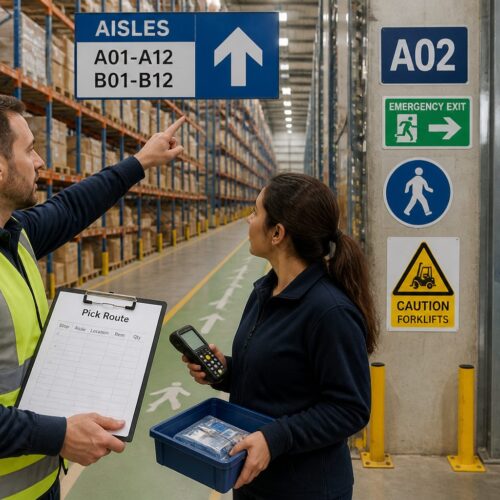


Warehouse teams waste a shocking amount of time arguing about where something “should” be, and most of that drama starts with sloppy aisle naming. A clean aisle numbering system for warehouses turns those arguments into quick, boring answers.
If you have ever watched a new picker stare at a rack sign like it is a math problem, you already know the cost of unclear location labeling. The goal is simple, make every storage spot easy to say out loud, easy to print, and hard to misread.
I prefer schemes you can maintain when you are tired, short staffed, and expanding into the next unit. If your rack identification and bin numbering depend on one “system expert,” the system is already broken.
This article focuses on practical patterns that work with forklifts, scanners, WMS screens, and paper pick tickets. You can keep ISO style safety and logistics symbology consistent while still using plain English codes that operators trust.
What a good aisle numbering system needs to do
A good aisle numbering system for warehouses answers one question fast, “Where am I, and what is the next location?” If the code does not support that in two seconds, the code is too clever.
Your scheme must stay readable from a moving lift and from the floor at the pick face. That means short codes, consistent direction rules, and signs placed where people actually look.
It also needs to work in your software, because a WMS search field hates ambiguity. If “Aisle 1” and “Aisle 01” both exist, you will eventually ship the wrong SKU to the wrong customer.
Finally, the system has to survive change without a weekend relabeling marathon. The best location labeling leaves room for growth and makes exceptions obvious instead of invisible.
The first test is whether two people can independently walk to the same slot using only the code on the pick ticket. If they land in different places, your code is describing the building poorly.
The second test is whether someone can stand at the end of an aisle and predict the next three labels they will see. Predictability is what makes scanning fast and mistakes rare.
A good system also supports quick problem solving when something is missing. When the numbering is logical, a lead can say “check the next bay up” and everyone knows what that means.
It should reduce radio chatter, not increase it. If pickers constantly ask “which side is left” or “does this aisle restart,” the system is demanding too much memory.
Think about how the code behaves when printed small on a carton label or displayed on a handheld screen. A location that wraps to a second line or gets truncated is a location that will be mistyped.
It also needs to be robust against common human errors like swapped digits and skipped separators. Fixed width fields and consistent separators make those errors easier to spot before a pallet is moved.
Another requirement is that the system supports cycle counting and auditing without special translation. If your counter cannot tell where to start and what “next” means, counts will be slow and inaccurate.
Aisle numbering should also support maintenance and safety work, because those teams navigate too. When a contractor can find “Aisle 12, Bay 20” without an escort, you save time and reduce risk.
Finally, a good scheme makes the building feel smaller. When people can orient themselves quickly, they move with confidence and spend more time picking than wandering.
Choosing a structure: sequential, grid-based, or zone-based
Sequential aisle numbers are the easiest to start, because you label aisles 01 through 40 and call it a day. They work well in narrow aisle pallet racking where travel is basically a straight run up and down.
Grid-based structures fit buildings with cross aisles and multiple blocks of racking, because the code can tell you both row and column. If you have ever used a parking garage layout, you already understand why a grid reduces wrong turns.
Zone-based structures shine when the building has mixed storage types, like pallet rack, shelving, mezzanine, and bulk floor. A zone letter up front tells the operator what equipment and safety rules apply before they even start moving.
The choice is less about theory and more about your building’s shape and your order profile. If 80 percent of picks come from one fast pick zone, zone-based numbering keeps the rest of the warehouse from polluting your most used codes.
Sequential numbering breaks down when the building has multiple entry points or when aisles do not run parallel. If two aisles are physically adjacent but numerically far apart, people will second guess the sign.
Grid-based systems are great for navigation, but they require discipline in how you define the origin and axes. If you cannot point to a clear “row 1, column 1” corner, the grid becomes a debate.
Zone-based systems can become too abstract if you create a new zone for every small exception. If you have twelve zones but only two are used daily, you have created complexity without value.
I like to choose a structure based on the most frequent task, not the most interesting corner case. Your fastest moving SKUs deserve the simplest navigation, because that is where errors multiply.
Also consider whether your warehouse has multiple floors or mezzanine levels that behave like separate buildings. In that case, zones can keep you from mixing ground level and mezzanine aisle numbers in the same sequence.
Another factor is whether you run batch picking, pick-to-cart, or forklift pallet picking. A picker walking with a cart needs different wayfinding support than a lift operator who can see the top of the racks.
Cross docks and flow-through buildings often benefit from numbering that mirrors the inbound-to-outbound flow. When the numbers increase toward shipping, it becomes easier to stage and consolidate without thinking.
Seasonal overflow is another clue, because it introduces temporary zones that still need to be found quickly. If you know you rent extra space every peak season, plan a zone for it now instead of improvising later.
Whatever structure you pick, document the logic in one page and keep it boring. If the explanation takes ten minutes, the system will be taught wrong by the second week.
Rack, bay, level, and position: building a clear location code
Once aisles make sense, you still need a location code that points to a single spot on a single rack. A useful pattern is Zone-Aisle-Rack-Bay-Level-Position, and you can drop parts you do not need.
Keep the meaning fixed, so “03-12-04” never flips between bay and level depending on the area. Consistency matters more than elegance, because humans remember rules and forget exceptions.
Start by deciding what the smallest addressable unit is in your operation. If you pick full pallets, you may not need a position letter, but you still need a bay and a level that are unambiguous.
Define what “rack” means in your building, because some sites call each run a rack and others call each upright frame a rack. Pick one definition and make sure engineering, operations, and the WMS all use the same word.
Bay numbering should follow the physical uprights, not the beams, because uprights are what stay fixed when you reconfigure. If you count bays by beam pairs and later change the beam layout, you will create phantom addresses.
Level numbering should be based on the usable storage levels, not the number of beam sets installed. If you have a floor position plus three beam levels, decide whether the floor is Level 01 or Level 00 and never drift from it.
Position letters work best when they are tied to a clear travel direction rule. If a picker can face the same way every time they read “L” and “R,” the position letter becomes a shortcut instead of a puzzle.
If you have double-deep or pushback racking, add depth as a separate field instead of hiding it in bay numbers. A simple “D1, D2” or “F, B” prevents the classic mistake of placing a pallet in the wrong lane.
For carton flow or pick modules, consider adding a sub-position for lane or shelf if the WMS requires it. The trick is to keep the core code readable while allowing the software to be precise.
Try to avoid characters that look alike on worn labels, like O and 0, I and 1, or S and 5. If you must use letters, choose a limited alphabet and keep it consistent across zones.
Fixed width fields are your friend because they make the code visually scannable. When every aisle is two digits and every level is two digits, the eye can catch a missing digit instantly.
Separators like dashes can improve readability, but too many separators can make labels long and cluttered. Pick one separator style and use it everywhere, including on maps and training materials.
Also think about how the code sorts in spreadsheets and WMS screens. If you use fixed width numbers, locations sort in the same order humans expect, which makes audits and slotting work less painful.
| Element | Example | Rule that prevents mistakes |
|---|---|---|
| Zone | FP | Use 1 to 3 letters tied to storage type |
| Aisle | 07 | Two digits, fixed width, no “7” vs “07” |
| Bay | 14 | Count from a defined start end, always |
| Level | 03 | Bottom is 01, never “G” or “0” |
| Position | L | Left or Right, based on travel direction rule |
When you publish the code format, include one example that shows a complete location and one that shows a simplified location for areas that do not need every field. People copy examples more than they read rules.
Do a quick “radio test” by having a supervisor read ten locations to a picker over a headset. If the picker asks for repeats, you need clearer separators, fewer characters, or a better phonetic habit.
Finally, make sure the physical layout matches the code assumptions, especially at aisle breaks and cross aisles. If bay numbers restart after a cross aisle but the code does not show that, you will create duplicate addresses in real life.
Sign and label formats you can read at a glance
Big fonts beat fancy materials every time, because nobody reads a tiny label at 12 mph on a reach truck. Use high contrast, like black on yellow or black on white, and avoid color combos that disappear under sodium lights.
Pick a fixed format and stick to it, such as “A07-B14-L03-R.” When you keep separators consistent, operators spot a wrong digit faster and scanners struggle less with OCR or manual entry.
Put aisle signs at both ends and at decision points, not just at the “main” end that managers walk through. If you have cross aisles, hang repeaters so a picker can confirm they are still in Aisle 07 halfway down.
For bin numbering on shelving, label the shelf upright and the bin face, because bins migrate. If you rely on a removable tote label alone, the physical bin and the system bin will drift apart over time.
Aisle markers should be visible above the highest obstruction you regularly stage in the aisle, including pallets on the floor. If your staging blocks the sign, the sign is decorative, not functional.
Use a consistent hierarchy in your signage, where aisle numbers are the largest, bay ranges are medium, and detailed bin labels are smaller. That hierarchy matches how people navigate, first finding the aisle, then the bay, then the exact slot.
Consider reflective materials or good lighting in dark corners, because shadows can turn a 3 into an 8. If you cannot read the label from the normal approach angle, the label will be guessed instead of read.
Barcodes should be placed where scanners can reach without unsafe stretching or climbing. A perfect barcode in the wrong place still results in manual keying, and manual keying is where errors breed.
If you use both human-readable text and barcodes, make sure they encode the same string. Mismatched barcode data is a quiet disaster because it looks fine until inventory starts drifting.
Standardize label sizes by application, like one size for rack beams, one for uprights, and one for shelf bins. When label sizes are predictable, maintenance teams can print replacements without measuring every time.
Do not rely on color alone to distinguish zones or levels, because color fades and not everyone sees color the same way. Use color as a secondary cue behind clear text and consistent code structure.
Keep your fonts simple and avoid condensed styles that blur at distance. The goal is legibility under motion and dust, not design awards.
Labels also need to survive the real warehouse environment, including impacts, moisture, and cleaning. If your labels peel, the location system slowly dissolves into handwritten tape.
When you install new signs, walk the pick path and verify visibility from the exact approach direction. A sign that looks perfect from the aisle center can disappear when you approach from a cross aisle.
Finally, treat sign placement like part of the process, not a one-time project. If you change rack layout, update signs immediately, because old signs are worse than no signs.
Handling expansions, re-slotting, and temporary storage
Expansions punish numbering systems that have no gaps, because you end up with “Aisle 7A” and “Aisle 7B” taped onto a sign. Leave numeric space, like numbering aisles by twos, so you can insert Aisle 08 later without drama.
Re-slotting is easier when your rack identification is location based, not product based. The location code should stay put while SKUs move, otherwise your historical data and cycle count routines get messy fast.
Temporary storage needs an honest label, because “just put it over there” becomes permanent inventory. Create a dedicated TEMP zone with short, obvious bin numbering, and require a scan into TEMP before anything sits.
If you use floor staging lanes, treat them like real locations with start and end markers. A taped rectangle without a code is an invitation for pallets to stack up until nobody can find the oldest one.
When you plan for expansion, decide whether new space will extend existing aisles or create a new block with its own numbering. Extending is simpler for training, but a new block can reduce travel confusion if the building has a hard break.
Leave room in your zone codes too, especially if you know you will add a mezzanine, freezer, or hazmat cage later. If you burn all your obvious zone letters early, you will be stuck with awkward codes that nobody remembers.
Re-slotting projects often fail because teams change the physical location but forget to update labels and the WMS in the same day. Treat label updates as part of the move, not as cleanup work for later.
If you run wave picking, re-slotting can also change the most common travel paths overnight. After a big re-slot, verify that aisle numbering still supports the new routes instead of fighting them.
Temporary storage should have rules for time limits and ownership, not just location codes. If TEMP is where problems go to hide, it will become a second warehouse with no discipline.
For returns, quarantine, and quality hold, create separate zones that are physically distinct and clearly labeled. Mixing those pallets into normal aisles creates inventory accuracy issues and compliance risk.
If you use drop zones for replenishment, label them as well, even if they are not long-term storage. A labeled drop zone makes it easier to audit replenishment work and prevents pallets from being abandoned.
When you add new racks, keep the same bay and level conventions, even if the rack vendor uses different numbering on their drawings. Vendor drawings are not your operational truth, so translate them into your system once and move on.
Have a simple process for creating new locations in the WMS, printing labels, and installing them in the field. If location creation requires three departments and a week of email, people will invent unofficial locations instead.
Finally, run a post-expansion audit where someone walks the new area and checks that every physical label exists in the system and vice versa. That one walk prevents months of slow inventory drift.
Aligning numbering with picking routes and traffic flow
The cleanest aisle numbering system for warehouses matches how people move, not how the CAD drawing looks. If your primary pick path runs clockwise, your aisle numbers should increase in that same direction.
Decide a travel direction rule, like “odd aisles pick northbound, even aisles pick southbound,” and print it on training cards. That one rule reduces left right confusion when you add position letters like L and R.
Cross aisles deserve their own naming, because they are navigation tools, not storage. I like “X1, X2, X3” for cross aisles, and I treat them like street intersections when I design sign placement.
Traffic safety improves when your numbering supports one way patterns and keeps forklifts out of pedestrian pick modules. Pair location labeling with floor arrows and standard safety pictograms so the route is obvious even to a visitor.
Picking routes should minimize backtracking, and your numbering should make that route feel natural. When numbers jump around, people assume they missed something and they turn around unnecessarily.
If you use pick paths in the WMS, align the path sequence with the aisle numbering sequence. When the WMS tells someone to go from Aisle 02 to Aisle 19 and back to Aisle 03, the numbering is not the only problem.
Define where aisle numbering starts based on where people enter the storage area, not where the building blueprint starts. The “zero point” should be a physical landmark like receiving doors, shipping doors, or the main pedestrian entrance.
For mixed equipment environments, consider separate pick paths for walkers and lift operators. A numbering system can support both, but only if you avoid creating ambiguous left-right definitions across different approaches.
High velocity areas benefit from simpler codes and more frequent confirmation signage. If your fastest pick aisle has the smallest signs, you have prioritized the wrong place.
One-way aisles are easier to enforce when the numbering tells you the intended direction. If bay numbers increase in the direction of travel, people can tell they are going the wrong way without reading a safety poster.
Pedestrian crossings and forklift intersections should have extra wayfinding cues, because that is where attention is split. A quick glance at an aisle marker should confirm location without stopping in a traffic lane.
If you have staging near shipping, label those lanes so loaders can call out exactly where a pallet sits. “Near door 6” is not a location, it is a guess with a deadline.
Also consider how replenishment moves happen, because replenishment traffic often conflicts with picking. If replenishment uses the same aisles, make sure location codes do not encourage meet-and-pass situations in narrow aisles.
Finally, walk the building during peak hours and see where people hesitate. Hesitation points are usually signage and numbering failures, not worker failures.
Training tips to help new hires learn the system fast
Most new hires do not struggle with scanning, they struggle with reading the building. Give them a simple map that shows zones, aisle numbers, and the “zero point” where counting starts.
Teach the code out loud, because spoken practice catches weird phrasing early. If people keep saying “A seven” when the label is “A07,” you will eventually hear “A seventeen” over a radio and regret it.
Start training with orientation, not speed, and let them walk the main routes without a pick assignment. Ten quiet minutes learning the layout saves hours of confused wandering later.
Explain the logic behind the numbering, because logic is easier to remember than memorized facts. When they understand why bays increase from the receiving end, they can self-correct when they feel lost.
Use a short set of practice picks that intentionally hit different zones and levels. A new hire who only picks one aisle for two days will look fast until the first time you move them.
Pair them with a trainer who follows the rules strictly, because bad habits spread fast. If the trainer says “it is basically over there,” the trainee learns that the system is optional.
Make sure they know where to find the rules when they forget, like a laminated card on the cart or a poster at the scanner station. A system that depends on memory is a system that will fail on night shift.
Teach them what to do when the label is missing or damaged, because that will happen. If the process is to report it and move on, you keep the system clean instead of building a culture of guessing.
Include common error examples, like swapped bay digits or picking the right bay on the wrong side. When people know the typical traps, they slow down for the two seconds that matter.
Have them practice confirming the location by reading the full code, not just the aisle number. Many mis-picks happen because someone stops at the right aisle and then grabs from the first open slot.
Finally, reinforce that location accuracy is part of safety, not just inventory. When people rush and park in the wrong spot, they create traffic conflicts and blocked exits along with wrong picks.
- Start point for aisle counting, marked on the floor
- Two digit aisle rule, always 01, 02, 03
- Bay numbering direction, posted at aisle end
- Level numbering rule, bottom shelf is 01
- Left and right definition, tied to travel direction
- TEMP zone procedure, scan in and scan out
Review these rules in the first week and again after a month, because confidence can hide misunderstandings. A quick refresher prevents small mistakes from becoming personal “workarounds.”
If you use multiple shifts, align training language across trainers so the same code is described the same way. Nothing confuses a new hire faster than two supervisors using different terms for the same thing.
Consider adding a short quiz that uses photos of real rack signs and asks for the spoken location. If they can read a sign in a photo, they can read it on the floor.
Celebrate correct behavior, like reporting a missing label, because that is how the system stays healthy. When people feel punished for slowing down to be accurate, they will stop being accurate.
Conclusion
A maintainable aisle numbering system for warehouses is plain, consistent, and built for change. When location labeling, rack identification, and bin numbering follow the same logic, the building becomes easy to learn and hard to misuse.
If you are redesigning, start with how people travel and where errors happen, then back into the code structure. Spend the money on big readable signs and disciplined rules, because relabeling a live warehouse costs more than you think.
Write the rules down, post them at the workstations, and keep one owner accountable for updates. When the next expansion comes, you will add locations with confidence instead of inventing “temporary” labels that never go away.
The best systems feel boring because they remove the need for interpretation. When everyone can predict the next label, the warehouse runs on process instead of tribal knowledge.
Do not aim for perfection on day one, but do aim for consistency that you can defend. A simple standard applied everywhere beats a clever standard applied only in half the building.
Once your numbering is stable, use it as a foundation for slotting, replenishment, and cycle count discipline. Clean locations make clean data, and clean data makes every improvement project easier.