

Food packaging date code labeling is one of those details that everyone notices only when it fails. If a receiver has to squint, guess, or call the plant, your whole shipping day slows down.
I have seen perfectly good product get quarantined because two people read the same code two different ways. Clear date codes keep product moving, and they keep your brand out of expensive arguments later.
Date marks also tie directly into international safety expectations, even when the rules differ by country and customer. If you export, your label has to work for a warehouse team that may not share your local date habits.
Production teams often focus on print speed and ink cost, but the real cost is misreads in the field. A good format makes the code obvious at a glance and easy for scanners and cameras to capture.
When codes are inconsistent, every downstream team creates its own workaround, and those workarounds become new failure points. The goal is not just compliance, but a label that works when the dock is loud, cold, and rushed.
Even small mistakes like a missing dash or a faint character can turn into a hold, a rework, or a customer complaint. If you want smoother shipping days, date code clarity is one of the highest return fixes you can make.
Why date codes matter for inventory and rotation
Warehouse rotation lives and dies by what the picker can read in two seconds on a pallet. If the code is unclear, FIFO turns into “grab whatever is closest,” and that is how short dated product ends up on the next truck.
Most WMS rules assume the date field is reliable, because the system cannot correct a bad print. When food packaging date code labeling is consistent, receiving can verify product age without opening cases or hunting for paperwork.
Returns are another quiet drain that date codes can reduce. If a customer claims a shipment arrived “too close to expiry,” a readable code lets you confirm what left your dock and what sat on theirs.
Rotation also affects food safety risk, because older lots sit longer in warm zones like staging areas and trailers. Clean, predictable codes help teams enforce hold times, cooler limits, and recall checks without playing detective.
In many warehouses, the person receiving is not the person shipping, so the code has to communicate without context. A clear date lets the receiver assign the right location and prevents the pallet from getting buried behind newer inventory.
Mixed pallets make the problem worse, because a single short dated case can force the whole pallet into a different pick path. When codes are readable, teams can quickly sort exceptions instead of rejecting the whole load.
Rotation rules also change by channel, because foodservice, retail, and e-commerce often have different minimum shelf life requirements. If your date is easy to read, your sales team can allocate inventory confidently instead of guessing what will pass.
Some customers measure shelf life at receipt, while others measure at delivery to their store or kitchen. A consistent code makes those calculations straightforward and keeps your customer service team out of back-and-forth calls.
Inventory counts are cleaner when dates are legible, because cycle counters can verify age without breaking down pallets. That saves labor and reduces damage, especially in frozen and refrigerated environments where handling time matters.
If you ever need to prioritize a shipment due to a cooler issue or a delayed truck, the date code becomes your triage tool. A readable date lets you make fast decisions that protect both quality and margin.
Common date code types: pack date, best by, and use by
Pack or production dates tell you when the product was made, and they are gold for internal controls. Plants use them to connect a case back to shift logs, ingredient lots, and sanitation records.
Best by dates are usually about quality, like texture changes in crackers or flavor fade in roasted nuts. Many retailers still treat a best by date format like a hard stop, so sloppy printing can trigger chargebacks fast.
Use by dates are closer to a safety boundary and tend to get stricter handling in distribution. If you ship refrigerated deli items, a clear use by mark helps receivers decide whether the pallet goes to the front or gets rejected.
Some products carry both a pack date and a best by date, and that can confuse people if the label does not explain which is which. If you print two dates, label them plainly with words, not just abbreviations that vary by region.
A pack date is especially useful when shelf life depends on storage conditions, because it gives QA a starting point even if the best by date is missing or damaged. It also helps when you change formulations and need to compare performance across runs.
Best by is often chosen for shelf-stable products where the main concern is quality drift rather than pathogen growth. Even then, customers may reject product that is technically fine if the date looks wrong or confusing.
Use by language tends to bring more scrutiny because it signals higher risk, and it often triggers stricter receiving rules. That makes print quality and placement even more critical for chilled and ready-to-eat categories.
Some brands add a “freeze by” or “sell by” date, which can be helpful but can also clutter the panel. If you add extra dates, make sure the primary date for the channel is the most prominent and the easiest to interpret.
Retailers and distributors may also require a minimum number of days remaining at receipt, which is why the exact interpretation of the date matters. If your label leaves room for doubt, the receiver will protect themselves by rejecting it.
When you sell the same SKU into multiple channels, the safest approach is to standardize the internal pack date and keep the consumer-facing date clear and explicit. That way you can trace product precisely even if the external requirement changes.
Choosing a date format that reduces misreads
The fastest way to cause errors is mixing formats across SKUs, plants, or customers. Pick one best by date format that works globally, then lock it into your label spec and your printer templates.
I prefer YYYY-MM-DD for logistics because it sorts correctly, it is hard to misread, and it plays well with databases. If marketing insists on a consumer facing format like “Best by Jan 5 2027,” keep the logistics code separate and machine friendly.
Ambiguity usually shows up in the day and month positions, which is why numeric-only formats are risky outside a single region. If you must use numbers, add a four-digit year and separators that make the structure obvious.
Month names reduce confusion, but only if you standardize the language and the abbreviations. A warehouse in another country may not recognize a local abbreviation, so keep it to a consistent three-letter English month set if you go that route.
Two-digit years are another trap because they look fine until a system or a person interprets them incorrectly. If you are building templates today, printing a four-digit year is a small change that prevents a lot of future cleanup.
Julian formats can be efficient on small packs, but they require training and they invite transcription errors. If you use Julian day codes, consider printing a plain-language date elsewhere on the case for receiving teams.
Consistency also means consistent leading zeros, because 2026-1-5 and 2026-01-05 do not look the same to people or to some systems. Decide on one style and enforce it so that scanning and manual entry match.
Think about how the date will be spoken over the phone during a dispute, because that is when confusion spikes. A format that is easy to read aloud and hard to invert saves time when customer service is under pressure.
If your product has multiple packaging levels, align the format across unit, case, and pallet labels. When the case uses one format and the pallet tag uses another, you invite mismatches in receiving and putaway.
Finally, make sure your chosen format fits the print area with a comfortable font size. A perfect format that forces tiny characters is still a failure in the field.
| Date format | Example printed | Misread risk and notes |
|---|---|---|
| YYYY-MM-DD | 2026-11-03 | Low risk, sorts well, common in systems and exports |
| DD-MMM-YYYY | 03-NOV-2026 | Low to medium risk, clear month, needs consistent three letter month set |
| MM/DD/YY | 11/03/26 | High risk, US only habit, ambiguous outside the US |
| DD/MM/YY | 03/11/26 | High risk, conflicts with MM/DD/YY, easy to swap day and month |
| Julian day with year | 26 307 | Medium risk, compact for small packs, training required for warehouses |
Why date codes matter for international shipments and audits
Export shipments expose every weakness in your coding habits, because the receiver may not share your assumptions. A code like 04/07/26 can mean two different dates, and both sides will swear they are right.
Auditors also read labels, and they notice when the same product has three coding styles across three production lines. Consistent food packaging date code labeling makes your documentation match what is on the case, which is what auditors want to see.
If you ship to co-packers or use third party warehouses, your code becomes the shared language across companies. When that language is clear, disputes about shelf life allocation, temperature abuse, or stock rotation get resolved with evidence instead of emails.
Some customers require specific fields in EDI, and your printed code should match those fields exactly. If your ASN says 2026-11-03 but the case says 11/03/26, you have created a problem for the receiver that you will pay for later.
International shipments also spend more time in transit, which makes shelf life math more sensitive. If the receiver cannot quickly confirm the date on arrival, your product may sit on hold while someone asks for clarification.
Customs inspections and border holds can expose product to temperature swings, and that increases the need for tight traceability. When codes are clear, you can identify exactly which pallets were delayed and decide what to do without guessing.
Different markets also have different expectations for language around dates, and some prefer explicit words like “EXP” or “Best before.” Even when the regulation is not strict, the customer expectation can be, and that is what drives acceptance.
Audits often include trace exercises, and the auditor will ask you to locate product by lot and date quickly. If your printed codes are inconsistent or hard to read, the trace takes longer and makes your controls look weaker than they are.
Many certification schemes also expect that labels are legible through the product’s intended life, including cold chain handling. If your ink fades in condensation, you may pass the paperwork review but fail the practical check.
When you sell through distributors, your label has to survive relabeling, repacking, and pallet rebuilds. A robust date code gives you continuity even when the product changes hands multiple times.
International partners also tend to rely more on photos for claims, and a clear code photographs well. If the code is faint or placed on a reflective area, you lose one of the easiest ways to resolve disputes quickly.
Where to print date codes for easy finding and scanning
Print location matters as much as the format, because workers do not rotate cases to hunt for a tiny stamp. Put the date code on the same panel on every case size, and put it near other logistics marks like the GTIN and case count.
Avoid printing across seams, folds, or heavy corrugate texture, because that is where characters break and scanners fail. If you use shrink film, print on a flat, tensioned area where the film will not wrinkle after cooling.
For pallets, think about how the load is oriented in racks and on a dock. If the code faces inward or ends up under stretch wrap bands, your team will cut wrap, rewrap, and lose time on every exception.
Camera based readers like consistent contrast and consistent placement, so do not move the code around to “fit” artwork changes. Treat the code zone like a reserved parking spot, because it keeps the whole operation predictable.
On cases, a side panel is usually easier than the top because pallets are stacked tight and top panels get covered. If you want fast verification, put the code where a person can see it while walking by.
On retail units, the bottom seal is a popular spot, but it can be hard to read once the product is on a shelf. If you use the bottom, consider a secondary location for multipacks or display-ready trays.
Do not print on areas that get scuffed during case erection, because friction will remove ink before the product even leaves the plant. The best print zone is protected from both glue squeeze-out and mechanical contact points.
If you use preprinted cases, coordinate the blank coding area with the box supplier so the zone stays clean across artwork revisions. A small shift in graphics can accidentally push the code onto a dark color or a busy pattern.
For film packaging, avoid highly reflective spots that create glare under warehouse lighting. A code that looks fine to the operator can become unreadable in a phone photo or a fixed camera scan.
Placement also affects ergonomics, because receivers often scan while holding a case at waist height. If the code is in a consistent waist-level zone, you reduce awkward handling and speed up throughput.
If you run multiple lines, align the print location across equipment so that mixed pallets still have predictable code placement. That consistency matters when a customer uses automated vision systems to verify dates at speed.
Lot codes and batch IDs: building simple traceability into labels
A lot code is the backbone of recall execution, and it should never be an afterthought squeezed into leftover space. If you can trace a case to a shift, a kettle, or a filler head, you can narrow investigations and reduce the amount you pull back.
Keep the lot code short enough that humans can copy it correctly, but structured enough that your team can decode it. A common pattern is plant ID, line ID, Julian day, and a time block, which works well when you have multiple facilities.
Do not confuse the lot code with the date, because some companies reuse the same date across multiple lots in a day. A separate traceability label field, clearly marked as LOT or BATCH, prevents someone from using the best by date as a stand in identifier.
If you use 2D codes like GS1 DataMatrix, you can encode GTIN, expiration, and lot in one scan, but only if your printed text still backs it up. When scanners fail, the human readable lot code is what keeps product moving.
Lot structure should match how you actually investigate issues, not how you wish the plant ran. If you need to separate by ingredient silo or rework addition, build that into the internal record even if it does not appear in the printed code.
Time information is useful, but only if it is stable and not dependent on a clock that drifts. If line clocks are not synchronized, you can still use time blocks like A, B, C shifts or two-hour windows to keep it practical.
Keep characters unambiguous, because O and 0, I and 1, and S and 5 cause real mistakes in the field. If you can control the character set, avoid letters and numbers that look alike in your chosen font.
When you run parallel lines, the lot code should make it obvious which line produced the case. That one detail can cut hours off troubleshooting when a single filler head starts creating defects.
Batch IDs also help when you do internal holds for allergen changeovers or sanitation verification. If the hold is tied to a lot code that is easy to read, you can release or destroy the right product without sweeping up good inventory.
If you ever need to communicate with regulators or customers during an incident, the lot code becomes the anchor of every conversation. A clear lot code on the case prevents confusion when photos and emails start flying.
Even if you encode everything in a 2D symbol, keep the printed lot code large enough for a human to read at arm’s length. The best traceability system is the one that still works when the Wi‑Fi is down and the scanner battery is dead.
Data fields that make labels work in real warehouses
Warehouse teams care about a few fields, and they want them in the same place every time. If you want fewer receiving errors, standardize the order, spacing, and wording of your date and traceability label fields.
Make the label say what it means, because abbreviations change by company and by country. “PKD” might mean packed date to you, but a new temp worker might read it as pick date and enter it wrong.
Think about what a receiver actually does in the first minute after a truck arrives, because that is when labels are tested. They check product name, count, temperature condition, and date, and they do it while managing a line of drivers.
If the label makes them rotate the case, interpret a cryptic abbreviation, and then guess the date order, you have added friction to every pallet. Those seconds add up, and they show up as detention, missed appointments, and angry calls.
Font choice matters more than people expect, because some industrial printers produce jagged edges at speed. A simple, bold font with clear numerals will outperform a thin font even if both are technically the same point size.
Contrast should be treated like a requirement, not a preference, because warehouses are not evenly lit. Black on brown corrugate may look acceptable under a line light but disappear in a dim trailer.
Spacing is also a field-level control, because crowded characters merge when ink spreads or when film wrinkles. If you leave a little breathing room, your code stays readable even when conditions are not perfect.
Include only what the warehouse needs on the case, because extra fields create extra opportunities for confusion. If you must include internal codes, separate them visually from the key fields used for receiving and rotation.
When you use barcodes, make sure the human-readable fields are still present and aligned. Barcodes speed things up when they work, but the human-readable text is what saves you when a label is scuffed or a scanner is down.
Finally, match the label language to the environment, because a bilingual facility may need bilingual field names. If your workforce is mixed, clear words beat clever abbreviations every time.
- Use “PROD” for production date and “EXP” for expiration date
- Print LOT in front of the lot code value
- Keep one primary date format across all case labels
- Reserve a fixed print zone away from seams and glue
- Match printed dates to EDI and WMS date fields
- Use a readable font size with strong contrast
Preventing smears and fades: ink and substrate tips
Smears usually come from one of three things, wet ink, dusty substrate, or contact before cure. You can chase printer settings all day, but if the corrugate is shedding fibers or the film has slip additives, the ink will struggle.
For corrugated cases, high resolution inkjet can look great, but it hates rough surfaces and water based inks can wick. If your code breaks up, consider a different print head height, a darker ink, or a coated print patch on the case.
Thermal transfer works well on many films and labels, but ribbon choice matters more than people admit. Wax ribbons are cheap and can rub off, while wax resin or full resin ribbons cost more but survive condensation and handling.
Whatever you choose, test it like a warehouse will, with cold packs, wet gloves, and friction against other cases. If your food packaging date code labeling survives that abuse, it will survive normal distribution.
Humidity and temperature swings can change how inks behave, especially when you move from a warm packaging room to a cold dock. If you see smearing only on certain shifts, look at the environment, not just the operator.
Condensation is a common enemy for refrigerated items, because water can dissolve or lift some inks before they fully set. If your product sweats after packing, you may need a faster-drying ink system or a different location on the pack.
Film choice matters because some films are designed to resist ink for performance reasons, and that makes coding harder. If you change film suppliers, treat it like a code validation event, not a simple purchasing swap.
Printer maintenance is part of label quality, because clogged nozzles create missing strokes that turn 8 into 3 and 0 into nothing. A quick daily purge and a documented cleaning schedule prevent a lot of mystery defects.
Ribbons and inks also have their own lot variability, and a new lot can behave differently on the same substrate. If you track consumable lots, you can connect print problems to a change and fix it faster.
Protect the code from abrasion during case packing, because conveyors and guides can rub the print area repeatedly. Sometimes the simplest fix is moving the print a few inches away from a contact point.
If you overprint on preprinted graphics, make sure the background ink is compatible and fully cured. Some glossy coatings look great for branding but create a slick surface that rejects coding ink.
Lightfastness can matter for products stored in bright retail backrooms or near dock doors, especially for long shelf life items. If codes fade over months, you will not notice until the first long-aged pallet comes back.
Quality checks that catch code problems before shipping
Most plants already check weights and seals, but date codes often get a quick glance and a shrug. Build a simple verification step that checks the printed value against the scheduled run, because that is where wrong year and wrong day errors hide.
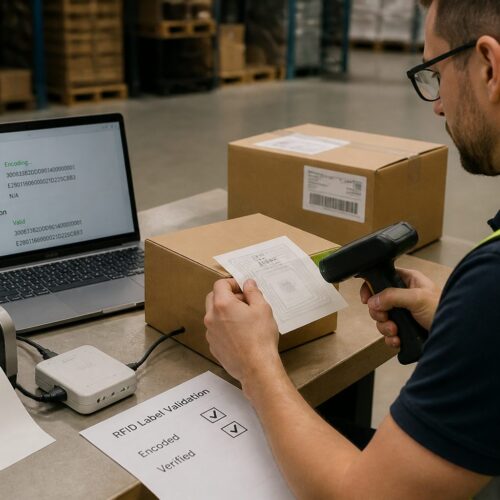
A good check includes readability, placement, and permanence, not just “a code exists.” If you can scan it with the same handheld used at receiving, you will catch low contrast prints before they leave the building.
Train operators to stop the line when the code drifts, because small shifts become big problems on a high speed packer. If management punishes stoppages, people will ship bad codes and hope nobody notices.
Keep rejected samples in a binder with date, line, ink or ribbon lot, and substrate supplier, because patterns show up fast. When a vendor changes a film coating or a corrugate liner, your print quality can change overnight.
Verification should include the meaning of the code, not just the appearance, because a perfectly printed wrong date is still a failure. A quick cross-check against the production schedule and shelf life rule prevents the classic “next year” mistake.
It helps to define what “readable” means in measurable terms, such as distance, lighting, and acceptable character defects. If the standard is vague, every shift will interpret it differently and you will get inconsistent results.
Consider adding a start-up check, an hourly check, and a changeover check, because most code issues happen at transitions. The first cases after a ribbon change or head clean are where you catch missing characters and alignment problems.
When you have multiple printers on a line, verify that they are synchronized and using the same template version. Template drift is common when one machine gets updated and the others keep an older file.
Vision systems can help, but they need good lighting and a realistic pass/fail threshold. If the system is too strict, operators will bypass it, and if it is too loose, it becomes a false sense of security.
Include packaging and maintenance teams in the troubleshooting loop, because code problems are often mechanical. A loose bracket, a vibrating mount, or a worn roller can turn a good print into a smeared one.
Document what happens when a code fails, including who decides disposition and how far back you quarantine. A clear escalation path keeps bad product from slipping through when the line is trying to hit a shipping cutoff.
Finally, close the loop with customer complaints by comparing their photos to your retained samples. If you can match the defect pattern, you can fix the root cause instead of guessing at printer settings.
Conclusion
Clear food packaging date code labeling is a practical tool for faster receiving, cleaner rotation, and fewer disputes. When your dates and lot code are easy to find and easy to read, your logistics team spends time moving product instead of decoding it.
Pick a format that travels well, print it in a consistent zone, and pair it with a traceability label that your team can use under pressure. Then test the ink and substrate like the real world does, because the dock is not a clean lab.
If you treat date codes as part of your operational design, you will see the benefits in fewer holds, fewer credits, and fewer late trucks. The best systems are boring in the best way, because nobody has to think about them to make them work.
Small improvements like a clearer format, a darker ink, or a better print zone can remove daily friction across the supply chain. When you make the code easy for the next person, you protect your product and your brand at the same time.