
The global supply chain operates on precision, speed, and reliable information exchange. In this complex environment, the humble shipping label plays an indispensable role, evolving from simple paper tags to sophisticated data carriers.
Modern logistics demands more than just basic identification; it requires comprehensive data accessibility at every touchpoint. This necessity drives the adoption of advanced symbology, transforming how goods are tracked, managed, and delivered securely.
Among the various innovations, qr codes on shipping labels have emerged as a powerful tool, offering unprecedented data density and versatility. Understanding their standards, optimal placement, and diverse use cases is crucial for any organization aiming to optimize its operations and enhance safety protocols.
The Evolving Role of Symbology in Global Logistics
For decades, linear barcodes served as the primary method for automated product identification in logistics. These traditional symbols provided a fast, machine-readable way to capture basic information like product codes or serial numbers.
However, the increasing complexity of supply chains, coupled with demands for more detailed traceability, began to push the limits of what linear barcodes could offer. Companies needed to embed richer data directly onto items without significantly increasing label size.
This challenge paved the way for two-dimensional symbologies, with QR codes leading the charge due to their exceptional data capacity. Unlike their linear predecessors, QR codes can store hundreds of characters, encompassing a wealth of information in a compact square.
This capability fundamentally changes how businesses approach labeling, allowing for a single point of scan to retrieve extensive shipment details. The shift towards qr codes on shipping labels represents a significant leap in data management efficiency and operational transparency.
The transition from simple barcodes to advanced QR codes is not merely a technological upgrade but a strategic imperative. It supports the intricate requirements of modern logistics, where every piece of data contributes to faster processing and improved decision-making.
Understanding QR Codes: A Data Powerhouse for Shipping
QR codes, short for Quick Response codes, are a type of matrix barcode first developed in Japan for the automotive industry. Their design allows for rapid readability and a significantly higher data storage capacity compared to traditional one-dimensional barcodes.
These square symbols utilize patterns of black modules arranged on a white background to encode information, which can include URLs, text, contact information, and complex logistical data. The error correction capability inherent in QR codes ensures they remain scannable even if partially damaged or obscured.
| Feature | Traditional Barcode (e.g., UPC) | QR Code | Impact on Shipping Labels |
|---|---|---|---|
| Data Capacity | Limited (e.g., 12-20 characters) | High (e.g., up to 7,089 numeric, 4,296 alphanumeric) | Enables comprehensive shipment details on a single label |
| Readability | Requires clear, linear scan | Omni-directional scan (from any angle) | Faster processing, less orientation hassle for warehouse staff |
| Error Correction | Minimal to none | Built-in (up to 30% damage tolerance) | Increased reliability, fewer rescans for damaged labels |
| Physical Size | Longer, linear format | Compact, square format | Saves label space, suitable for smaller packages |
| Typical Data | Product ID, price | Tracking numbers, origin/destination, contents, safety data, URLs | Transforms labels into interactive data portals |
Standardization: The Backbone of Universal QR Code Adoption
For qr codes on shipping labels to be truly effective across international supply chains, adherence to established standards is non-negotiable. These standards ensure interoperability, consistency, and reliable data exchange between different systems and stakeholders.
The International Organization for Standardization (ISO) plays a pivotal role in defining the specifications for QR codes. Specifically, ISO/IEC 18004 outlines the technical requirements for the QR Code symbology, covering aspects like encoding, error correction levels, and symbol structure.
Beyond the symbology itself, other ISO standards address the content and structure of the data encoded within these symbols for logistics applications. For example, standards like ISO/IEC 15434 specify syntax for high-capacity ADC media, guiding how data elements are formatted within the QR code.
Industry-specific bodies also contribute to these standards, often providing guidelines for data content relevant to their sectors. Adopting these universal specifications prevents fragmentation and ensures that a QR code scanned in one country is understood and processed correctly in another.
Compliance with these international standards is not just a best practice; it is a fundamental requirement for seamless global logistics. It facilitates automated processing, reduces manual errors, and underpins the reliability of supply chain operations worldwide.
Proper adherence to these global guidelines helps mitigate risks associated with misidentification or data corruption. This systematic approach supports the integrity of the entire logistical process, from initial dispatch to final delivery.
Strategic Placement and Optimal Size for Readability
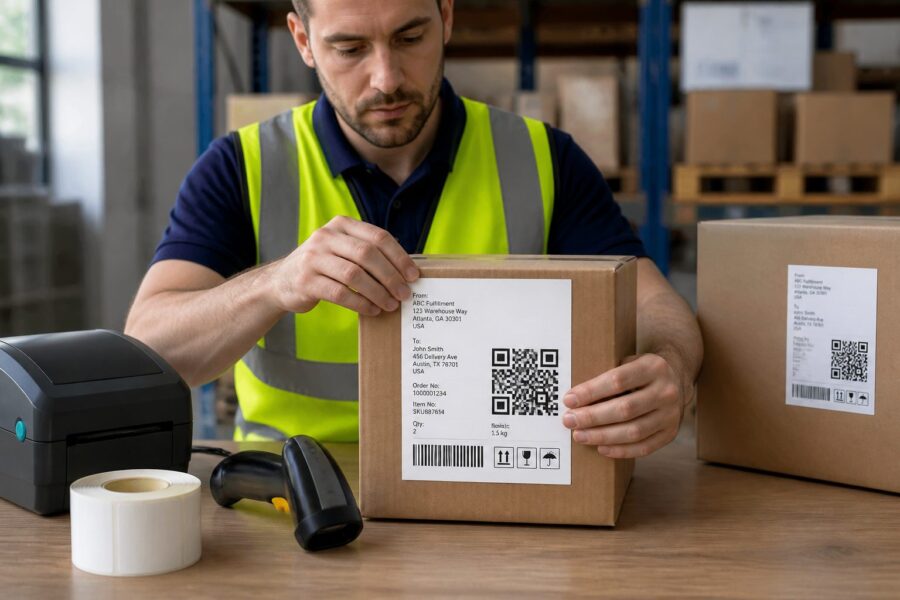
The effectiveness of qr codes on shipping labels hinges significantly on their physical attributes and placement. Even with robust error correction, a poorly placed or improperly sized QR code can lead to scanning failures and operational delays.
Industry best practices suggest placing QR codes on a flat, unobstructed surface of the package, away from seams, edges, or areas prone to damage. The goal is to maximize visibility and minimize the chance of distortion during transit or handling.
Regarding size, a minimum dimension of 25mm x 25mm (approximately 1 inch x 1 inch) is often recommended for general logistics applications. However, the optimal size depends on the scanning distance and the resolution of the scanning equipment used in the warehouse or during transit.
For longer-range scanning or environments with variable lighting, larger QR codes provide greater reliability. It is also crucial to maintain sufficient quiet zones, which are clear margins around the QR code, to prevent interference from other label elements.
The contrast between the QR code and its background is another critical factor; a stark difference, typically black on white, ensures optimal readability for scanners. Regular testing of label designs under various operational conditions helps validate both placement and size choices.
Considering the material of the shipping label is also important, as reflective or textured surfaces can sometimes interfere with scanning. Selecting appropriate label stock ensures the printed QR code remains clear and scannable throughout its journey.
Enhanced Safety and Traceability Across the Supply Chain
The rich data capacity of qr codes on shipping labels offers significant advantages for enhancing both safety and traceability within complex logistics networks. This capability extends far beyond simple package identification, providing critical information at a glance.
By embedding details such as handling instructions, hazardous material warnings, or temperature sensitivity directly into the QR code, workers gain immediate access to vital safety information. This proactive approach minimizes risks associated with improper handling or storage of sensitive goods.
- Instant access to material safety data sheets (MSDS)
- Real-time tracking of package location and status
- Verification of product authenticity and origin
- Digital record of chain of custody
- Automated alerts for temperature excursions or impacts
- Streamlined recall management processes
- Compliance with regulatory reporting requirements
Seamless Integration with Warehouse Management Systems (WMS)
The true power of qr codes on shipping labels is unlocked through their seamless integration with advanced Warehouse Management Systems (WMS). This synergy transforms static labels into dynamic data portals, driving efficiency throughout the warehouse environment.
When a QR code is scanned, the WMS instantly retrieves comprehensive information about the package, including its contents, destination, and specific handling instructions. This real-time data access eliminates manual data entry, significantly reducing human error and accelerating processing times.
For inbound logistics, QR codes facilitate faster receiving and put-away processes, as the system already knows where each item belongs. Outbound operations benefit from quicker picking and packing, ensuring the right products are dispatched to the correct locations.
Inventory management becomes far more accurate with QR code integration, providing precise stock levels and location data. This improved visibility helps prevent stockouts, minimizes waste, and optimizes storage space utilization within the warehouse.
Furthermore, the data captured from scanning qr codes on shipping labels feeds directly into analytics platforms, offering valuable insights into operational bottlenecks and performance metrics. These insights empower logistics managers to make data-driven decisions for continuous improvement.
The robust data exchange facilitated by QR codes strengthens the entire supply chain, ensuring that information flows freely and accurately from the point of origin to the final destination. This connectivity is essential for maintaining agility and responsiveness in a fast-paced market.
Addressing Challenges and Ensuring Readability
While qr codes on shipping labels offer immense benefits, their effective implementation requires careful consideration of potential challenges. Ensuring consistent readability across diverse operational environments is paramount for maintaining efficiency.
One major challenge involves the physical durability of labels themselves, as they are exposed to harsh conditions like moisture, extreme temperatures, and abrasive handling. Choosing appropriate label materials and printing methods is crucial to withstand these elements.
Print quality also significantly impacts scanability; low-resolution printing or smudged ink can render a QR code unreadable. Regular maintenance of printers and quality checks on printed labels are essential to prevent such issues.
Environmental factors within warehouses or transit hubs, such as poor lighting or glare, can also impede scanner performance. Implementing robust scanning hardware and optimizing lighting conditions wherever possible helps mitigate these problems.
Furthermore, ensuring compatibility between different scanning devices and the encoded data format is vital for seamless operations. Adherence to ISO standards for data structure helps overcome potential interoperability issues between various systems.
Proactive measures, including routine testing of scanning systems and employee training on proper label handling, contribute significantly to the overall success of QR code implementation. Addressing these challenges head-on ensures that the investment in advanced labeling technology yields its full potential.
QR Codes and the Future of Connected Logistics
The integration of qr codes on shipping labels is a foundational step towards a more connected and intelligent logistics ecosystem. These versatile symbols are poised to play an even greater role as supply chains become increasingly digitized and automated.
As the Internet of Things (IoT) expands, QR codes can serve as direct links between physical goods and their digital twins, providing real-time data streams from sensors embedded in packages. This allows for unprecedented visibility into cargo conditions, such as temperature, humidity, or shock events.
Blockchain technology also finds a natural partner in QR codes, enabling immutable records of every scan and movement of a package. This enhances transparency, verifies authenticity, and builds trust across the entire supply chain, from manufacturer to consumer.
The evolution of augmented reality (AR) applications could allow warehouse staff to scan a QR code and instantly visualize package contents or optimal storage locations through their smart devices. This innovative approach streamlines workflows and reduces training times for new personnel.
Furthermore, advancements in machine learning will enable systems to analyze the vast amounts of data collected via QR code scans, predicting potential delays or identifying inefficiencies before they become critical issues. This predictive capability transforms reactive logistics into a proactive, intelligent system.
The ongoing development of new encoding standards and higher data capacities will further expand the utility of QR codes, allowing for even more complex information to be stored. This continuous innovation ensures that qr codes on shipping labels remain at the forefront of logistical symbology.
Ultimately, the future sees QR codes not just as identifiers but as integral components of a fully integrated, smart logistics network. They are a critical enabler for the next generation of supply chain management, driving efficiency and resilience.
Maximizing Efficiency and Compliance with Advanced Labeling
Implementing qr codes on shipping labels offers a clear pathway to significantly enhance operational efficiency and ensure robust compliance across the global supply chain. This modern symbology provides a competitive edge in a demanding market.
By leveraging the high data capacity and error correction capabilities of QR codes, businesses can drastically reduce manual data entry and associated errors. This automation leads to faster processing times, fewer misrouted shipments, and improved overall productivity.
Adherence to international standards like ISO/IEC 18004 for QR code symbology and related data content standards is fundamental. Such compliance ensures universal readability and interoperability, which are crucial for seamless cross-border logistics.
The enhanced traceability provided by QR codes allows companies to track products with granular detail, meeting increasingly stringent regulatory requirements for product provenance and safety. This capability is particularly vital for industries dealing with sensitive or high-value goods.
Investing in quality label printing, proper placement, and robust scanning infrastructure ensures that QR code implementation is successful and sustainable. These factors directly impact the reliability and efficiency gains realized from this technology.
Ultimately, the strategic adoption of qr codes on shipping labels positions an organization at the forefront of modern logistics, driving both operational excellence and unwavering adherence to global safety and data standards. This proactive approach secures a more resilient and responsive supply chain.
Embracing this technology is not just about keeping up with trends; it is about building a foundation for future growth and adaptability in an ever-evolving global marketplace. The benefits extend across every facet of the logistics operation, from the warehouse floor to the customer’s door.