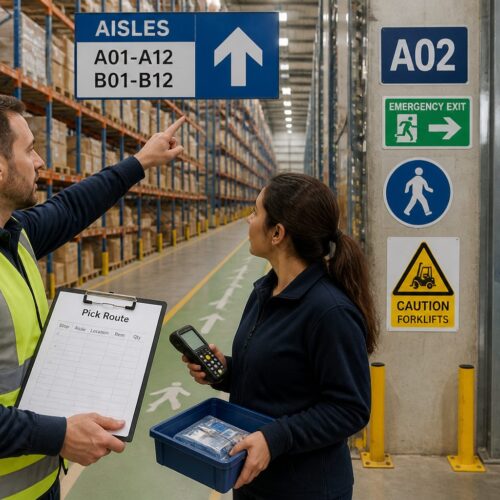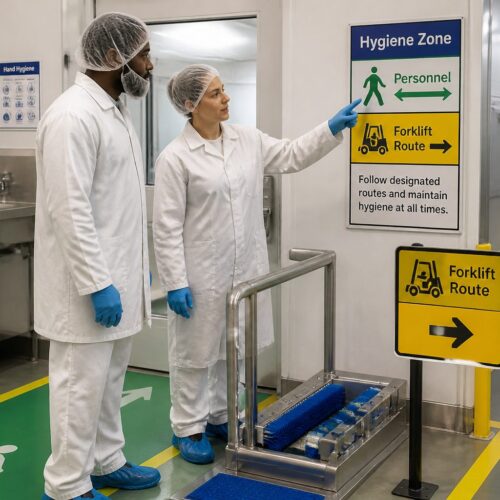


When a warehouse layout changes, people keep moving the same speed even if the building makes less sense for a while. That mismatch is where minor confusion turns into near misses and damaged product.
Wayfinding for temporary warehouse layouts works only when it is treated like a safety control, not a decoration. If you do it casually, workers invent their own routes and your forklift traffic pattern becomes a rumor.
I have seen temporary signs taped up in a hurry that pointed to aisles that no longer existed by the afternoon. A temporary setup can be safe, but only if the navigation cues change faster than the physical work does.
This article focuses on practical symbology, placement, and change discipline that hold up during re-slots, peak season overflow, construction, and inventory counts. You will see where temporary signs, layout change communication, and removable floor tape fit together as one system.
Why temporary layouts create wayfinding risk
Temporary layouts create risk because the brain relies on repeated patterns, and warehouses train those patterns fast. When you move racks or receiving lanes, experienced staff often walk the old path without noticing until they hit a dead end.
The biggest hazard is mixed traffic where pedestrians and powered industrial trucks share space that used to be separated. A detour that adds one blind corner can change the whole interaction between a picker and a forklift.
Risk also comes from partial updates, like a new aisle numbering scheme with old location labels still on beams. People start translating in their heads, and translation is slow when a pallet is tipping or a trailer door is open.
Wayfinding for temporary warehouse layouts has to anticipate shortcuts because shortcuts are what people do under pressure. If your temporary route is longer than the old one, assume someone will cut through staging unless you block it and mark it.
Setting rules for temporary routes and detours
Start by writing down what counts as a temporary route, because vague language leads to random tape lines and random arrows. A temporary route is a defined path with a start, an end, and a reason it exists.
Pick a small set of route types and stick to them, such as pedestrian detour, forklift detour, and shared corridor with speed limit. When everything has its own special exception, nobody can remember which exception applies today.
Make the detour rules physical, not just verbal, by using barriers, cones, or portable rails where the old route used to be. If the old opening stays open, people will take it and then blame the signage when they meet a forklift head on.
Define decision points and mark them, because decision points are where people slow down and look for cues. Put arrows and symbols at intersections, dock door clusters, and the ends of long aisles, not halfway down a corridor where nobody needs to decide.
Fast sign options: magnetic, adhesive, and standalone panels
Speed matters during a re-slot or a construction weekend, but fast does not mean sloppy. Choose temporary signs that can go up in minutes and still stay readable after dust, vibration, and a few bumps from pallets.
Match the sign hardware to the surface, because the wrong attachment method creates a new hazard when it falls or curls. Magnetic signs work well on steel racks, adhesive panels suit smooth walls, and standalone panels fill gaps where you have no mounting surface.
| Option | Best use case | Watch-outs |
|---|---|---|
| Magnetic rack signs | Rapid aisle ID changes on steel uprights and beams | Won’t hold on painted wood, can slide on dusty steel |
| Pressure-sensitive adhesive panels | Short-term wall directions near offices, breakrooms, and restrooms | Adhesive residue, poor hold on textured block |
| Standalone A-frame panels | Detours in wide cross aisles and temporary pedestrian crossings | Trip risk if placed in narrow paths, can be hit by forklifts |
| Hanging aisle blades with zip ties | High visibility aisle markers over seasonal overflow zones | Height clearance issues, ties degrade and need checks |
Keeping temporary symbols distinct from permanent wayfinding
If temporary and permanent cues look the same, workers cannot tell what changed, and they stop trusting both. Your temporary system should look obviously temporary from ten feet away.
Use a dedicated color family for temporary signs, like orange headers or a thick orange border, and reserve it only for temporary conditions. Do not borrow the same background and pictograms used on your permanent aisle IDs, exit routes, or safety labels.
Keep the symbol set tight and repeat it, because repetition is what makes wayfinding automatic. For example, use one detour arrow style, one “temporary pedestrian route” icon, and one “temporary forklift route” icon across the whole site.
Put an effective date or a short tag like “TEMP UNTIL 6/15” on directional panels when the route is expected to revert. People accept change more easily when they know you planned it and you plan to clean it up.
Change control: who updates signs and when
Signage fails when everyone can change it, because everyone changes it differently. Assign a single owner for wayfinding for temporary warehouse layouts, and back that person up with a named alternate for nights and weekends.
Require a simple change request even for small moves, like shifting a pick module entrance ten feet. That request can be a form in your maintenance system or a printed sheet, but it must capture what changes, when it changes, and who approves it.
Set update windows that match how the building runs, such as end of shift, pre-shift, or a planned downtime hour. If updates happen mid-shift without a hard rule, you get half the team following the new arrows and half following memory.
Do a quick field verification after every change, because maps lie and corners surprise you. The owner should walk the new route like a new hire would, starting at time clock, then breakroom, then the main pick faces.
Briefing teams: quick visual updates at shift start
Layout change communication works best when it is visual and short, because shift start is already crowded with priorities. Show one annotated photo of the affected area and one simple map, then send people to the floor to see the signs in context.
Supervisors should point to the exact decision points that changed, like “the pedestrian cut-through by Dock 12 is closed” or “Forklifts enter the overflow zone from Cross Aisle C only.” If you brief in generalities, workers fill in the blanks with yesterday’s routes.
- Map screenshot with the detour line
- Photo of the new barrier location
- One sentence on what changed since last shift
- Temporary symbol legend posted at time clock
- Radio call sign for reporting missing signs
- Reminder of pedestrian right of way rules in shared corridors
Removing and restoring without leaving confusing artifacts
Bad cleanup is how temporary controls become permanent clutter, and clutter trains people to ignore signs. Plan removal on day one, including what gets pulled, what gets restored, and who checks that the old cues are fully back.
Removable floor tape is a lifesaver when you need a route fast, but it can leave ghost lines if you pick the wrong adhesive for your concrete sealer. Test a small patch in an out of the way area, then commit to one tape type for the whole facility.
When you pull temporary signs, remove the attachment hardware too, because leftover magnets, zip ties, and adhesive squares look like missing information. People read absence as a clue, and a blank spot on a rack upright can send them hunting for a sign that no longer matters.
After restoration, do a reset walk focused on what long-term staff will misread, like old aisle numbers peeking from behind new placards. If you cannot remove a permanent marker quickly, cover it fully and label the cover so it does not look accidental.
Why temporary layouts create wayfinding risk
Seasonal overflow zones are a classic example, because you create aisles where there used to be open staging. People assume open space means permission, then they walk into a new forklift lane that has no history in their heads.
Construction adds another layer, because contractors bring their own barricades and signs that may not match your standards. If your temporary signs compete with a contractor’s warning placards, the message becomes visual noise.
Even small changes, like reversing one way travel in a cross aisle, can trigger wrong way encounters. A single wrong way forklift is enough to make every pedestrian distrust the marked route for the rest of the week.
When you plan wayfinding for temporary warehouse layouts, treat every change as a new site for the first hour. That mindset forces you to over-communicate at the points where confusion actually happens.
Setting rules for temporary routes and detours
One rule that works is to keep detours on the same side of the building whenever possible, so people do not cross main traffic twice. If receiving is on the north side, try to keep the temporary pedestrian detour on the north side too.
Another rule is to cap the number of route changes per week unless you have a dedicated reconfiguration team. If the route changes every day, workers stop looking at signs and start following whoever looks confident.
Use physical gating to prevent wrong turns at the source, because arrows are polite and barriers are honest. A short span of portable guardrail can do more than five temporary signs when you are trying to stop a shortcut through replenishment.
When you must run pedestrians through a shared corridor, mark a clear edge line and a crossing point with removable floor tape. Paint is not the answer for a two week project, and chalk disappears before the second shift shows up.
Keeping temporary symbols distinct from permanent wayfinding
Temporary signs should also use different wording than permanent signs, because people scan familiar phrases and assume nothing changed. If your permanent sign says “Aisle 12,” your temporary overlay can say “TEMP Aisle 12 access” so the eye stops for half a second.
Size and placement matter as much as color, and temporary panels often need to be bigger than you think. In a warehouse, a sign that looks fine at a desk becomes unreadable when viewed past shrink wrap glare and racking.
Keep temporary arrows consistent in direction and angle, because crooked arrows look like they were slapped up during a panic. If you want people to trust the route, the route has to look intentional.
Do not mix temporary signs into permanent sign clusters, because the cluster becomes a wall of text. Put the temporary cue first in the line of sight, then the permanent reference behind it if you must keep both visible.
Change control: who updates signs and when
Document where you store temporary signs, tape, and panels, because scavenger hunts lead to improvisation. Improvisation is how you end up with handwritten cardboard arrows that curl up and point at the ceiling.
Keep a sign register with a simple ID like TEMP-DTR-07 and a location note like “Cross Aisle B, by Battery Charging.” When a sign goes missing, you can replace it fast instead of arguing about whether it ever existed.
Put a time limit on temporary controls, even if the project has no fixed end date. A weekly review forces someone to decide whether the detour is still needed or whether the building can go back to its normal pattern.
When leadership pushes for speed, hold the line on minimum wayfinding checks. If you cannot verify the route, delay the move, because a rushed change that causes an incident costs far more time than a two hour pause.
Briefing teams: quick visual updates at shift start
Briefings work better when the floor matches the briefing, so do not show a map that still has last week’s aisle names. If your WMS uses location codes, include those codes on the visual so pickers do not have to translate.
Ask for one repeat-back from the group, because silence does not mean understanding. A lead can point to the map and say where the detour begins, and you will spot confusion before it turns into traffic.
Use radios for rapid corrections, but do not rely on radio alone for wayfinding. Radio is great for “the detour is blocked,” but it is terrible for teaching a new route to forty people at once.
If you run multiple shifts, brief the same change the same way, because inconsistency breeds distrust. Layout change communication should sound like one voice even if three supervisors deliver it.
Removing and restoring without leaving confusing artifacts
When you remove removable floor tape, pull it slowly at a low angle and clean the edge line right away. If you leave adhesive dirt trails, your old route still looks active and people keep following it.
Schedule a restoration window with enough labor to do it right, because cleanup is usually the first task to get cut. The warehouse then carries the mess for months, and every future temporary sign has to compete with the leftovers.
Restore permanent wayfinding with a checklist that includes height, orientation, and visibility, not just “sign is present.” A permanent aisle blade that faces the wrong direction might as well be missing.
After restoration, take updated photos of key intersections and store them with your standard work. Next time you need wayfinding for temporary warehouse layouts, you will know what “normal” looked like and you can spot drift fast.
Conclusion
Temporary layouts are part of warehouse life, but confusion does not have to be. When you treat temporary signs, layout change communication, and removable floor tape as a coordinated system, people move safely even while the building shifts under them.
The standard I use is simple: if a new hire can find the route without asking, you did it right. If your best operator still gets turned around, your wayfinding is not temporary, it is broken.