
Common Challenges in Wayfinding Implementation and How to Overcome Them
Implementing effective parking area wayfinding in logistics facilities often presents several challenges, ranging from budgetary constraints to the complexity of existing infrastructure. Recognizing these hurdles is the first step toward developing practical and sustainable solutions. We must approach these challenges with foresight and strategic planning.
One common challenge involves the sheer scale and dynamic nature of logistics facilities, where layouts can change due to expansion or reconfigurations. Wayfinding systems must be flexible and scalable, designed for easy updates and modifications without requiring a complete overhaul. Modular signage and digital solutions offer greater adaptability in these evolving environments.
Budgetary limitations can also pose a significant hurdle, as comprehensive signage and ground marking projects require substantial investment. Prioritizing critical safety zones and high-traffic areas for initial implementation, then phasing in other improvements, can make the project more financially manageable. We can achieve significant improvements through a phased approach.
Resistance to change from long-term employees who are accustomed to existing, albeit inefficient, systems can also be an issue. Thorough communication about the benefits of the new wayfinding system, coupled with comprehensive training, helps overcome this resistance. Involving staff in the planning process can also foster a sense of ownership and acceptance.
Ensuring compliance with various local, national, and international standards adds another layer of complexity. Partnering with experts in logistics symbology and safety standards can help navigate these regulatory landscapes effectively. This expertise ensures that the implemented parking area wayfinding in logistics facilities meets all necessary legal and safety requirements from the outset.
Future Trends in Logistics Facility Wayfinding and Symbology
The field of parking area wayfinding in logistics facilities is continually evolving, driven by technological advancements and an increasing emphasis on safety and efficiency. Future trends point towards more integrated, intelligent, and personalized wayfinding experiences. We are moving beyond static signs to dynamic, responsive systems.
One significant trend involves the deeper integration of IoT (Internet of Things) devices and AI-powered analytics to create truly smart parking and navigation systems. Sensors can monitor parking space availability, vehicle flow, and potential bottlenecks in real time, feeding this data into a central system. This allows for predictive wayfinding, anticipating and mitigating congestion before it occurs.
Augmented reality (AR) applications could soon play a role, providing drivers with overlayed navigational cues directly on their windshields or through mobile devices. This offers a highly intuitive and immersive way to guide vehicles through complex parking areas. Imagine real-time arrows and instructions appearing precisely where you need them.
Furthermore, the push for greater sustainability will influence material choices for signage, favoring recycled, recyclable, and energy-efficient options. Solar-powered illuminated signs and low-energy digital displays will become standard, aligning wayfinding with broader environmental goals. We must consider the ecological footprint of our solutions.
The continuous refinement of international standards for symbols and labeling will also ensure that wayfinding remains universally understood and effective across an increasingly interconnected global supply chain. As logistics operations become more complex, the demand for clear, standardized, and intelligent parking area wayfinding in logistics facilities will only grow. We look forward to seeing these innovations take hold.
The Economic and Operational Benefits of Superior Wayfinding
Implementing superior parking area wayfinding in logistics facilities delivers tangible economic and operational benefits that directly impact a company’s bottom line. These advantages extend far beyond mere compliance, creating a more efficient, safer, and ultimately more profitable operation. We must recognize the strategic value of this investment.
Reduced accident rates represent a significant economic benefit, as fewer incidents mean lower insurance premiums, reduced workers’ compensation claims, and less downtime for vehicle repairs. The human cost of accidents is immeasurable, but the financial repercussions are very real and substantial. A safer environment is a more cost-effective one.
Operational efficiency improves dramatically with clear wayfinding, as drivers spend less time searching for destinations and navigating complex layouts. This translates to faster turnaround times for trucks, more efficient movement of forklifts, and optimized use of loading docks. Every minute saved contributes to higher throughput and productivity.
Enhanced safety and efficiency also contribute to improved employee morale and retention. A well-organized and safe workplace reduces stress and frustration for drivers and operators, fostering a more positive work environment. People prefer working in facilities that prioritize their well-being and provide clear operational guidance.
Moreover, a reputation for safety and efficiency can attract new business and strengthen relationships with existing clients. Partners and customers appreciate working with logistics providers who demonstrate a commitment to best practices and smooth operations. Superior parking area wayfinding in logistics facilities becomes a competitive differentiator in the market.
Common Challenges in Wayfinding Implementation and How to Overcome Them
Implementing effective parking area wayfinding in logistics facilities often presents several challenges, ranging from budgetary constraints to the complexity of existing infrastructure. Recognizing these hurdles is the first step toward developing practical and sustainable solutions. We must approach these challenges with foresight and strategic planning.
One common challenge involves the sheer scale and dynamic nature of logistics facilities, where layouts can change due to expansion or reconfigurations. Wayfinding systems must be flexible and scalable, designed for easy updates and modifications without requiring a complete overhaul. Modular signage and digital solutions offer greater adaptability in these evolving environments.
Budgetary limitations can also pose a significant hurdle, as comprehensive signage and ground marking projects require substantial investment. Prioritizing critical safety zones and high-traffic areas for initial implementation, then phasing in other improvements, can make the project more financially manageable. We can achieve significant improvements through a phased approach.
Resistance to change from long-term employees who are accustomed to existing, albeit inefficient, systems can also be an issue. Thorough communication about the benefits of the new wayfinding system, coupled with comprehensive training, helps overcome this resistance. Involving staff in the planning process can also foster a sense of ownership and acceptance.
Ensuring compliance with various local, national, and international standards adds another layer of complexity. Partnering with experts in logistics symbology and safety standards can help navigate these regulatory landscapes effectively. This expertise ensures that the implemented parking area wayfinding in logistics facilities meets all necessary legal and safety requirements from the outset.
Future Trends in Logistics Facility Wayfinding and Symbology
The field of parking area wayfinding in logistics facilities is continually evolving, driven by technological advancements and an increasing emphasis on safety and efficiency. Future trends point towards more integrated, intelligent, and personalized wayfinding experiences. We are moving beyond static signs to dynamic, responsive systems.
One significant trend involves the deeper integration of IoT (Internet of Things) devices and AI-powered analytics to create truly smart parking and navigation systems. Sensors can monitor parking space availability, vehicle flow, and potential bottlenecks in real time, feeding this data into a central system. This allows for predictive wayfinding, anticipating and mitigating congestion before it occurs.
Augmented reality (AR) applications could soon play a role, providing drivers with overlayed navigational cues directly on their windshields or through mobile devices. This offers a highly intuitive and immersive way to guide vehicles through complex parking areas. Imagine real-time arrows and instructions appearing precisely where you need them.
Furthermore, the push for greater sustainability will influence material choices for signage, favoring recycled, recyclable, and energy-efficient options. Solar-powered illuminated signs and low-energy digital displays will become standard, aligning wayfinding with broader environmental goals. We must consider the ecological footprint of our solutions.
The continuous refinement of international standards for symbols and labeling will also ensure that wayfinding remains universally understood and effective across an increasingly interconnected global supply chain. As logistics operations become more complex, the demand for clear, standardized, and intelligent parking area wayfinding in logistics facilities will only grow. We look forward to seeing these innovations take hold.
Color Coding and Universal Symbols for Enhanced Safety
Color coding and the consistent application of universal symbols are powerful tools for enhancing safety and clarity in parking area wayfinding in logistics facilities. These visual cues transcend language barriers, enabling instant recognition of hazards, mandatory actions, and directional guidance. A well-implemented color and symbol scheme provides immediate, intuitive information.
Different colors can quickly communicate specific types of information or warnings. For example, red typically signifies danger or prohibition, yellow indicates caution or warning, and blue often denotes mandatory actions or information. This established color psychology allows for rapid interpretation of critical messages without needing to read text.
Universal symbols, such as those standardized by ISO 7010, are instantly recognizable across cultures and languages. A “no entry” symbol, a “pedestrian crossing” symbol, or a “forklift traffic” symbol communicates its meaning at a glance. Integrating these symbols into all signage reinforces global safety standards and improves understanding for an international workforce.
Applying color coding to ground markings, such as painted lines for pedestrian walkways, forklift lanes, and truck staging areas, further reinforces the wayfinding system. These visual distinctions help segregate traffic types and delineate safe zones, reducing the likelihood of collisions. Clear delineation is paramount for preventing accidents between different vehicle categories.
Combining color coding with universal symbols creates a robust, highly effective visual communication system that supports parking area wayfinding in logistics facilities. This approach minimizes ambiguity, speeds up decision-making, and significantly contributes to a safer operational environment for all personnel and visitors. We must leverage these visual communication principles to their fullest.
Implementing Digital Solutions and Smart Wayfinding Systems
While traditional static signage forms the backbone of parking area wayfinding in logistics facilities, modern technology offers advanced digital solutions and smart wayfinding systems. These innovations provide dynamic, real-time information, significantly enhancing efficiency and responsiveness within complex facility layouts. We should embrace these technological advancements to optimize operations.
Digital displays, integrated with facility management software, can show real-time parking availability, direct drivers to specific loading docks, or warn of temporary closures. This dynamic information prevents congestion and guides vehicles more efficiently than static signs alone. Such systems adapt instantly to changing operational needs.
- Real-time parking availability updates
- Dynamic routing to open docks
- Automated vehicle identification and guidance
- Integration with truck appointment systems
- Digital messaging for safety alerts
- Interactive maps for pedestrian navigation
- Analytics for traffic flow optimization
Training and Maintenance: Sustaining a Safe Wayfinding Environment
Even the most meticulously designed parking area wayfinding in logistics facilities will fail without proper training and ongoing maintenance. Signage and markings are only effective if facility personnel and visitors understand their meaning and if they remain in good condition. We must treat wayfinding as an active, living system, not a static installation.
Training programs for all employees, especially new hires and temporary workers, should explicitly cover the facility’s wayfinding system, including all symbols, color codes, and traffic rules. This ensures everyone understands the designated routes for trucks, forklifts, and cars, as well as pedestrian safety zones. Comprehensive training reduces misinterpretations and enhances compliance.
Regular maintenance is crucial to ensure signs remain visible, legible, and structurally sound. This involves routine cleaning of signs, repainting faded ground markings, and promptly repairing or replacing damaged signage. Neglected signs quickly lose their effectiveness and can even become safety hazards themselves.
Facility managers should implement a schedule for inspecting all wayfinding elements, including digital displays and reflective surfaces. These inspections should identify any wear and tear, vandalism, or obstruction that compromises the system’s integrity. Proactive maintenance prevents small issues from escalating into significant operational or safety problems.
Furthermore, feedback mechanisms from drivers, operators, and pedestrians can provide valuable insights into potential improvements or areas of confusion within the wayfinding system. Addressing these concerns promptly demonstrates a commitment to safety and continuous improvement. Sustaining an effective wayfinding environment requires constant vigilance and adaptation.
The Economic and Operational Benefits of Superior Wayfinding
Implementing superior parking area wayfinding in logistics facilities delivers tangible economic and operational benefits that directly impact a company’s bottom line. These advantages extend far beyond mere compliance, creating a more efficient, safer, and ultimately more profitable operation. We must recognize the strategic value of this investment.
Reduced accident rates represent a significant economic benefit, as fewer incidents mean lower insurance premiums, reduced workers’ compensation claims, and less downtime for vehicle repairs. The human cost of accidents is immeasurable, but the financial repercussions are very real and substantial. A safer environment is a more cost-effective one.
Operational efficiency improves dramatically with clear wayfinding, as drivers spend less time searching for destinations and navigating complex layouts. This translates to faster turnaround times for trucks, more efficient movement of forklifts, and optimized use of loading docks. Every minute saved contributes to higher throughput and productivity.
Enhanced safety and efficiency also contribute to improved employee morale and retention. A well-organized and safe workplace reduces stress and frustration for drivers and operators, fostering a more positive work environment. People prefer working in facilities that prioritize their well-being and provide clear operational guidance.
Moreover, a reputation for safety and efficiency can attract new business and strengthen relationships with existing clients. Partners and customers appreciate working with logistics providers who demonstrate a commitment to best practices and smooth operations. Superior parking area wayfinding in logistics facilities becomes a competitive differentiator in the market.
Common Challenges in Wayfinding Implementation and How to Overcome Them
Implementing effective parking area wayfinding in logistics facilities often presents several challenges, ranging from budgetary constraints to the complexity of existing infrastructure. Recognizing these hurdles is the first step toward developing practical and sustainable solutions. We must approach these challenges with foresight and strategic planning.
One common challenge involves the sheer scale and dynamic nature of logistics facilities, where layouts can change due to expansion or reconfigurations. Wayfinding systems must be flexible and scalable, designed for easy updates and modifications without requiring a complete overhaul. Modular signage and digital solutions offer greater adaptability in these evolving environments.
Budgetary limitations can also pose a significant hurdle, as comprehensive signage and ground marking projects require substantial investment. Prioritizing critical safety zones and high-traffic areas for initial implementation, then phasing in other improvements, can make the project more financially manageable. We can achieve significant improvements through a phased approach.
Resistance to change from long-term employees who are accustomed to existing, albeit inefficient, systems can also be an issue. Thorough communication about the benefits of the new wayfinding system, coupled with comprehensive training, helps overcome this resistance. Involving staff in the planning process can also foster a sense of ownership and acceptance.
Ensuring compliance with various local, national, and international standards adds another layer of complexity. Partnering with experts in logistics symbology and safety standards can help navigate these regulatory landscapes effectively. This expertise ensures that the implemented parking area wayfinding in logistics facilities meets all necessary legal and safety requirements from the outset.
Future Trends in Logistics Facility Wayfinding and Symbology
The field of parking area wayfinding in logistics facilities is continually evolving, driven by technological advancements and an increasing emphasis on safety and efficiency. Future trends point towards more integrated, intelligent, and personalized wayfinding experiences. We are moving beyond static signs to dynamic, responsive systems.
One significant trend involves the deeper integration of IoT (Internet of Things) devices and AI-powered analytics to create truly smart parking and navigation systems. Sensors can monitor parking space availability, vehicle flow, and potential bottlenecks in real time, feeding this data into a central system. This allows for predictive wayfinding, anticipating and mitigating congestion before it occurs.
Augmented reality (AR) applications could soon play a role, providing drivers with overlayed navigational cues directly on their windshields or through mobile devices. This offers a highly intuitive and immersive way to guide vehicles through complex parking areas. Imagine real-time arrows and instructions appearing precisely where you need them.
Furthermore, the push for greater sustainability will influence material choices for signage, favoring recycled, recyclable, and energy-efficient options. Solar-powered illuminated signs and low-energy digital displays will become standard, aligning wayfinding with broader environmental goals. We must consider the ecological footprint of our solutions.
The continuous refinement of international standards for symbols and labeling will also ensure that wayfinding remains universally understood and effective across an increasingly interconnected global supply chain. As logistics operations become more complex, the demand for clear, standardized, and intelligent parking area wayfinding in logistics facilities will only grow. We look forward to seeing these innovations take hold.
Navigating a bustling logistics facility can often feel like solving a complex puzzle, especially in the outdoor parking areas where various vehicles converge. Effective parking area wayfinding in logistics facilities is not merely a convenience; it stands as a fundamental pillar of operational efficiency and, more importantly, safety. We need clear, unambiguous guidance for everyone, from an 18-wheeler truck driver to a forklift operator and a delivery car driver.
Poorly marked parking zones lead to confusion, delays, and an elevated risk of accidents involving personnel and equipment. This problem demands a standardized approach to labeling and symbols, ensuring universal understanding across diverse workforces and international supply chains. Implementing robust wayfinding systems directly impacts productivity and reduces potential liabilities.
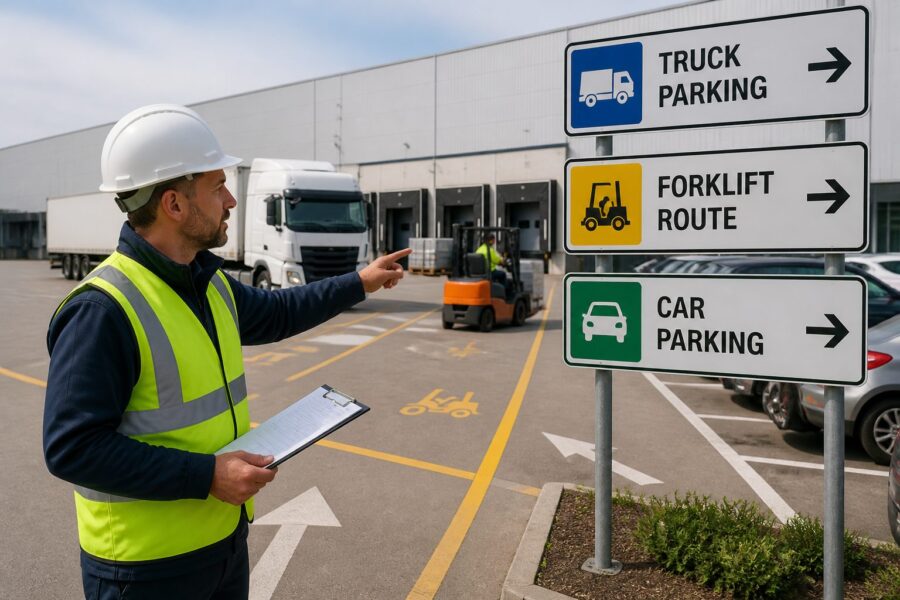
This article explores the critical elements of designing and implementing superior parking area wayfinding in logistics facilities, encompassing signs for trucks, forklifts, and cars. We will discuss how international standards and thoughtful design choices can transform chaotic parking zones into orderly, safe, and highly efficient operational spaces. Let’s ensure every vehicle and pedestrian knows exactly where to go.
The Critical Role of Clear Wayfinding in Logistics Parking
Logistics facilities are dynamic environments where time equals money, and safety is paramount. Clear parking area wayfinding in logistics facilities directly addresses both these concerns by streamlining vehicle movement. When drivers understand where to park, load, or unload, they save precious minutes and avoid unnecessary maneuvering.
Ambiguous signage, or a complete lack thereof, causes significant operational bottlenecks and frustration. Trucks may block loading docks, forklifts might encounter unexpected pedestrian traffic, and delivery vans could struggle to find designated drop-off points. Such scenarios directly impede the smooth flow of goods and personnel, impacting overall logistics efficiency.
Beyond efficiency, safety remains the most compelling reason for investing in superior wayfinding. Accidents involving vehicles and pedestrians in parking areas are unfortunately common, often resulting from poor visibility or confusing instructions. Well-designed signs, compliant with international standards, clearly delineate pathways, zones, and potential hazards.
Effective wayfinding systems minimize human error by providing intuitive visual cues that require minimal interpretation. This reduces stress for drivers and operators, allowing them to focus on their primary tasks rather than navigating a confusing layout. A well-organized parking area reflects a professional and safety-conscious operation.
Ultimately, investing in clear parking area wayfinding in logistics facilities is not an expense but a strategic investment. It improves safety records, enhances operational flow, and contributes to a positive, productive work environment for everyone involved. We must prioritize this essential aspect of facility management.
Understanding Diverse Vehicle Needs: Trucks, Forklifts, and Cars
Effective parking area wayfinding in logistics facilities requires a nuanced understanding of the distinct needs of each vehicle type operating within the space. Trucks, forklifts, and cars possess vastly different turning radii, blind spots, and operational speeds, necessitating tailored signage solutions. A one-size-fits-all approach simply will not work.
Heavy goods vehicles, like articulated trucks, require wide turning lanes, ample parking spaces, and clear overhead clearance indicators. Their drivers sit high above the ground, meaning signs must be positioned at appropriate heights for optimal visibility. We must consider the scale of these vehicles when planning signage placement and size.
Forklifts operate primarily within designated warehouse zones but frequently transition into outdoor parking or staging areas. These vehicles have unique maneuverability characteristics and often carry oversized loads, requiring distinct pathways and speed limit signs. Their operators benefit from ground-level markings and overhead signs that account for their typical line of sight.
Passenger cars, used by staff, visitors, and smaller delivery services, need clearly marked parking bays separate from heavy vehicle traffic. Pedestrian walkways must be explicitly defined and protected, especially where car parking intersects with truck or forklift routes. Segregation of traffic types is a fundamental safety principle.
Designing comprehensive parking area wayfinding in logistics facilities means integrating solutions for all these vehicle types into a cohesive system. This involves careful planning of traffic flow, designated zones, and a hierarchy of signage that guides each user appropriately. We cannot overlook any segment of the facility’s vehicle population.
International Standards and Best Practices for Logistics Symbology
Adhering to international standards is paramount for creating universally understood parking area wayfinding in logistics facilities. Standards like those set by ISO (International Organization for Standardization) provide a common language for safety symbols and labeling, transcending linguistic barriers. This consistency is vital in a globalized logistics environment where diverse nationalities work side-by-side.
ISO 7010, for instance, specifies graphically represented safety signs for the purpose of accident prevention, fire protection, health hazard information, and emergency evacuation. Utilizing these recognized symbols ensures that warnings, mandatory actions, and prohibitions are immediately understood, regardless of a person’s native language. We must embrace these established guidelines for maximum effectiveness.
| Standard/Practice | Key Focus | Application in Wayfinding |
|---|---|---|
| ISO 7010 | Graphical Safety Signs | Universal hazard, mandatory, prohibition symbols for parking zones |
| OSHA 1910.145 | Safety Color Codes | Specific colors for warning, caution, danger, informational signs |
| ANSI Z535 Series | Safety Signage Design | Guidelines for sign format, text, symbols, and color combinations |
| Local Traffic Regulations | Road Markings, Signage | Speed limits, stop signs, pedestrian crossings, lane designations |
| Facility-Specific Labeling | Internal Logistics | Dock numbers, staging areas, specific vehicle parking zones |
| Ergonomic Placement | Visibility & Readability | Sign height, angle, size for different vehicle operators and pedestrians |
Designing Effective Signage: Placement, Visibility, and Durability
The effectiveness of parking area wayfinding in logistics facilities hinges critically on the design, placement, and durability of the signage itself. Signs must not only convey information but also do so clearly, quickly, and consistently under various conditions. Poorly designed or maintained signs are as detrimental as having no signs at all.
Strategic placement is non-negotiable; signs must be visible from a distance, unobstructed by obstacles, and positioned at heights appropriate for the target vehicle operator. For truck drivers, this means higher mounting, while forklift operators and pedestrians benefit from signs closer to eye level or ground markings. We must consider the sightlines of all users.
Visibility extends beyond placement to encompass factors like size, font, and color contrast. Large, clear fonts and high-contrast color schemes ensure readability in varying light conditions, including dawn, dusk, and inclement weather. Reflective materials or internal illumination are essential for nighttime operations, enhancing safety and guidance.
Durability is another crucial aspect, as outdoor logistics environments expose signs to harsh elements, vehicle impacts, and general wear and tear. Signs manufactured from robust, weather-resistant materials, securely mounted, will withstand these challenges, reducing the need for frequent replacement. We need materials that can endure the rigors of a busy facility.
Furthermore, signs should be consistent in their design language across the entire facility, reinforcing the overall wayfinding system. This includes uniform use of symbols, arrow styles, and color coding, preventing confusion and building familiarity for regular users. A cohesive visual identity strengthens the message of safety and order.
Color Coding and Universal Symbols for Enhanced Safety
Color coding and the consistent application of universal symbols are powerful tools for enhancing safety and clarity in parking area wayfinding in logistics facilities. These visual cues transcend language barriers, enabling instant recognition of hazards, mandatory actions, and directional guidance. A well-implemented color and symbol scheme provides immediate, intuitive information.
Different colors can quickly communicate specific types of information or warnings. For example, red typically signifies danger or prohibition, yellow indicates caution or warning, and blue often denotes mandatory actions or information. This established color psychology allows for rapid interpretation of critical messages without needing to read text.
Universal symbols, such as those standardized by ISO 7010, are instantly recognizable across cultures and languages. A “no entry” symbol, a “pedestrian crossing” symbol, or a “forklift traffic” symbol communicates its meaning at a glance. Integrating these symbols into all signage reinforces global safety standards and improves understanding for an international workforce.
Applying color coding to ground markings, such as painted lines for pedestrian walkways, forklift lanes, and truck staging areas, further reinforces the wayfinding system. These visual distinctions help segregate traffic types and delineate safe zones, reducing the likelihood of collisions. Clear delineation is paramount for preventing accidents between different vehicle categories.
Combining color coding with universal symbols creates a robust, highly effective visual communication system that supports parking area wayfinding in logistics facilities. This approach minimizes ambiguity, speeds up decision-making, and significantly contributes to a safer operational environment for all personnel and visitors. We must leverage these visual communication principles to their fullest.
Implementing Digital Solutions and Smart Wayfinding Systems
While traditional static signage forms the backbone of parking area wayfinding in logistics facilities, modern technology offers advanced digital solutions and smart wayfinding systems. These innovations provide dynamic, real-time information, significantly enhancing efficiency and responsiveness within complex facility layouts. We should embrace these technological advancements to optimize operations.
Digital displays, integrated with facility management software, can show real-time parking availability, direct drivers to specific loading docks, or warn of temporary closures. This dynamic information prevents congestion and guides vehicles more efficiently than static signs alone. Such systems adapt instantly to changing operational needs.
- Real-time parking availability updates
- Dynamic routing to open docks
- Automated vehicle identification and guidance
- Integration with truck appointment systems
- Digital messaging for safety alerts
- Interactive maps for pedestrian navigation
- Analytics for traffic flow optimization
Training and Maintenance: Sustaining a Safe Wayfinding Environment
Even the most meticulously designed parking area wayfinding in logistics facilities will fail without proper training and ongoing maintenance. Signage and markings are only effective if facility personnel and visitors understand their meaning and if they remain in good condition. We must treat wayfinding as an active, living system, not a static installation.
Training programs for all employees, especially new hires and temporary workers, should explicitly cover the facility’s wayfinding system, including all symbols, color codes, and traffic rules. This ensures everyone understands the designated routes for trucks, forklifts, and cars, as well as pedestrian safety zones. Comprehensive training reduces misinterpretations and enhances compliance.
Regular maintenance is crucial to ensure signs remain visible, legible, and structurally sound. This involves routine cleaning of signs, repainting faded ground markings, and promptly repairing or replacing damaged signage. Neglected signs quickly lose their effectiveness and can even become safety hazards themselves.
Facility managers should implement a schedule for inspecting all wayfinding elements, including digital displays and reflective surfaces. These inspections should identify any wear and tear, vandalism, or obstruction that compromises the system’s integrity. Proactive maintenance prevents small issues from escalating into significant operational or safety problems.
Furthermore, feedback mechanisms from drivers, operators, and pedestrians can provide valuable insights into potential improvements or areas of confusion within the wayfinding system. Addressing these concerns promptly demonstrates a commitment to safety and continuous improvement. Sustaining an effective wayfinding environment requires constant vigilance and adaptation.
The Economic and Operational Benefits of Superior Wayfinding
Implementing superior parking area wayfinding in logistics facilities delivers tangible economic and operational benefits that directly impact a company’s bottom line. These advantages extend far beyond mere compliance, creating a more efficient, safer, and ultimately more profitable operation. We must recognize the strategic value of this investment.
Reduced accident rates represent a significant economic benefit, as fewer incidents mean lower insurance premiums, reduced workers’ compensation claims, and less downtime for vehicle repairs. The human cost of accidents is immeasurable, but the financial repercussions are very real and substantial. A safer environment is a more cost-effective one.
Operational efficiency improves dramatically with clear wayfinding, as drivers spend less time searching for destinations and navigating complex layouts. This translates to faster turnaround times for trucks, more efficient movement of forklifts, and optimized use of loading docks. Every minute saved contributes to higher throughput and productivity.
Enhanced safety and efficiency also contribute to improved employee morale and retention. A well-organized and safe workplace reduces stress and frustration for drivers and operators, fostering a more positive work environment. People prefer working in facilities that prioritize their well-being and provide clear operational guidance.
Moreover, a reputation for safety and efficiency can attract new business and strengthen relationships with existing clients. Partners and customers appreciate working with logistics providers who demonstrate a commitment to best practices and smooth operations. Superior parking area wayfinding in logistics facilities becomes a competitive differentiator in the market.
Common Challenges in Wayfinding Implementation and How to Overcome Them
Implementing effective parking area wayfinding in logistics facilities often presents several challenges, ranging from budgetary constraints to the complexity of existing infrastructure. Recognizing these hurdles is the first step toward developing practical and sustainable solutions. We must approach these challenges with foresight and strategic planning.
One common challenge involves the sheer scale and dynamic nature of logistics facilities, where layouts can change due to expansion or reconfigurations. Wayfinding systems must be flexible and scalable, designed for easy updates and modifications without requiring a complete overhaul. Modular signage and digital solutions offer greater adaptability in these evolving environments.
Budgetary limitations can also pose a significant hurdle, as comprehensive signage and ground marking projects require substantial investment. Prioritizing critical safety zones and high-traffic areas for initial implementation, then phasing in other improvements, can make the project more financially manageable. We can achieve significant improvements through a phased approach.
Resistance to change from long-term employees who are accustomed to existing, albeit inefficient, systems can also be an issue. Thorough communication about the benefits of the new wayfinding system, coupled with comprehensive training, helps overcome this resistance. Involving staff in the planning process can also foster a sense of ownership and acceptance.
Ensuring compliance with various local, national, and international standards adds another layer of complexity. Partnering with experts in logistics symbology and safety standards can help navigate these regulatory landscapes effectively. This expertise ensures that the implemented parking area wayfinding in logistics facilities meets all necessary legal and safety requirements from the outset.
Future Trends in Logistics Facility Wayfinding and Symbology
The field of parking area wayfinding in logistics facilities is continually evolving, driven by technological advancements and an increasing emphasis on safety and efficiency. Future trends point towards more integrated, intelligent, and personalized wayfinding experiences. We are moving beyond static signs to dynamic, responsive systems.
One significant trend involves the deeper integration of IoT (Internet of Things) devices and AI-powered analytics to create truly smart parking and navigation systems. Sensors can monitor parking space availability, vehicle flow, and potential bottlenecks in real time, feeding this data into a central system. This allows for predictive wayfinding, anticipating and mitigating congestion before it occurs.
Augmented reality (AR) applications could soon play a role, providing drivers with overlayed navigational cues directly on their windshields or through mobile devices. This offers a highly intuitive and immersive way to guide vehicles through complex parking areas. Imagine real-time arrows and instructions appearing precisely where you need them.
Furthermore, the push for greater sustainability will influence material choices for signage, favoring recycled, recyclable, and energy-efficient options. Solar-powered illuminated signs and low-energy digital displays will become standard, aligning wayfinding with broader environmental goals. We must consider the ecological footprint of our solutions.
The continuous refinement of international standards for symbols and labeling will also ensure that wayfinding remains universally understood and effective across an increasingly interconnected global supply chain. As logistics operations become more complex, the demand for clear, standardized, and intelligent parking area wayfinding in logistics facilities will only grow. We look forward to seeing these innovations take hold.