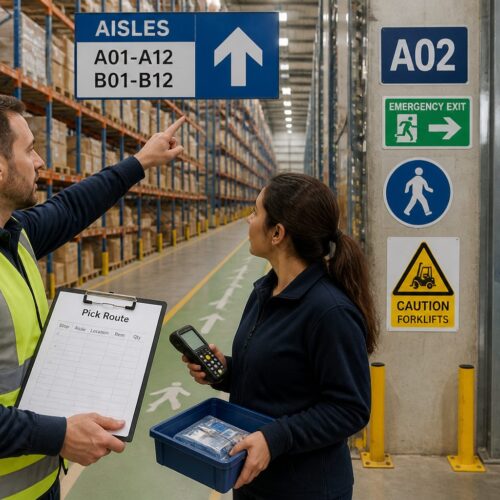

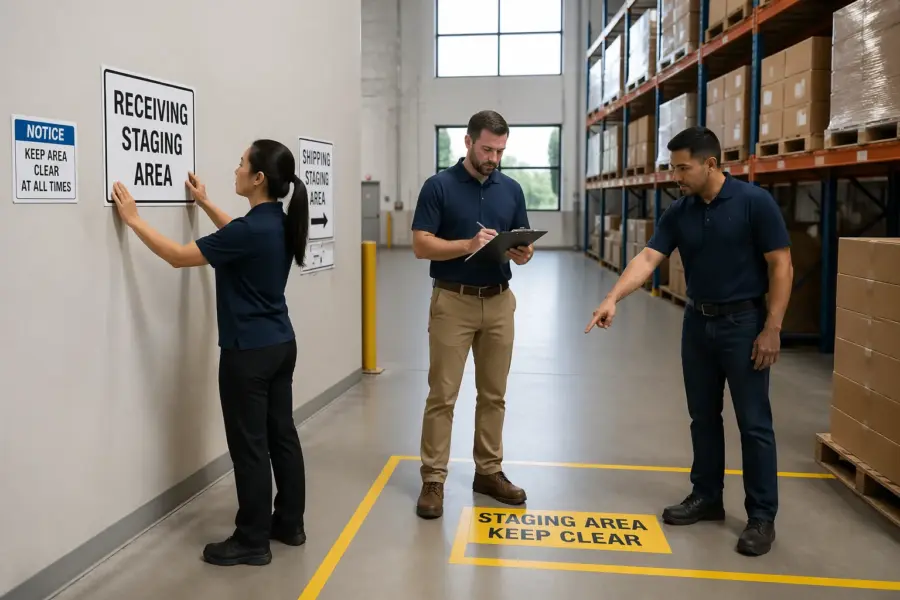
Warehouses run on seconds, and staging is where seconds disappear when the space is poorly labeled. If you want fewer misroutes and less arguing on the dock, start with labeling staging areas in warehouses like you mean it.
I have watched good teams get dragged down by bad staging names like “Zone A” that mean five different things depending on who you ask. Clear labels turn staging from a vague holding pen into a controlled, auditable step in the flow.
Staging labels are not decoration, they are operational controls that should match how people actually move pallets and carts. When the labels match the work, supervisors stop policing and operators stop improvising.
This article focuses on names, signs, floor boundaries, and simple symbols that read fast from a forklift seat. The goal is to make staging zone signs, pallet staging labels, and lane marking tape work together as one system.
What staging labels need to communicate in seconds
A staging label has to answer three questions at a glance, what belongs here, how much fits here, and what happens next. If a person has to stop and interpret the sign, the label already failed.
The fastest labels combine a short zone name with a purpose line like “OUTBOUND LTL” or “INBOUND QC.” That second line matters because many staging areas look identical once they fill up.
Use large characters that can be read from at least one aisle away, and do not get cute with fonts. Forklift operators read shape and contrast first, then words.
Every label should also communicate ownership, meaning which team controls moves in or out of that space. When ownership is unclear, pallets drift and the staging area turns into a negotiation.
In practice, that means the label should hint at the decision maker, like “SHIPPING CONTROL” or “RECEIVING LEAD,” even if it is just a small line at the bottom. The goal is not to add bureaucracy, it is to remove the pause where someone asks who is allowed to touch it.
Labels also need to communicate direction, because staging is rarely neutral in a process. If the next move is toward doors, scales, QA, or a specific aisle, say it plainly so the operator does not have to guess.
Time matters too, especially in outbound where freight can age out and become a fire drill. A simple “CUT-OFF 16:00” or “SHIP TODAY” line can prevent the quiet buildup of late freight.
Do not forget the human reality that staging gets used by new hires, temps, and drivers who are not fluent in your internal shorthand. If a label cannot be understood by someone on day three, it will be misused on day thirty.
Finally, the label has to work under stress, when the dock is loud and the aisle is busy. That is why contrast, placement, and short wording beat cleverness every time.
Naming conventions: simple zone names that don’t confuse
Start with a naming scheme that matches how your WMS, TMS, and radio menus already talk about locations. If the sign says “OB-12” but the scanner calls it “DOCK STAGE 3,” people will ignore one of them.
Good names encode function first, then sequence, like “IN-STG-01” for inbound staging or “OB-STG-07” for outbound staging. Avoid names that require tribal knowledge, like “Tampa” for a lane that changes every quarter.
Keep zone names short enough to say over a radio without repeating them twice. If a name routinely gets shortened in conversation, print the shortened version on the sign.
Reserve letters for meaning and numbers for order, and do not mix them randomly. When you standardize this, pallet staging labels stop looking like one-off stickers and start looking like a map.
A good test is whether two people can independently point to the same space when they hear the name once. If they cannot, the name is not a location, it is a rumor.
Keep the scheme consistent across buildings if you run multiple sites, because transfers and borrowed labor expose weak naming fast. A driver who works two facilities should not have to relearn what “STG-2” means every time.
Use prefixes that match the flow, like IN, OB, X (exception), or RTN (returns), and keep them in the same position in the name. When the prefix moves around, scanners and humans both make mistakes.
If you need sub-zones, make them predictable, like “OB-STG-07A” and “OB-STG-07B,” and only use them when the physical boundary is real. Sub-zones without physical separation create phantom locations that only exist on paper.
Avoid naming zones after people, because people change roles and the label becomes awkward to update. If you want accountability, put the role on the sign and keep the location name stable.
Also avoid naming zones after carriers unless the carrier assignment is stable, because contract changes will turn your dock into a renaming project. If you must reference carriers, do it as a purpose line that can be swapped without changing the core zone ID.
When you roll out a naming convention, publish a one-page key that shows the pattern and a few examples. People do not need a manual, they need a pattern they can copy without thinking.
Marking boundaries: floor lines, posts, and overhead IDs
Boundaries are where labeling staging areas in warehouses becomes real, because the floor is the only thing nobody can argue with. If the lines are faint or broken, the staging area expands until it blocks travel paths.
Use lane marking tape or durable paint to draw a box that matches the maximum pallet footprint, then add a buffer strip for forks and pedestrian clearance. Posts and end caps help when pallets stack up and hide floor lines.
Think about the approach angle, because a boundary that looks obvious on foot can disappear from a forklift seat. If the operator cannot see the corner until they are already inside it, the line is not doing its job.
Corner chevrons work because they show direction and they survive partial obstruction. A solid rectangle is fine, but chevrons communicate the box even when the middle is covered by pallets.
Overhead IDs matter in high stacks and high traffic, because floor markings get buried under product and dust. A hanging marker that repeats the zone name gives you a second reference when the floor is invisible.
Posts and bollards are not just protection, they are punctuation that tells people the space ends here. If you place them at the corners, they stop the slow creep that turns a lane into a blob.
Do not place overhead signs where sprinkler lines, lights, or door tracks visually compete with them. If the sign blends into the ceiling clutter, you paid for a label that no one can find.
Floor stencils are underrated because they force the location ID to live where the work happens. A stencil that says “OB-STG-07” inside the box makes it hard to pretend the box is something else.
Make sure boundaries respect safety clearances, especially around electrical panels, fire exits, and pedestrian crossings. A staging label that encourages parking in a no-go space will eventually become a safety incident with paperwork attached.
If you have mixed equipment, like reach trucks and pallet jacks, design boundaries for the widest turning behavior you actually see. A box that only works for one truck type becomes a daily exception for the other.
| Boundary method | Best use case | Common failure to avoid |
|---|---|---|
| Lane marking tape box with corner chevrons | Fast setup for seasonal staging lanes | Using light colors that disappear under dust |
| Painted lines with stenciled location ID | Permanent outbound lanes near dock doors | Skipping prep so paint peels under traffic |
| Bollards with overhead zone placard | High density areas where pallets block sightlines | Placing signs too high to read from equipment |
| Floor sign plus hanging aisle marker | Long lanes where operators enter from both ends | Only labeling one end of the lane |
When you choose a boundary method, match it to how often the layout changes and how hard the floor gets hit. Tape is fast and flexible, but paint wins when the lane is permanent and traffic is constant.
If you use tape, commit to cleaning and prep, because tape over dust is a temporary suggestion. A ten-minute sweep and wipe before taping can save you months of peeling corners.
Double-label long lanes at both ends and at the midpoint if they are entered from multiple aisles. People do not drive to the end of a lane to discover what it is, they decide before they enter.
Where possible, align boundaries with rack lines, columns, or building grids so the layout feels natural. Randomly angled boxes may fit on paper, but they create weird dead space and encourage sloppy parking.
Finally, treat boundary maintenance like equipment maintenance, because it is part of uptime. If you wait until the lines are gone, you are choosing confusion as your default.
Differentiating inbound, outbound, and exception staging
Inbound staging should look different from outbound staging, even if the floor space is the same size. If everything uses the same color and wording, people will park the nearest pallet in the nearest open spot.
Inbound zones work best when they reference the next process step, like “RECEIVING COUNT” or “PUTAWAY READY.” Outbound zones should reference shipping mode or carrier logic, like “PARCEL,” “LTL,” or “TL DOOR 12.”
Exception staging needs the strongest visual separation because it attracts problems and tends to grow. I prefer a dedicated exception color and a physical boundary like a short rail, because tape alone gets ignored when the dock is hot.
Make exceptions explicit on staging zone signs with plain words like “HOLD” or “DAMAGED” instead of soft labels like “SPECIAL.” When you name it bluntly, you reduce the number of pallets that end up there by accident.
Color coding is useful, but only if you keep the palette tight and consistent across the building. If every team picks their own shade of blue, you end up with a rainbow that communicates nothing.
Inbound staging often needs more information about condition, because receiving is where you catch shortages, overages, and labeling issues. A simple “COUNTED / NOT COUNTED” cue near inbound staging can prevent bad inventory from moving deeper into the building.
Outbound staging needs clarity on sequence, because shipping is sensitive to route order and trailer availability. If you stage by carrier but load by route, the label should reflect the real loading logic, not the org chart.
Returns and reverse logistics deserve their own look even when they share a door, because the paperwork and disposition rules are different. If returns get staged in the same visual system as outbound, they will eventually get shipped by mistake.
Exception staging should also communicate what kind of exception it is, because “HOLD” can mean quality, credit, documentation, or damage. If you cannot split the space, at least split the signage so the next action is obvious.
Do not let exception staging become a storage substitute, because that is how you hide problems instead of solving them. A clear label plus a visible boundary makes it harder to pretend the pile is normal.
When space is tight, use vertical cues like post signs and hanging placards to keep differentiation visible above the freight. If the only indicator is on the floor, it disappears as soon as the first layer of pallets arrives.
If you share a dock between inbound and outbound at different times of day, use flip signs or reversible placards rather than trying to remember the schedule. A label that changes with the operation is better than a permanent label that is wrong half the time.
Using symbols for status: ready, hold, or rework
Status symbols are useful when they are consistent and limited, because too many icons turn into wallpaper. Pick a small set that maps to real decisions, like ship it, stop it, or fix it.
For “Ready,” use a simple check mark symbol paired with the word READY, because symbols alone confuse new hires and temps. For “Hold,” a stop hand or octagon works well, and for “Rework,” use a circular arrow plus the word REWORK.
Put the status symbol on a movable placard or magnetic sign where supervisors can change it without printing new labels. If you rely on marker scribbles, the message fades or gets overwritten during shift change.
Match the status system to your quality process, so “Rework” means a defined action like re-labeling, re-wrapping, or re-counting. When the symbol triggers a checklist, the staging area stops being a mystery zone.
Keep the symbols physically close to the freight decision point, not somewhere on a wall across the aisle. If the operator has to look away from the pallet to find the status, they will default to habit.
Use the same symbol meanings on paperwork, whiteboards, and digital dashboards so the building tells one story. When the floor says READY but the screen says HOLD, people pick the message that benefits them in the moment.
Avoid using color alone as the status indicator, because color blindness and lighting conditions are real. Pair color with shape and text so the meaning survives bad LEDs and dusty lenses.
If you use tags on pallets, standardize where they are placed, like top right corner of the stretch wrap or a specific stringer. A tag that can be anywhere becomes invisible when you need it most.
Status also needs a timestamp when the operation cares about age, because “HOLD” for ten minutes is different from “HOLD” for three days. A simple date line or pre-printed time boxes can keep old problems from blending into new ones.
Train supervisors to change status deliberately and publicly, not casually in passing. When the floor sees the status flip happen, people trust the system and stop creating their own side rules.
Do not let too many special statuses creep in, because every new icon is a new argument waiting to happen. If a status does not change a decision, it does not deserve a symbol.
When you audit the system, look for pallets with no status at all, because that is where mistakes breed. A blank pallet in staging is usually a pallet that will be forgotten until it becomes urgent.
Preventing overflow: visual limits and spillover rules
Overflow happens when a staging area has no visible limit, so people keep feeding it until the aisle narrows. The fix is to label the capacity and enforce a spillover rule that everybody knows.
Print capacity right on the pallet staging labels, like “MAX 8 PALLETS” or “MAX 3 ROWS,” and place it where the first pallet lands. If the limit is only in a SOP binder, it does not exist on the floor.
Capacity should reflect real pallet size and real behavior, not the theoretical best case. If the lane fits eight pallets only when they are perfect and square, your real capacity is lower.
Overflow rules should say where the next pallet goes, not just that overflow is bad. People will overflow anyway, so give them a safe, labeled place to do it.
A red overflow line is effective because it creates a moment of decision when the lane is full. If the pallet crosses the red line, it is a rule break that can be seen from far away.
Spillover zones should have their own names and should exist in the WMS as real locations. If spillover is not scannable, it will become invisible inventory that only lives in someone’s memory.
Time limits matter because overflow tends to become semi-permanent storage. A simple “OVERFLOW MAX 2 HOURS” expectation, paired with a tag, keeps the dock from turning into a museum of old freight.
Make one role the gatekeeper for overflow moves, because shared responsibility becomes no responsibility. When everyone can authorize overflow, the overflow becomes the plan.
- Post a max pallet count on each lane sign
- Mark a red overflow line using lane marking tape
- Define the spillover zone name and location in the WMS
- Assign a single role to authorize overflow moves
- Use a time limit tag for overflow pallets
- Block travel aisles from overflow with cones or chains
Cones and chains are not elegant, but they are honest, because they physically prevent the lazy option. If you do not block the travel aisle, overflow will eventually choose it.
When overflow becomes frequent, treat it as a signal, not a personal failure. Either the capacity label is wrong, the schedule is wrong, or the downstream process is slow, and the floor is telling you which one.
Use simple visual management like a whiteboard count or a lane fullness indicator if your operation is sensitive to peaks. The point is to make the problem visible early, not after the dock is jammed.
Do not let overflow rules conflict with safety rules, because safety will lose in the moment and win later in the incident report. If the spillover zone is not safe, it is not a spillover zone, it is a hazard.
Also watch for overflow that hides inside other zones, like parking a ninth pallet in a lane by nudging it into the buffer. If you label the buffer as “NO STAGE,” you remove the gray area people love to exploit.
Finally, measure overflow by time and touches, not just by how it looks. Every overflow move is an extra touch, and extra touches are where damage and misroutes multiply.
Maintaining labels during re-slotting and seasonal peaks
Re-slotting breaks labeling systems because the floor changes faster than the signs. If you do not plan for change, you end up with staging zone signs that describe last month’s layout.
Build labels with replaceable inserts, so you can swap a zone name without scraping adhesive off posts. When you standardize sign sizes and mounting points, updates take minutes instead of a weekend.
Seasonal peaks often add pop-up lanes, and that is where lane marking tape earns its keep. Use a standard tape color for temporary lanes and remove it as soon as the peak ends, because leftover tape becomes a fake boundary.
Schedule a weekly walk with operations and safety together, and make them carry a roll of tape and a label kit. If the walk ends with a work order queue, nothing changes on the floor.
Label maintenance needs an owner the same way equipment maintenance needs an owner. If everyone can fix labels, no one will, because it is always easier to move a pallet than to fix a sign.
Keep a small staging signage standard kit on site, including blank inserts, fasteners, a stencil set, and approved tape colors. When supplies are locked in a cabinet across the building, people improvise with cardboard and hope.
During re-slotting, update the digital location master at the same time you update the physical signs. A perfect sign on the floor does not help if the scanner forces a different location name.
When you create temporary lanes, label them as temporary in plain language, like “TEMP OB-STG-T1.” That one word prevents the common mistake where a temporary lane becomes permanent by accident.
Seasonal labor makes consistency more important, because temps will follow the most visible cue, not the best practice you explained once. If your labels are clean and consistent, training time drops and errors drop with it.
After peak, do a cleanup pass that removes temporary tape, retires temporary signs, and restores the baseline map. If you skip the cleanup, your building will carry peak chaos into normal season.
Use photos as part of your standard, because a picture of a correctly labeled lane is faster than a paragraph in a binder. When someone asks what “good” looks like, you should be able to show it in ten seconds.
Audit for label drift, which is when the sign still exists but the meaning has quietly changed. Drift is dangerous because people think they are compliant while the system is actually lying.
When you change a staging label, communicate it like a process change, not like a facility tweak. The label is part of the process, so treat it with the same respect as a new scan step.
Finally, budget time for label work during layout projects, because it is not a finishing touch, it is a dependency. A new lane without a label is just a new place for confusion to live.
Conclusion
Clear labeling staging areas in warehouses is a practical discipline, not a graphics project. When names, boundaries, and symbols agree with each other, people stop improvising and the flow tightens up.
Start by fixing the worst two lanes, then expand the same rules across the building. Consistent staging zone signs, readable pallet staging labels, and well-placed lane marking tape will do more for daily performance than another memo ever will.
When you do it right, staging becomes predictable, and predictability is what makes speed sustainable. You will feel it in fewer radio calls, fewer rescans, and fewer last-minute trailer scrambles.
Do not chase perfection on day one, just chase clarity that holds up under pressure. A clear label that survives a busy shift beats a beautiful sign that gets ignored.
Staging is the handshake between processes, and sloppy handshakes cause drops. Tight labels, tight boundaries, and simple status cues keep the handoff clean.
If you want a simple next step, walk the dock and ask operators which two staging labels they trust the least. Fix those first, and you will build buy-in faster than any training session.