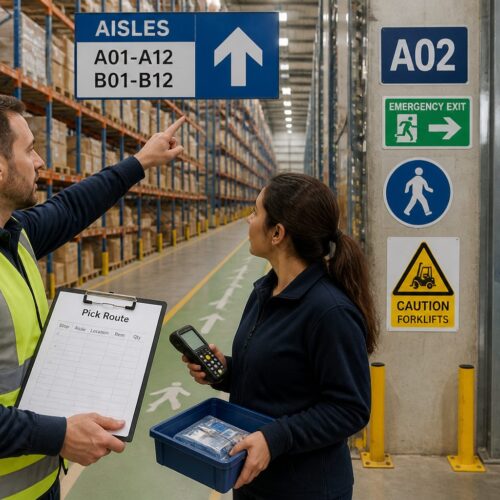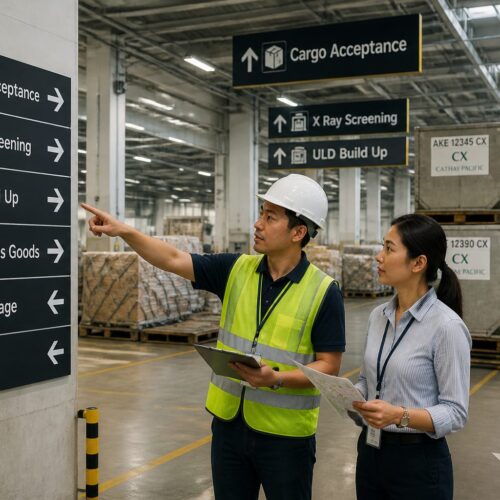

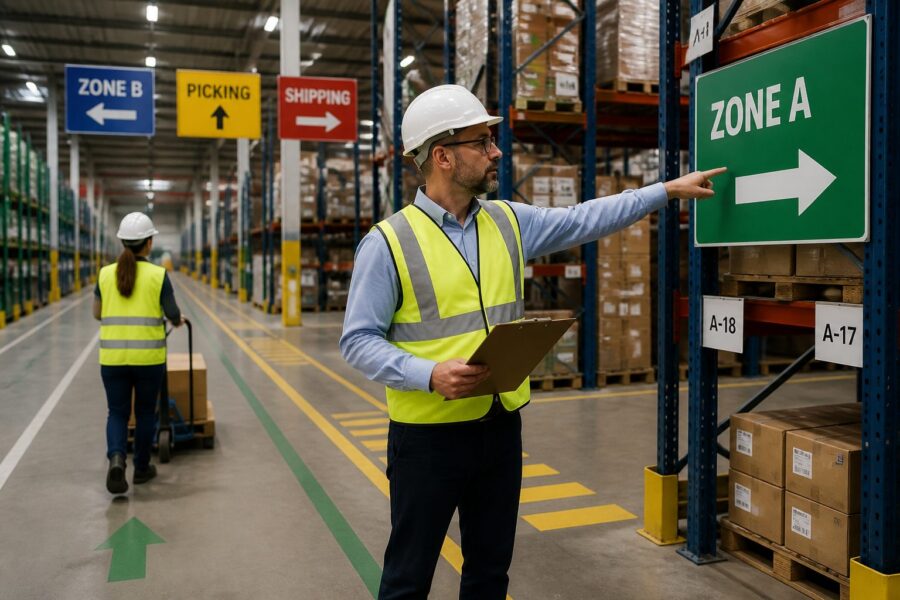
In the fast-paced world of warehousing, efficiency is the name of the game. One of the most effective strategies for optimizing warehouse operations is implementing a robust warehouse zone wayfinding system.
This system involves dividing the warehouse into distinct zones and using clear signage and other visual cues to guide employees and equipment to the right locations. A well-designed system streamlines processes, reduces errors, and ultimately boosts productivity.
Let’s take a look at how a warehouse zoning system works and how to implement it. This system is not just about putting up signs; it’s about creating a logical and intuitive layout that supports smooth operations.
Benefits of a Well-Defined Zoning System
A well-defined zoning system offers several key advantages for warehouse operations. By clearly delineating different areas, warehouses can significantly improve their efficiency and accuracy.
One of the primary benefits is faster picking and packing times. When employees can quickly locate the items they need, the entire fulfillment process accelerates.
Another significant advantage is reduced errors. Clear warehouse zone wayfinding minimizes the chances of employees picking the wrong items or misplacing products, leading to fewer returns and happier customers.
Improved safety is also a notable benefit. A well-organized warehouse reduces the risk of accidents and injuries, creating a safer working environment for everyone.
Beyond the immediate gains, a well-defined zoning system contributes to long-term cost savings. Efficient operations translate to lower labor costs, reduced energy consumption, and minimized waste.
Moreover, a clear and organized warehouse enhances employee morale. Workers feel more confident and efficient when they can easily navigate the space and locate items, leading to increased job satisfaction.
Another often overlooked benefit is improved inventory management. When items are properly zoned and tracked, it’s easier to maintain accurate inventory counts and prevent stockouts or overstocking situations.
A well-defined zoning system also allows for better space utilization. By optimizing the layout of the warehouse, you can maximize storage capacity and reduce the need for expansion.
Finally, a well-organized warehouse is more adaptable to changes in demand and product mix. It is easier to reconfigure zones and adjust storage locations as needed, ensuring that the warehouse remains efficient and responsive.
Creating a Logical and Consistent Zoning Scheme
The foundation of effective warehouse zone wayfinding is a logical and consistent zoning scheme. This involves carefully planning the layout of the warehouse and assigning clear, understandable labels to each zone.
Start by analyzing the flow of goods through the warehouse. Identify areas where products are received, stored, picked, packed, and shipped.
Consider factors like product size, weight, and frequency of access when assigning zones. High-demand items should be placed in easily accessible locations, while bulky or slow-moving items can be stored in less convenient areas.
Develop a clear and consistent naming convention for zones. Use letters, numbers, or a combination of both to identify each area, ensuring that the system is easy to understand and remember.
Consider the specific needs of your warehouse when designing the zoning scheme. A warehouse that handles perishable goods will require different zones than one that stores durable goods.
Think about the seasonality of your business. If you experience peak seasons with increased demand, you may need to adjust your zoning scheme to accommodate the influx of inventory.
Involve employees in the planning process. They can provide valuable insights into the flow of goods and identify potential bottlenecks.
Document your zoning scheme thoroughly. Create a map of the warehouse with clearly labeled zones and detailed descriptions of each zone’s purpose.
Regularly review and update your zoning scheme as needed. As your business evolves, your warehouse layout may need to change to accommodate new products, processes, or technologies.
Ensure the chosen system is scalable for future growth. It should be able to accommodate new zones and products as your business expands.
Signage Best Practices for Clear Navigation
Effective signage is crucial for guiding employees through the warehouse. Signs should be strategically placed, easy to read, and consistent in design.
Use large, clear fonts that are visible from a distance. Ensure that signs are well-lit and free from obstructions.
| Signage Element | Best Practice | Rationale |
|---|---|---|
| Font Size | Minimum 4 inches | Ensures visibility from a distance |
| Placement | Eye-level, above aisles | Easy to spot and read |
| Material | Durable, weather-resistant | Withstands warehouse conditions |
| Consistency | Uniform design and colors | Reduces confusion and errors |
Consider using directional arrows to guide employees to specific locations. Use contrasting colors to make signs stand out from their surroundings.
Regularly inspect and maintain signage to ensure it remains in good condition. Replace damaged or faded signs promptly to avoid confusion.
Use universally understood symbols and icons to supplement text. This can be particularly helpful for employees who speak different languages.
Consider the viewing angle when placing signs. Ensure that they are visible from the most common vantage points.
Use reflective materials for signs in dimly lit areas. This will improve visibility and reduce the risk of accidents.
Place signs at decision points, such as intersections and aisle entrances. This will help employees make the right turns and stay on track.
Ensure that signage is consistent with the naming convention used in your inventory management system. This will help employees quickly locate the items they need.
Use different types of signs to convey different types of information. For example, you might use large overhead signs to identify zones and smaller signs to identify specific storage locations.
Consider using digital signage to display real-time information, such as inventory levels and order status. This can help employees make informed decisions and improve efficiency.
Using Color-Coding to Differentiate Zones
Color-coding is a powerful tool for visually differentiating zones within a warehouse. By assigning different colors to specific areas, you can create a more intuitive and easily navigable environment.
Choose colors that are easily distinguishable from one another. Avoid using similar shades that could cause confusion.
Apply color-coding consistently throughout the warehouse. Use colored tape, paint, or labels to mark the boundaries of each zone.
Consider using different colors for different types of products or storage areas. For example, you might use blue for raw materials, green for finished goods, and red for hazardous materials.
Document the color-coding scheme and make it readily available to all employees. This will ensure that everyone understands the system and can navigate the warehouse effectively.
Consider the psychological effects of different colors. For example, blue is often associated with calmness and productivity, while red is associated with energy and excitement.
Use color-coding to highlight safety hazards. For example, you might use yellow to mark areas where forklifts are operating and orange to mark areas where personal protective equipment is required.
Extend color-coding to other areas of the warehouse, such as storage bins and shelves. This will further reinforce the zoning scheme and make it easier for employees to locate items.
Consider using color-coded floor markings to guide employees and equipment through the warehouse. This can be particularly helpful in high-traffic areas.
Regularly review and update your color-coding scheme as needed. As your business evolves, your color-coding scheme may need to change to accommodate new products or processes.
When selecting colors, consider employees who may be colorblind. Use color combinations that are easily distinguishable for everyone.
Integrating Zone Information into Inventory Management Systems
To maximize the effectiveness of warehouse zone wayfinding, it’s essential to integrate zone information into your inventory management system (IMS). This allows you to track the location of every item in the warehouse and quickly retrieve it when needed.
Update your IMS to include a field for zone location. When receiving new inventory, record the zone where each item is stored.
Use barcode scanners or RFID technology to automate the process of tracking inventory movement. This will reduce errors and improve the accuracy of your inventory data.
Generate reports from your IMS to analyze inventory distribution and identify areas for improvement. This can help you optimize your zoning scheme and improve warehouse efficiency.
Ensure that your IMS allows for flexible zone assignments. You may need to move items between zones based on demand or storage capacity.
Integrate your IMS with your order management system (OMS). This will allow you to automatically assign picking tasks to employees based on the location of the items in the order.
Use your IMS to track the performance of each zone. This can help you identify areas that are underperforming and take corrective action.
Provide employees with mobile access to your IMS. This will allow them to quickly look up inventory locations and update inventory data in real-time.
Regularly audit your inventory data to ensure accuracy. This will help you identify and correct any discrepancies between your IMS and the physical inventory in the warehouse.
Consider using a warehouse management system (WMS) instead of a basic IMS. A WMS offers more advanced features for managing warehouse operations, including zone management, task management, and reporting.
Training Employees on the Zoning System
Even the best-designed zoning system will be ineffective if employees don’t understand how to use it. Comprehensive training is essential for ensuring that everyone can navigate the warehouse efficiently and accurately.
Provide new employees with thorough training on the zoning system during onboarding. This should include a detailed explanation of the zoning scheme, signage, and color-coding.
- Explain the logic behind the zoning system
- Demonstrate how to read and interpret signage
- Provide hands-on practice navigating the warehouse
- Offer refresher training periodically
- Encourage employees to ask questions
Regularly reinforce the importance of following the zoning system. Emphasize the benefits of the system, such as faster picking times and reduced errors.
Encourage employees to provide feedback on the zoning system. This can help you identify areas for improvement and ensure that the system meets their needs.
Develop training materials that are easy to understand and remember. Use visuals, such as maps and diagrams, to illustrate the zoning scheme.
Provide training in multiple languages, if necessary. This will ensure that all employees can understand the zoning system.
Use a variety of training methods, such as classroom instruction, hands-on practice, and online tutorials. This will cater to different learning styles.
Test employees’ understanding of the zoning system after training. This will help you identify any gaps in their knowledge and provide additional training as needed.
Make training an ongoing process. Provide regular refresher training to reinforce employees’ knowledge of the zoning system and keep them up-to-date on any changes.
Recognize and reward employees who consistently follow the zoning system. This will encourage others to do the same.
Regularly Evaluate and Improve the System
A warehouse zoning system isn’t a one-time project, it is a living thing. It requires regular evaluation and improvement to ensure it continues to meet the evolving needs of the warehouse.
Track key performance indicators (KPIs) such as picking times, error rates, and inventory accuracy. This will help you identify areas where the zoning system is performing well and areas where it could be improved.
Solicit feedback from employees on a regular basis. They are the ones who use the zoning system every day, so their insights are invaluable.
Be willing to make changes to the zoning system as needed. This could involve reconfiguring zones, adding new signage, or updating the color-coding scheme.
Stay up-to-date on the latest trends and best practices in warehouse zone wayfinding. This will help you identify new opportunities to improve your system and stay ahead of the competition.
Conduct regular audits of the warehouse to identify any potential problems with the zoning system. Look for things like damaged signage, misplaced inventory, and congested aisles.
Analyze data on inventory movement to identify patterns and trends. This can help you optimize your zoning scheme and improve warehouse efficiency.
Benchmark your warehouse zoning system against industry best practices. This can help you identify areas where you are falling behind and take corrective action.
Use a continuous improvement process, such as Plan-Do-Check-Act (PDCA), to systematically evaluate and improve your warehouse zoning system.
Document all changes to the zoning system. This will help you track the evolution of the system and understand why certain changes were made.
Communicate all changes to the zoning system to employees. This will ensure that everyone is aware of the changes and can adjust their work accordingly.
Addressing Common Challenges in Implementation
Implementing a warehouse zone wayfinding system can present several challenges. These challenges can range from resistance to change from employees to difficulties in integrating the system with existing warehouse management systems.
One common challenge is employee resistance to change. Some employees may be accustomed to the existing layout and processes and may be reluctant to adopt a new system.
To overcome this challenge, communicate the benefits of the new system clearly and involve employees in the planning process. Provide thorough training and ongoing support to help them adapt to the new system.
Another challenge is integrating the zoning system with existing warehouse management systems. This can be complex and may require custom software development or modifications to existing systems.
To address this, work closely with your IT team and software vendors to ensure seamless integration. Test the system thoroughly before going live to identify and resolve any issues.
Another challenge can be the initial cost of implementation. This includes the cost of signage, software, and training.
To mitigate this, prioritize the most critical areas of the warehouse first and implement the system in phases. This can help spread out the costs over time.
Space constraints can also be a challenge. Some warehouses may have limited space for implementing a comprehensive zoning system.
In these cases, focus on optimizing the use of existing space and consider vertical storage solutions. A carefully designed zoning system can actually improve space utilization.
Maintaining the system over time can also be a challenge. Signage can become damaged or faded, and inventory can be misplaced.
To address this, establish a regular maintenance schedule and train employees to report any issues they encounter. Regular audits can also help identify and correct any problems.
The Role of Technology in Enhancing Wayfinding
Technology plays a significant role in enhancing warehouse zone wayfinding. From barcode scanners to advanced warehouse management systems, various technological tools can streamline operations and improve accuracy.
Barcode scanners and RFID technology enable real-time tracking of inventory. This minimizes the risk of errors and ensures that employees can quickly locate the items they need.
Warehouse management systems (WMS) provide a centralized platform for managing inventory, orders, and warehouse operations. These systems can be integrated with the zoning system to provide employees with clear directions to specific locations.
Mobile devices, such as smartphones and tablets, can be used to provide employees with real-time information about inventory locations and order details. This can further improve efficiency and reduce errors.
Consider investing in technology that complements your zoning system. This can lead to significant improvements in warehouse efficiency and accuracy.
Voice-picking technology allows employees to receive instructions and confirm actions hands-free. This can be particularly useful in busy warehouses where employees need to move quickly.
Real-time location systems (RTLS) can track the location of employees and equipment in the warehouse. This can help optimize workflows and improve safety.
Automated guided vehicles (AGVs) and autonomous mobile robots (AMRs) can automate the movement of goods within the warehouse. These technologies can improve efficiency and reduce labor costs.
Wearable technology, such as smart glasses, can provide employees with real-time information and instructions. This can improve efficiency and reduce errors.
Cloud-based warehouse management systems offer several advantages over traditional on-premise systems. These systems are more scalable, flexible, and cost-effective.
Data analytics can be used to identify patterns and trends in warehouse operations. This can help you optimize your zoning system and improve efficiency.
Future Trends in Warehouse Wayfinding
The field of warehouse wayfinding is constantly evolving. New technologies and strategies are emerging all the time, offering even greater opportunities for optimizing warehouse operations.
One emerging trend is the use of augmented reality (AR) to guide employees through the warehouse. AR applications can overlay digital information onto the real world, providing employees with real-time directions and inventory details.
Another trend is the use of artificial intelligence (AI) to optimize warehouse layouts and zoning schemes. AI algorithms can analyze data on inventory movement and order patterns to identify the most efficient ways to organize the warehouse.
Robotics and automation are also playing an increasingly important role in warehouse wayfinding. Automated guided vehicles (AGVs) and autonomous mobile robots (AMRs) can navigate the warehouse independently, reducing the need for human intervention.
Stay informed about these emerging trends and consider how they could be applied to your warehouse operations. This will help you stay ahead of the curve and maintain a competitive edge.
The Internet of Things (IoT) is also poised to transform warehouse wayfinding. IoT devices can collect data on a variety of factors, such as temperature, humidity, and equipment performance. This data can be used to optimize warehouse operations and improve safety.
Digital twins are virtual representations of physical warehouses. These twins can be used to simulate different scenarios and test new zoning schemes before they are implemented in the real world.
Predictive analytics can be used to forecast demand and optimize inventory levels. This can help you ensure that you have the right products in the right place at the right time.
Sustainability is becoming an increasingly important consideration in warehouse design. Future warehouse wayfinding systems will need to be environmentally friendly and energy efficient.
Personalized wayfinding systems will tailor instructions and information to the individual employee. This can improve efficiency and reduce errors.
Blockchain technology can be used to track inventory throughout the supply chain. This can improve transparency and reduce the risk of fraud.
Conclusion
Warehouse zone wayfinding is an essential element of efficient warehouse management. By implementing a well-defined zoning system, warehouses can streamline processes, reduce errors, and improve safety.
Whether you’re implementing a new system or optimizing an existing one, remember that the key is to create a logical and intuitive layout that supports smooth operations. Don’t forget to train your employees and regularly evaluate and improve the system.
By embracing technology and staying informed about emerging trends, you can create a warehouse wayfinding system that is both efficient and effective. This will help you optimize your warehouse operations and achieve your business goals.
Ultimately, a well-designed warehouse zone wayfinding system is an investment in the future of your business. It will help you improve efficiency, reduce costs, and enhance customer satisfaction.
So, take the time to plan and implement a system that meets your specific needs. The benefits will be well worth the effort.